Boyer’s Coffee has been roasted in Colorado since 1965. In independent living communities, assisted living facilities, and skilled nursing centers, that name carries real weight; residents recognize it, families notice it, and a facility that serves Boyer’s is signaling that it pays attention to quality in a way a generic institutional brand simply can’t replicate.
This page walks through what a Boyer’s-branded coffee program through Denver Beverage actually looks like at a healthcare facility, from blend selection through equipment to ongoing service. For a broader view of our full healthcare beverage programs, start there.
Why Boyer’s Coffee Works in Healthcare Settings
Boyer’s isn’t just a locally roasted coffee. It’s a Colorado institution. Residents in independent and assisted living settings often have decades of history with the brand, a name they recognize from the grocery store, from their kitchen, from a lifetime of mornings in Colorado. That familiarity has real value in a care environment where comfort and continuity matter.
Brand recognition as a quality signal:
When a resident’s family member visits and sees Boyer’s on the counter, it communicates something specific: this facility makes thoughtful choices about quality, not just cost. Generic bulk-coffee programs don’t carry that signal. Boyer’s does, because it’s a brand with a genuine identity in Colorado.
Resident satisfaction at the floor level:
A cup of coffee is a small thing in isolation. In a care facility, it’s part of the daily rhythm of a resident’s life, and familiar flavors from a trusted brand contribute to that rhythm in a way that matters to residents and, by extension, to their families and to facility reviews.
What sets a Boyer’s program apart from commodity coffee supply:
A commodity coffee arrangement delivers product. A Boyer’s program through Denver Beverage delivers a named, recognizable brand with specific blends, formats sized for institutional volume, commercial brewing equipment, and ongoing service, all through a single provider. Denver Beverage is Boyer’s exclusive distribution partner in Colorado, so facilities here access Boyer’s through Denver Beverage rather than a retail channel that wasn’t built for healthcare volume or regulatory environments.
Boyer’s Blends for Healthcare Volume
This is the section most administrators need most, and almost no supplier provides it clearly. The question isn’t just “do you carry Boyer’s?” It’s “which blends work in a dining room that serves 150 residents at breakfast, and which are right for a resident lounge running a single-cup brewer?”
High-volume batch brewing environments:
For dining rooms, large common areas, and hospital cafeteria settings, Boyer’s medium and dark roast blends hold up well in high-volume batch brewing. Boyer’s DenverBlend and Colorado Café Blend suit the flavor profiles most residents expect from a premium cup, and in batch brewing settings, volume consistency and repeatability matter as much as the roast profile itself.
Single-cup brewing contexts:
Smaller resident lounges, clinical staff break rooms, and individual room programs call for a different format. Single-cup brewing systems sized for these settings let residents brew fresh coffee on their own schedule, with less staff involvement, and Boyer’s blends are available in formats built for these systems.
Fractional pre-measured coffee packs:
For busy dining service environments, fractional pre-measured packs are the standard supply format for a reason. Each pack measures a precise dose for a standard batch brewer pot, so kitchen staff aren’t guessing on quantities, waste is reduced, and consistency across shifts is built into the format rather than left to individual staff judgment. This is the format Denver Beverage recommends for healthcare dining rooms and high-traffic common-area service.
Whole bean and ground coffee options:
Where facilities have brewing equipment that benefits from whole bean or coarser ground formats, those options are available. The right format depends on the equipment in place and the volume the facility runs. Denver Beverage’s team helps match the supply format to the brewing setup, not the other way around.
Commercial Brewing Equipment for Healthcare Facilities
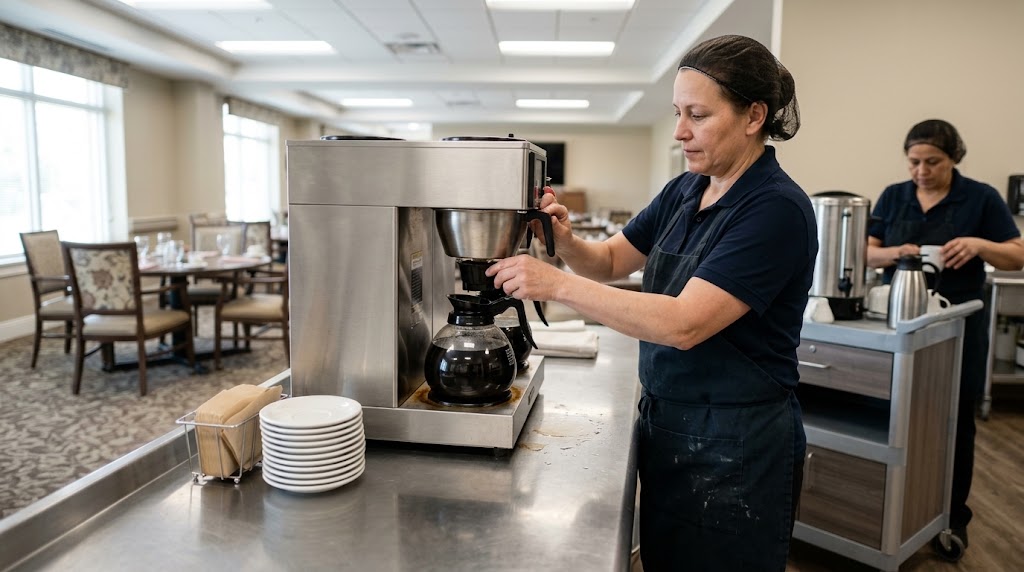
Commercial coffee brewing equipment for a healthcare facility isn’t the same category as a café espresso machine. It needs to hold up to institutional volume, meet regulatory requirements, and work in an environment where kitchen staff are managing multiple priorities at once.
High-volume batch brewers for dining rooms and common areas:
Brands like Bunn and Curtis are well-established in commercial foodservice settings, and Denver Beverage works with equipment in these categories. A batch brewer sized for a healthcare dining room should handle multiple brewing cycles across a service period without performance degradation.
Single-cup brewing systems for smaller settings:
For resident lounges, smaller break rooms, and settings where a full batch brewer is more than the volume requires, single-cup systems from manufacturers like De Jong Duke and Bravilor Bonamat offer a premium, right-sized solution. These systems are sized for the volume they’re actually serving, which matters for both quality and energy use.
NSF/ANSI certification is a hard requirement, not a preference:
Equipment used in commercial foodservice settings, including healthcare facilities, must meet NSF/ANSI certification standards. Per FDA Food Code Section 4-205.10, food equipment must be certified or classified for its specific intended use in a commercial environment, and equipment without NSF certification can cause a facility to fail a health department inspection.
Denver Beverage supplies NSF-certified brewing equipment as part of its program. Before specifying any brewer for a regulated foodservice environment, confirm its listing through the NSF certified product database directly.
Water filtration is part of equipment selection, not an afterthought:
Municipal water across Colorado varies in mineral content, and without appropriate inline filtration or softening, scale buildup shortens equipment life and affects brew quality. The Specialty Coffee Association’s water quality guidance sets general targets for brewing water. Denver Beverage specs filtration alongside brewing equipment, not separately, because the two systems affect each other directly.
Denver Beverage’s Integrated Program, Coffee, Equipment, and Service
A Dietary Director who sources Boyer’s coffee through a retail distributor, manages brewing equipment through a separate vendor, and handles equipment service through a third party has created three points of contact for what should be one program. Denver Beverage runs it as one.
Coffee supply, equipment, and service through a single provider:
- Coffee: the Boyer’s blends your facility needs, in the formats that work for your dining room and lounge setups, arrive on Denver Beverage’s distribution route.
- Equipment: sourced, specified, and placed by the same team.
- Service: when something needs attention, the same organization handles it.
13 field technicians and 7-day equipment service coverage on the Front Range:
Equipment faults don’t wait for Monday. A brewer down during breakfast service is a real operational problem, not something to schedule for the next weekday service window. Denver Beverage’s team covers equipment service seven days a week across the Front Range, so a fault that happens Sunday morning doesn’t sit unresolved until the following week.
State of Colorado preferred vendor for healthcare facilities:
For facilities navigating state procurement requirements, Denver Beverage holds the State of Colorado preferred vendor credential for healthcare. That credential matters when a procurement process requires it, and it simplifies vendor approval for facilities operating within the state framework.
Dish and laundry chemical programs as part of the relationship:
A Dietary Director managing a coffee program is almost certainly also managing commercial dishwashing. Our dish and laundry chemical programs cover commercial kitchen chemical supply for healthcare facilities, so the relationship that starts with coffee can extend into the broader operational supply picture without adding another vendor.
See What a Boyer’s Program Looks Like at Your Facility
Blend selection, batch versus single-cup equipment, and service coverage all depend on your dining room, your resident population, and your current setup. Denver Beverage’s healthcare team can walk through what that looks like specifically for your facility
Frequently Asked Questions
What Boyer’s Coffee blends are available for high-volume facility brewing?
Boyer’s DenverBlend and Colorado Café Blend, both medium-to-dark roasts, hold up well in batch brewing environments like healthcare dining rooms. Denver Beverage can walk you through the full roster of institutional-volume blends and match the roast profile to your residents’ preferences and your equipment.
Does Denver Beverage provide brewing equipment as part of the coffee program, or do we source it separately?
Denver Beverage provides NSF-certified coffee brewing equipment as part of the program, so hardware and coffee supply come from one place. Equipment is specified to match your facility’s volume, whether that’s a high-volume batch brewer for a dining room or a single-cup system for a resident lounge.
How does equipment service work if our brewer goes down?
Denver Beverage runs 13 field technicians with 7-day service coverage across the Front Range, so a technician can typically be dispatched the same day, mid-week, or on a weekend. See Denver Beverage’s commercial kitchen and beverage equipment repair page for full coverage details.
Is Denver Beverage a State of Colorado preferred vendor for healthcare facilities?
Yes. That credential matters for facilities whose purchasing department requires vendors to already carry state-level approval. It removes a step from the facility’s own procurement process.
What supply formats are available for busy dining service environments?
Fractional pre-measured coffee packs are the standard format for healthcare dining rooms, they eliminate measuring variance, reduce waste, and keep kitchen staff consistent through high-volume service. Whole bean and ground options are available too, and Denver Beverage’s team will recommend the right format for your equipment and volume.