You need a commercial ice machine. Maybe you’re opening a restaurant and trying to figure out what to order. Maybe your current machine died and you need to replace it fast. Maybe you’re an office manager setting up a new break room and someone asked for a countertop ice dispenser.
Whatever brought you here, the right machine comes down to three things: what kind of ice your operation needs, how many pounds per day you’ll go through, and where the machine physically lives. This guide walks through all three. It also covers what water filtration, cleaning schedules, and service relationships look like over the life of the equipment.
What Kind of Ice Does Your Operation Actually Need?
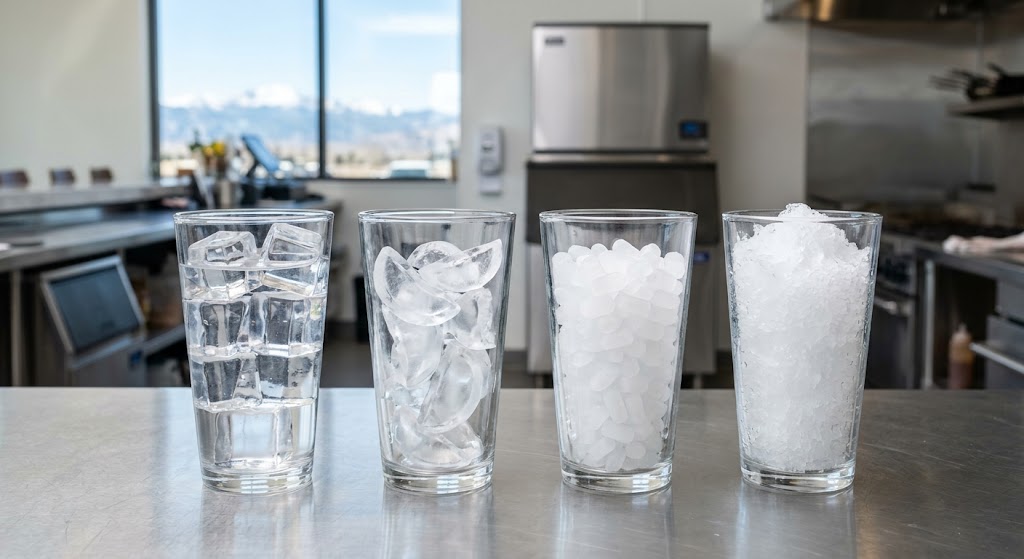
The ice type question matters more than most operators expect. The wrong type doesn’t just affect quality. It can make your machine the wrong tool for the job entirely. Four types come up most often:
- Cube ice (full cube and half cube): The standard for bar service and fountain drinks. Full cubes melt slowly and displace volume in a glass efficiently. Half cubes work well in blended drinks and high-volume fountain applications. If you’re running a bar program or a fountain soda setup, cube ice is almost certainly what you need.
- Nugget ice (also called sonic ice): Soft, chewable, and it absorbs the flavor of whatever it’s in. Nugget ice is popular in healthcare settings, fast-casual restaurants, and offices where the ice itself is part of the experience. If your team or patients are consuming the ice directly, nugget is worth a close look.
- Flake ice: Used in display cases, seafood counters, and salad bars. It’s rarely the right choice for beverage service because it melts quickly and dilutes drinks fast. If you’re buying a restaurant ice machine for bar or fountain use, skip flake.
- Crescent ice: Produced by several manufacturers as a high-efficiency alternative to full cube. Crescent ice interlocks in a glass, which reduces liquid displacement and slows dilution. It’s a legitimate option for bars and full-service restaurants.
Here’s how that looks in practice. A burger bar called recently asking about a full ice machine setup for fountain and bar use. That’s a cube or crescent application. An office manager separately asked about a countertop ice dispenser, which is a classic nugget-ice use case. Both are commercial ice machine purchases, but they’d end up with completely different equipment.
If you run a restaurant or bar, cube and crescent are your default starting points.
How Much Ice Do You Need Per Day?
Ice production capacity is measured in pounds per day, and sizing it correctly is where most operators get into trouble. Buy too small and you run out during a rush. Buy too large and you’re paying to run a machine that’s mostly idle. How much you need depends on the type of operation and how busy it gets:
- Bars and nightclubs: Bar programs burn through ice fast. As a baseline, plan on about 3 lbs of ice per seat per day.
- Full-service restaurants: A typical baseline is about 1.5 lbs per seat per day, adjusted for how much ice the kitchen and bar use during a rush.
- Offices and healthcare settings: Size by population and use case, not seat count. A break room has very different needs than a hospital cafeteria.
Capacity ratings also assume sea-level or low-altitude conditions. On the Front Range, Denver sits at around 5,280 feet, and many facilities in the I-70 corridor operate at significantly higher elevations. At altitude, air-cooled ice machines produce less ice than their rated capacity because thinner air is less efficient at dissipating heat. Engineers account for this with a de-rating factor for high-altitude condenser performance, so a machine’s rated daily output may be meaningfully lower at Denver’s elevation.
That isn’t a reason to panic. It is a reason to involve a local installer who knows how the equipment you’re considering performs at your elevation, rather than relying only on the manufacturer’s spec sheet, which is typically rated at sea level.
Also consider an Energy Star rating. It means the machine meets efficiency benchmarks for energy and water use, which matters over a five to ten year operating life on a machine that runs continuously.
Modular, Undercounter, or Countertop: Which Form Factor Fits?
Form factor determines where the machine lives, how much ice it can produce, and what supporting infrastructure you need:
- Modular (head unit with a separate ice storage bin): Modular units produce the highest daily output, so they’re the right choice for high-volume bars, full-service restaurants, and any operation running multiple fountain or bar stations. The burger bar above falls into this category. The storage bin is a separate purchase, and its capacity has to match the head unit’s production rate. A common mistake is pairing a high-output head with an undersized bin, which wastes production capacity you’re paying for. A local installer will catch that mismatch before the equipment ships.
- Undercounter: Self-contained, with lower daily output, designed to fit under a bar or prep counter. It’s good for back-bar use, supplemental ice in a smaller operation, or a secondary machine in a multi-station setup. These are popular in restaurants that need ice in more than one location without running a second full modular system.
- Countertop ice dispenser: Lower output still, designed for grab-and-go access. Healthcare break rooms, hotel service areas, and office break rooms all use countertop units, and the office manager above is exactly this use case.
If you’re an office or facility manager thinking about a broader refreshment program alongside the ice, see our office coffee and refreshments page for what a full program looks like.
Air-Cooled vs. Water-Cooled: What Condenser Type Do You Need?
Condenser type affects how the machine dissipates heat, how much ventilation it needs, and what it costs to run. There are three options:
- Air-cooled: These exhaust heat into the surrounding air. They’re the default for most commercial installations and work well in properly ventilated kitchens and back-of-house spaces. The catch is that they need adequate clearance, and in a tight equipment room with poor airflow, ambient temperature rises and ice production drops. At Front Range elevations, thinner air means air-cooled systems already work harder than they would at sea level, so ventilation matters more here.
- Water-cooled: These use a water loop to dissipate heat instead of air. They produce less ambient heat, which can help in a cramped or non-air-conditioned equipment room. But they consume significantly more water, and in Colorado’s semi-arid climate that’s a real operating cost. They also typically need a dedicated water supply line and a drain for the cooling loop.
- Remote condenser: The condenser sits outside or in a separate mechanical space, which removes its heat and noise from the main work area. These suit very high-volume operations or noise-sensitive environments, and they’re more complex to install and maintain.
For most Front Range restaurants and offices, air-cooled is the right starting point. The condenser choice matters more in unusual installation environments, high-altitude locations, or non-climate-controlled spaces.
Water Filtration: Why It’s Not Optional
Water quality directly affects ice clarity, machine longevity, and how often you’ll need service. It isn’t a minor consideration.
Colorado’s water hardness varies by municipality. Front Range municipal water is generally moderately hard, but the variation between cities is enough to change how fast scale builds up on commercial ice machines. A machine running on unfiltered or under-filtered water collects mineral scale on the evaporator plates and water distribution components. That slows ice production, forces more frequent cleaning, and shortens the machine’s working life.
Appropriate filtration is part of any correctly specified commercial ice machine installation. Denver Beverage supplies filtration alongside ice machine service as part of the filtered water and ice program. It’s a standard part of a correctly installed system, not an add-on. A machine without a filtration plan will cost more to operate and maintain over time than one where filtration was factored in from day one.
Ice Machine Cleaning: How Often and Why It Actually Matters
Cleaning is the part of ice machine ownership that gets skipped most often, and it’s the part that causes the most trouble. Here’s what the schedule looks like and why it matters:
- The schedule: NSF/ANSI 12, the standard covering commercial ice machines, requires manufacturers to specify how often the equipment should be cleaned and sanitized. Industry guidance commonly puts that at a minimum of every six months under normal operating conditions. Dusty environments, high-use settings, or harder water can call for more frequent cleaning.
- The risk: Neglected ice machine maintenance is the most common cause of premature equipment failure and one of the most common health inspection findings related to ice equipment. This isn’t a scheduling technicality. Ice machines are classified as food equipment, and the ice they produce is considered food under most health codes.
- The service side: Denver Beverage services Hoshizaki ice machines, Manitowoc ice machines, and Bunn equipment, among others. When something goes wrong with a machine we service, the same local team that knows your installation handles the repair. For broader equipment questions, see our commercial kitchen equipment repair page. Repairs by our CFESA-trained technicians carry a 90-day labor warranty.
- What to ask upfront: If you’re evaluating a machine or a service relationship, ask who handles the cleaning and service schedule before you sign anything. Ice machine maintenance is a recurring commitment, not a one-time installation task.
Is It Better to Buy or Lease a Commercial Ice Machine?
Buying outright puts repair and replacement costs on your operation, so if the machine fails in year three, that’s your expense. Leasing or a service-program arrangement can shift some of that equipment risk to the provider, depending on the terms.
For most commercial operations, the more useful question isn’t purchase price. It’s what the total cost of ownership looks like over five to ten years, including repairs, cleaning, water filtration, and eventual replacement. A cheaper machine that needs more service can end up costing more than a better-specified one that’s properly maintained from day one.
Denver Beverage installs and services commercial ice machines on the Front Range and the I-70 corridor. Call 303-295-3737 to talk through installation and service for your operation and your location.
What Does Pricing Look Like?
These are general market ranges, not Denver Beverage pricing:
- Entry-level undercounter units: Generally start under $2,000.
- Mid-range modular setups: Typically run $3,000 to $8,000 for the head unit alone, before the storage bin.
- High-output systems: For large restaurants or multi-station bar programs, these can exceed $15,000.
These are equipment purchase prices, not total installed costs. Installation, water filtration, any required plumbing or electrical work, and ongoing service are separate considerations. An Energy Star-rated machine costs more upfront but runs more efficiently over its lifespan, which matters on equipment that runs around the clock.
For what installation and service look like through Denver Beverage, including our own technicians and 7-day service coverage, call 303-295-3737 or reach our team on the filtered water and ice page.
Choosing the Machine Is Half the Job
The other half is who installs it, filters the water, and fixes it when something goes wrong. Denver Beverage has been Colorado-owned since 1986, with 13 service technicians and a 24-hour service response. Call 303-295-3737 or request a quote to talk through your restaurant, bar, office, or facility.
Frequently Asked Questions
What size commercial ice machine do I need for my restaurant?
Size your machine by pounds of ice per day, not by the unit’s physical dimensions. As a baseline, plan on about 3 lbs per seat per day for a bar and about 1.5 lbs per seat for a full-service restaurant, then work from your peak demand. On the Front Range, altitude cuts output below the rated figure, and a local installer can help you account for that when sizing.
What is the difference between a modular and undercounter ice machine?
A modular ice machine is a head unit that mounts on a separate ice storage bin. Modular units produce the highest daily ice output and are the right choice for high-volume restaurants and bars. An undercounter ice machine is self-contained, fits under a bar or prep counter, and produces less ice per day. Undercounter units work well for smaller operations or as supplemental machines in a larger setup. Size the bin to match the head unit.
How often should a commercial ice machine be cleaned?
At minimum, every six months under normal conditions, which is the common industry guideline, and your manufacturer’s instructions set the exact interval for your machine. Hard water or heavy use can shorten that interval. Ice is classified as food, and ice machines show up regularly on health inspection reports when cleaning schedules slip, so treat the six-month mark as the floor, not a target to stretch.
Is it better to buy or lease a commercial ice machine?
It depends on who you want carrying repair and replacement costs. Buying means they’re yours to cover, while leasing or a service arrangement can shift some of that equipment risk to the provider. For most commercial operators, total cost of ownership over five to ten years is a more useful frame than upfront price. Call 303-295-3737 to talk through installation and service for your situation.
How does Colorado’s altitude affect commercial ice machine performance?
Altitude lowers a machine’s ice output compared with its rated figure. Air is less dense at altitude, so air-cooled condensers dissipate heat less efficiently, and rated daily production is typically published at sea-level conditions. The effect grows with the site’s elevation and the ambient temperature. Someone who installs these machines locally and knows how they perform at elevation can give you a more accurate production estimate than the published rating alone.