You’ve already decided your office needs a real coffee program. The question now is how to get the equipment: rent it, lease it, or buy it outright. Most office managers underestimate how much that choice matters. Get it wrong for your office size and budget, and you’re looking at either a big upfront capital hit or years of avoidable costs piling up. Denver Beverage works with Colorado offices across all three models, so this conversation can start with what actually fits your situation.
The Upfront vs. Ongoing Cost Trade-Off
Every acquisition decision comes down to three variables: how much capital you want to commit now, what ongoing costs you’re willing to carry, and how long you’ll be in the space.
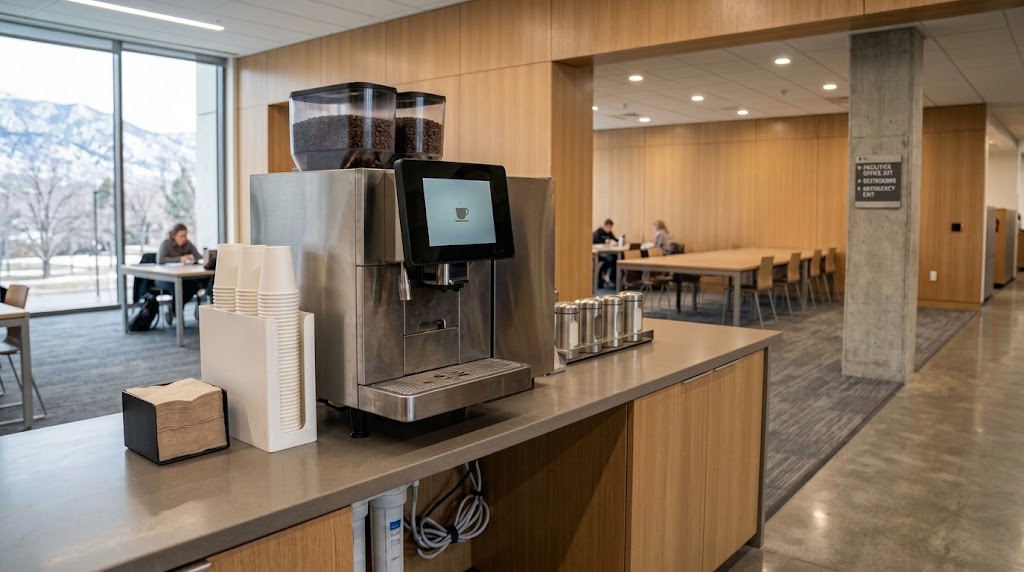
Purchase: A capable commercial bean-to-cup coffee machine runs $3,000 to $8,000 or more, depending on throughput. Single-serve brewers cost less upfront but carry high per-cup pod costs that compound quickly in larger offices. When you buy, you own the asset. You also own every repair bill, descaling cycle, filter change, and calibration.
Under IRS MACRS rules, commercial foodservice equipment typically depreciates over five to seven years, according to IRS Publication 946, meaning the asset loses book value even as maintenance costs grow.
Rental or lease: There’s no capital outlay, and the monthly cost is predictable. Maintenance and service are typically included. The trade-off is that over a long enough horizon, aggregate rental payments exceed the purchase price of the machine. Whether renting wins financially depends entirely on what’s bundled into the agreement and how long you’re in the space.
At a glance:
| Variable | Purchase | Rental or Lease |
| Upfront cost | $3,000 to $8,000+ | None |
| Ongoing cost | You cover repairs, descaling, filters, calibration | Typically included |
| Asset ownership | You own it, depreciates over 5 to 7 years | Vendor owns it |
| Long-horizon cost | Fixed after purchase | Can exceed purchase price over time |
To answer the question: neither model always wins. The right answer depends on your specific time horizon, budget flexibility, and whether your team can absorb maintenance responsibility.
What a Rental Agreement Actually Covers (And What It Doesn’t)
Most coffee equipment vendors say “maintenance included.” That phrase can mean very different things depending on who you ask. Before you sign anything, get specific answers to each of these.
Preventive maintenance visits: Ask how often PM visits happen and what’s actually covered. A proper PM includes descaling, filter changes, and calibration checks, not just a quick wipe-down. If an agreement lists “maintenance included” without defining the frequency, that’s not really a service commitment.
Repair and parts replacement: If a heating element or pump fails, who’s picking up the bill? Some agreements cover parts and labor in full, others treat every repair as its own billable event. Get this in writing before you commit to anything.
Equipment replacement: If the machine dies for good or breaks down beyond repair mid-term, is your office on the hook for the downtime and the replacement cost? A vendor who genuinely covers replacement takes that risk off your plate.
Supply continuity: Coffee supply may or may not be part of the rental program, that’s worth confirming as its own line item. Denver Beverage supplies coffee as part of its office coffee service program, including local and premium options like Ozo Organic Coffee, Queen City Collective, Boyer’s, and Boulder Organic, plus national brands like Lavazza, Peet’s, and Starbucks. That makes it a single-source coffee programs arrangement, not two separate vendors to manage.
Service response time: Denver Beverage runs 13 field technicians and 7-day equipment service coverage on the Front Range, so for offices in Denver metro and along the Front Range corridor, a broken machine gets a technician, not a ticket in a queue. Ask any vendor what their actual response window is in writing, not just ‘we’ll get to it.’
When Purchasing Makes More Sense
Purchase is the right model in specific situations. Don’t dismiss it because rental is the default conversation.
- Long-term space commitment: If you own or have a lease of five or more years with stable headcount, the total cost of ownership often favors purchase.
- High-volume usage: At very high daily cup volumes, per-unit rental cost can become expensive relative to owning outright.
- In-house facilities team: If your team handles preventive maintenance and basic repairs internally, you’re not paying for a service bundle you’ll actually use.
- Capital availability and asset preference: Some organizations prefer to own equipment outright for accounting or operational reasons. That’s a legitimate driver.
The honest version of this comparison is that purchase makes sense when you’re in it for the long haul and your team can handle the maintenance load. Rental makes sense when you’d rather keep your capital flexible, want service coverage built in, or aren’t locked into a long commitment.
Matching Equipment to Your Office: A Practical Sizing Guide
One gap that almost no vendor addresses directly: how do you match a coffee machine to your actual headcount and usage pattern? Here’s a practical starting point.
- Under 30 employees: A single-serve or pod-based coffee maker is usually sufficient. Low daily cup volume doesn’t justify the cost of a commercial brewer.
- 30 to 75 employees: A commercial batch brewer (Bunn or Curtis) or an entry-level bean-to-cup machine handles typical daily demand without overbuilding.
- 75 to 150 employees: Bean-to-cup machines with real milk options, such as De Jong Duke or Bravilor Bonamat models, match both throughput and beverage variety at this scale.
- 150 or more employees: High-capacity super-automatic bean-to-cup machines, or multiple units, are necessary. A single machine becomes a bottleneck during peak morning hours at this headcount.
These are guidance ranges, not rigid specifications. Actual fit depends on peak demand windows, beverage variety expectations, and whether a micro market or breakroom supplies program supplements the coffee setup.
Adding snacks and pantry supply can round out a breakroom without adding equipment complexity. Denver Beverage’s coffee brewing equipment page has more detail on the commercial options available for office settings. Treat this sizing guide as a starting point for a vendor conversation, not the final word.
Denver Beverage’s Approach: Rental, Lease, or Purchase, All Three
Denver Beverage offers all three acquisition models for office coffee equipment in Colorado. That matters because the conversation starts with what’s right for your office, not what the vendor needs to move.
Equipment service is concentrated on the Front Range, covering Denver Metro, Boulder County, Fort Collins, Colorado Springs, and the surrounding area. Distribution runs statewide, from Grand Junction to Sterling and from the Wyoming border down to Pueblo.
If you’re weighing acquisition models as part of a bigger office coffee decision, Denver Beverage’s office coffee service covers the full program, not just the equipment.
Ready to Compare Your Options?
Every office’s headcount, lease length, and budget are different, which is why the right acquisition model isn’t the same for every office. Talk to Denver Beverage about coffee equipment rental, lease, and purchase options.
FAQ
What’s typically included in an office coffee equipment rental agreement?
A solid rental agreement typically includes the equipment itself, preventive maintenance visits (descaling, filter changes, calibration), and repair or replacement if the machine fails. Supply continuity, meaning coffee, creamers, and filters, may or may not be included depending on the provider. Denver Beverage bundles supply into its office coffee program, so you’re working with one vendor, not two.
How do I know whether renting or buying makes more financial sense for my office?
The break-even point depends on how long you’ll be in the space, whether your team can handle maintenance, and what the rental agreement actually includes. If you’re in a space for five or more years with stable headcount and can absorb maintenance liability, purchase often wins on total cost. If you want capital flexibility, predictable monthly costs, and covered service, rental or lease tends to make more sense.
Does the rental fee include coffee supply, or is that separate?
That varies from vendor to vendor. Denver Beverage includes coffee supply as part of its office program, covering local and premium options like Ozo Organic Coffee, Queen City Collective, Boyer’s, and Boulder Organic, as well as national brands including Lavazza, Peet’s, and Starbucks. Ask any vendor to spell out exactly what’s in the monthly fee before signing.
How quickly can equipment be serviced or replaced if something breaks down?
Equipment service moves quickly when the vendor has real technician capacity behind it. Denver Beverage runs 13 field technicians with 7-day equipment service coverage on the Front Range, so if your office is in the Denver metro or Front Range corridor, help isn’t limited to a Monday-through-Friday schedule.
What size coffee machine does my office need?
As a starting point, offices under 30 employees usually do fine with a pod or single-serve coffee maker, while 30 to 75 employees is where a commercial batch brewer starts to make more sense.
Once you’re in the 75 to 150 employee range, a bean-to-cup machine with milk options usually fits both volume and variety, and above 150 employees, that typically means high-capacity equipment or multiple units. Peak demand timing and whether employees expect specialty coffee or basic drip will also affect the right fit.