Colorado universities are actively evaluating Starbucks-branded coffee programs, and the decision is more operationally complex than it appears from the outside. The key variable isn’t whether students want Starbucks, they do, it’s which deployment model fits each campus location, and how the university’s own procurement process interfaces with getting a program approved. This piece addresses both, for the facilities director or procurement officer who has to justify the decision internally and get it past facilities review.
How Campus Starbucks Programs Actually Work
A Starbucks presence on a university campus generally takes one of two forms, and the difference determines how a facilities director scopes the project.
- Full licensed store: A complete café operation, run under a Starbucks brand license, typically by the university’s own foodservice contractor, such as Aramark, Sodexo, or Compass Group, using Starbucks-certified equipment, trained baristas, and Starbucks-supplied product. That licensing relationship runs through Starbucks corporate and the university’s managed foodservice provider, not through a beverage equipment vendor.
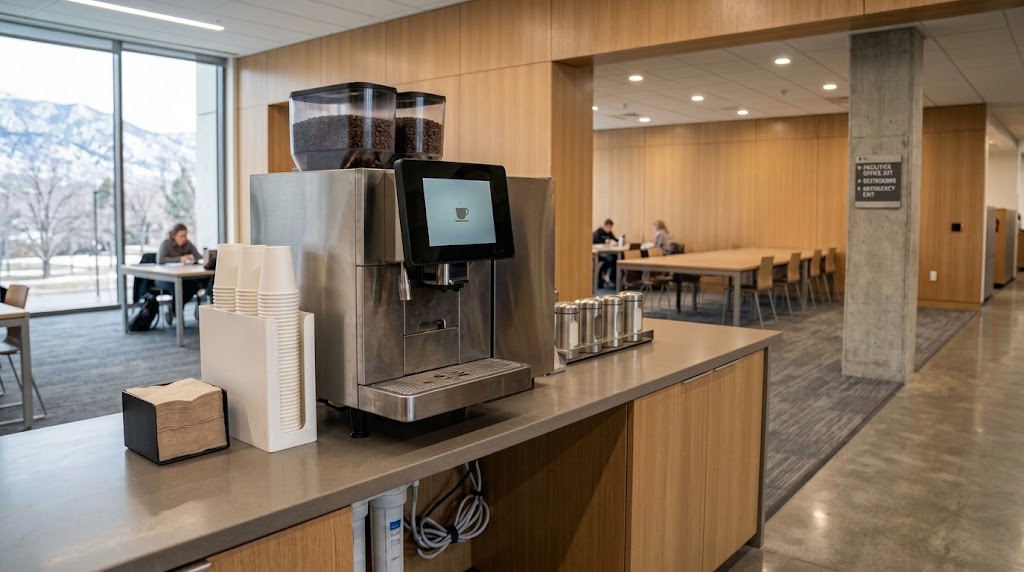
- Bean-to-cup or self-serve station: A lower-commitment path, supplied through an authorized placement partner. Denver Beverage is a Starbucks authorized bean-to-cup placement partner with statewide Colorado distribution and Front Range equipment service, and this is the deployment model Denver Beverage sets up directly: equipment selection, installation, and ongoing Starbucks-approved product supply, without the licensed-store buildout, staffing, or corporate approval process attached to a full café.
A few student-facing questions come up consistently, regardless of which model is in place:
- Starbucks Rewards: Rewards points and app-based redemption are generally tied to licensed, corporate-operated locations, not to a bean-to-cup or self-serve station. A campus with only an authorized placement shouldn’t expect Rewards functionality at that station.
- Mobile order and pay: Generally works at licensed store locations but not at a bean-to-cup station, since there’s no espresso bar workflow behind it.
- Meal plan acceptance: Depends entirely on the university’s own dining services contract, not on Starbucks either way.
Do not expect to find published cost figures, revenue share percentages, or minimum purchase commitments for a licensed store through general research. Those terms are negotiated directly between the university, its foodservice contractor, and Starbucks corporate, and they are institution-specific.
Matching the Program to the Location: Four Campus Use Cases
Facilities directors don’t think about their campuses as a single location. A dining hall integration has different operational requirements than a library self-serve station or a student union coffee shop. Here is how the four most common deployment environments differ.
Dining Hall Integration
High-volume, staffed, and meal-plan adjacent. A Starbucks-branded station in a resident dining hall works best where throughput is the primary goal: early morning peaks, between-class traffic, and high residential student volume. This scenario most commonly maps to the full licensed-store model, run through the university’s existing managed foodservice contract with a provider such as Aramark, Sodexo, or Compass Group, since dining hall integration usually needs full espresso bar output and meal-plan-linked point-of-sale.
Library Self-Serve Kiosks
Libraries need a lower-staffing-cost model suited to extended hours and study-period peaks. Library coffee programs are increasingly moving toward automated or semi-automated equipment that can operate with minimal on-site staff.
This is where Denver Beverage’s bean-to-cup placement model fits directly: a Starbucks-branded self-serve station, built on commercial coffee brewing equipment, can cover espresso-style and brewed coffee options without requiring a full barista-staffed setup. A library open until midnight needs a coffee solution that doesn’t require a barista until midnight, and that is exactly the gap a bean-to-cup unit is built to fill.
Student Union and Lounge Stations
The student union typically sees sustained traffic across the full day, and it’s usually the highest-visibility campus Starbucks location, since brand experience shows up here more than anywhere else on campus. It’s also where student sentiment issues, covered in the next section, are most likely to surface. Depending on the union’s existing foodservice setup, this location can run as either a full licensed store or a higher-capacity bean-to-cup deployment. Store hours, staffing, and visibility all carry more weight here than they would in a library or an event setting.
Campus Event and Catering Deployment
Starbucks-branded coffee at campus events, orientation, alumni weekends, commencement represents a different need than a permanent location. This is typically supplied through a coffee program rather than a licensed store: bulk product, branded disposables, and the equipment to brew and serve at scale. Denver Beverage’s coffee programs can supply event catering directly without requiring a permanent licensed store agreement, which makes event deployment a lower-commitment entry point for campuses not yet ready to commit to a full location.
University Procurement: What’s Different About the Buying Process
Higher education food retail runs on a fundamentally different procurement timeline than corporate or hospitality channels, and university buyers need to plan around that difference from the start.
- RFP process and state procurement rules: College campus food service decisions are typically governed by multi-year RFP processes, and at Colorado’s public universities, those RFPs follow state procurement regulations. A Starbucks licensing arrangement for a full licensed store is generally structured within or alongside the university’s existing managed foodservice contract, which affects how the procurement process gets sequenced.
- Licensing obligations to scope early: Campus licensing agreements for a full café carry real operational obligations beyond marketing terms, including brand standards compliance, equipment specifications, barista training, and product sourcing. Scope these accurately during the RFP or vendor selection phase, regardless of which foodservice contractor ends up operating the location.
- Timeline by deployment type: A permanent licensed store typically takes 12 to 18 months from initial evaluation to operational opening. A bean-to-cup station or event catering deployment moves considerably faster, since it carries none of the buildout or brand-licensing approval process.
Starting with a library or event deployment and layering in a full licensed store later is a realistic sequencing option for a university that wants to move faster than a full licensed store timeline allows.
For the equipment and bean-to-cup side of any of these deployments, Denver Beverage runs equipment selection, installation, and Starbucks-approved product supply through a single, Colorado-based point of contact.
Addressing Student Sentiment: What Facilities Directors Need to Know
Since Starbucks’ store-level unionization campaign began in late 2021, student organizers at more than 50 campuses have pushed to remove or block Starbucks contracts in response to the company’s labor practices. Cornell’s decision not to renew its Starbucks contract, announced in 2023 and taking effect when the agreement expires in 2025, is the most prominent example and has received significant coverage in higher education media.
Facilities directors evaluating a Starbucks program need to treat this as a real stakeholder management question, not a reason to avoid the decision. Three practical steps cover most of the groundwork:
- Assess campus climate: Get a read on how visible and organized labor-practice concerns are on your own campus before the evaluation moves forward, not after it surfaces internally.
- Review student government positions: Check whether student government has taken any formal position on Starbucks or similar branded contracts.
- Check existing institutional commitments: Confirm whether the university has made sustainability or labor-standards commitments that could be cited in opposition to a Starbucks program.
Both things are true at the same time. Student demand for branded coffee, including Starbucks, on campus remains strong even at institutions where some student activists have organized around this issue. The decision is ultimately an institutional one, made in the context of each campus’s specific environment, and an accurate picture of that environment before the evaluation serves facilities directors better than one that surfaces the issue after the fact.
Why Colorado Campuses Work with Denver Beverage on Coffee Programs
Denver Beverage is a Starbucks authorized bean-to-cup placement partner with statewide Colorado distribution and Front Range-based equipment service. That combination matters for the equipment and self-serve side of a campus coffee program specifically. It means a facilities director works with a partner who’s physically present in the Colorado market for installation and ongoing service, instead of coordinating equipment logistics from out of state.
That local presence backs a real response capability: 13 field technicians and 7-day equipment service coverage across the Front Range. For a campus coffee location that can’t afford extended downtime during finals week or orientation, that’s a procurement-relevant spec, not a marketing claim.
Denver Beverage’s reach goes beyond Starbucks placement. Its office coffee service and broader coffee programs cover the full range of campus needs, faculty and administrative building coffee programs, event catering supply, and breakroom refreshments for campus operations staff. The industries served page covers the full scope of what Denver Beverage supports across Colorado.
Getting a Campus Coffee Program Started
If you’re a Colorado university evaluating a bean-to-cup or self-serve Starbucks station for a library, student union, or event program, Denver Beverage handles equipment selection, installation, and ongoing supply for that side of the project. Talk to Denver Beverage directly to get started.
Frequently Asked Questions
Does Starbucks on a university campus accept Starbucks Rewards points?
Generally, only at locations running under a full licensed agreement, not at an authorized bean-to-cup or self-serve station. Rewards and app-based redemption are tied to corporate-run, licensed locations, so a campus with only a bean-to-cup placement shouldn’t promise that functionality to students. Worth confirming the specific setup for your campus before communicating it.
What’s the difference between a licensed Starbucks and a Starbucks bean-to-cup station?
A licensed store carries the full brand relationship, direct with Starbucks corporate through the campus foodservice contractor, along with the staffing and buildout that come with it. A bean-to-cup or self-serve station, the model Denver Beverage places on Colorado campuses, delivers Starbucks-approved coffee through automated equipment, skipping the espresso bar and the corporate licensing process entirely.
Can students use a campus meal plan at a Starbucks location on campus?
That comes down to the university’s own dining services contract, not Starbucks and not whichever vendor supplies the equipment. It’s a campus procurement and dining services decision. If meal plan integration matters for a specific location, it needs to be scoped into that location’s dining services agreement directly.
Does the Starbucks app work at university campus Starbucks locations?
A full-menu campus café supports mobile order and pay the same way a corporate store does. A self-serve bean-to-cup station usually can’t take an app order, since there’s no barista behind the counter to fulfill it, and Rewards redemption isn’t part of that station either.
How does a Colorado university start the process of adding a Starbucks program to campus?
It depends on which deployment model fits the location. A full licensed store goes through the university’s foodservice contractor and Starbucks corporate as part of an RFP or vendor selection process. For a library, student union, or event-focused bean-to-cup station, Denver Beverage is the direct first contact and can walk a campus team through equipment options and setup for that specific location.