Most office managers searching “office coffee services” already know they want coffee delivered. What they don’t know is which service model fits their office size, their budget, and their operational tolerance for managing yet another vendor.
This article maps the real options before you sign anything.
The Five Service Models, and Which Offices They Actually Fit
Picking a coffee service isn’t a brand decision. It’s an operational one. The model you choose determines who owns the equipment, who fixes it when it breaks, and how much per-cup cost you’re actually paying once consumables are factored in.
- Drip Coffee Programs
Drip is the workhorse of office coffee. It suits high-volume, cost-sensitive offices where throughput matters more than customization. Equipment is typically provider-owned and placed at no upfront cost under a supply contract. Consumables, whole bean or ground, sourced from roasters like Boyer’s Coffee or Boulder Organic, are delivered on a scheduled cadence based on your headcount and consumption rate.
The tradeoff is straightforward: low per-cup cost, limited individual variety. If your office runs 50 people through the same kitchen every morning and nobody is asking for oat milk lattes, drip is the right fit.
For coffee programs that include whole-bean options, roast variety matters more than most buyers realize, a provider with a real roaster partnership gives you more flexibility than one reselling generic commodity blends.
- Bean-to-Cup Machines
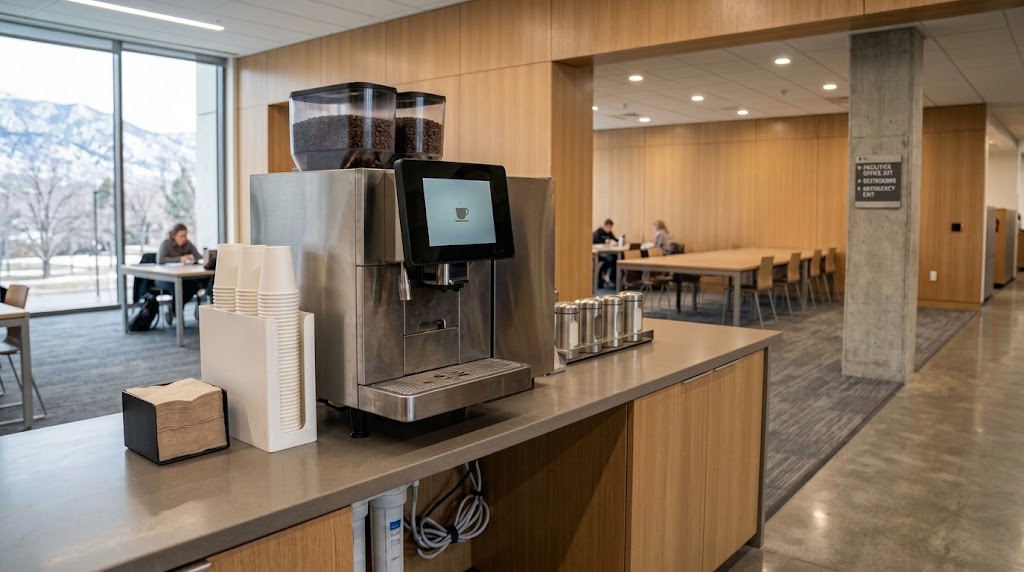
Bean-to-cup is the step up from drip for offices that want espresso drinks without hiring a barista. The De Jong Duke brewer is the benchmark machine in this category, it grinds fresh beans per cup, gives users hundreds of drink choices from a single interface, and handles everything from a straight espresso to a cappuccino without any staff intervention.
These machines suit offices of 50 or more employees where individual drink preferences vary enough to justify the equipment. The provider manages placement, installation, and servicing. Your role is restocking beans and flagging issues.
You can explore coffee brewing equipment options to see what machine categories make sense for your headcount and kitchen layout.
- Single-Serve and Pod Systems
Single-serve systems, platforms like Starbucks, Lavazza, and Flavia, solve for preference variety at lower volumes. One cup at a time means less waste per brew cycle and better control over what’s actually consumed versus what sits in a pot burning. The per-cup cost runs higher than drip. For offices where individual choice matters more than throughput, that tradeoff is usually worth it.
Denver Beverage is a Starbucks authorized placement provider. That means Starbucks-branded single-serve equipment and capsules placed in your breakroom are the real product, not a generic third-party approximation.
- Coffee and Hot Beverage Vending Machines
Vending is the lowest-touch format on this list. There’s no brewing step for anyone to manage, employees select a hot beverage from a machine, and the equipment is provider-owned and refilled on a delivery schedule rather than restocked by office staff.
It suits offices that want a coffee option with zero on-site preparation, or locations without a kitchen or breakroom big enough for a drip station or bean-to-cup machine. The tradeoff is variety: fewer customization options than a bean-to-cup machine, and a per-cup cost that runs higher than drip once volume is factored in. Many vending machines also carry snacks alongside hot beverages, which is where the format starts to overlap with a micro market, minus the self-checkout kiosk and fresh food options.
- Micro Market and Self-Serve Kiosk
A micro markets setup is not just a coffee option, it’s a full grab-and-go refresh station. Staffed by the GrabScanGo platform, a micro market gives employees 24/7 access to drinks, snacks, and essentials through a self-checkout kiosk. No staff labor required. No register. No one needs to manage transactions.
This model suits offices with 100 or more employees, multi-shift operations, or locations where the breakroom is expected to do more than hold a coffee maker. The equipment is provider-managed. Restocking is scheduled. The office’s operational lift is close to zero.
- Managed Breakroom and Pantry Service
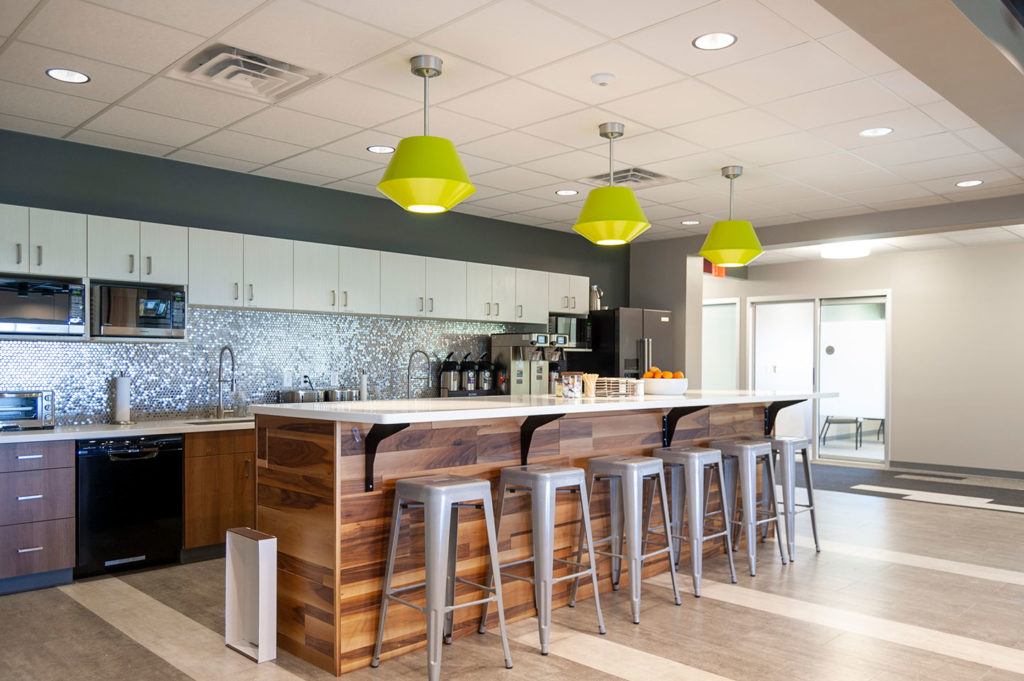
A managed breakroom program covers everything delivered and stocked under one agreement: beverages, snacks, cups, lids, napkins, and cleaning supplies. The breakroom supplies component is what separates a real full-service program from a coffee-only contract. When consumables, disposables, and equipment are on a single delivery schedule, the office manager stops tracking four separate vendor relationships and manages one.
This model suits any office that has already decided the procurement overhead of managing multiple breakroom vendors is not a good use of HR or facilities time.
What a Real Office Coffee Service Agreement Should Cover
Before you sign a service contract, the document in front of you should answer five specific questions. Most providers bury these details or omit them entirely.
- Equipment ownership vs. placement vs. lease. Who owns the machine? Who pays for repairs? If the unit fails on a Wednesday, does the provider replace it, or do you wait for a warranty claim to resolve? Get this in writing before committing.
- Service response window. A committed repair turnaround is the most overlooked term in any coffee service agreement. Denver Beverage runs 13 field technicians with 7-day service coverage. If the machine breaks Friday afternoon, that’s a concrete answer, not a “we’ll get to it Monday” outcome. Ask every provider for their specific response-time commitment, not a general assurance.
- Restocking frequency and trigger. How often are consumables delivered? Does the provider monitor inventory automatically, or do you have to call when you’re low? Automatic replenishment matters if you have 80 employees and no one whose job it is to watch the bean level.
- Minimum volumes and contract length. Some contracts penalize offices if headcount drops below a threshold. If your office has seasonal staffing or remote-work variability, confirm whether a volume floor exists and what the penalty looks like.
- Water quality provisions. Hard water degrades espresso machines and can affect drip brewers over time. Confirm whether the provider installs a filtration system, who is responsible for filter maintenance, and who covers the cost if scale buildup causes a service call.
Beyond Coffee, What Else Belongs in a Workplace Refreshment Program
The procurement argument for a single-source breakroom provider is simple: fewer vendors means fewer invoices, fewer delivery windows, and fewer service calls to coordinate across separate accounts.
- Filtered Water and Ice
Filtered water and ice stations, hot and cold dispensing with UV purification, eliminate the recurring cost of bottled water delivery and give employees a better product. Denver Beverage installs and services bottleless coolers, ice machines, and Bevi units, matched to how your office actually uses water. The same technicians who install the equipment handle the ongoing repairs, so it’s one relationship instead of a separate water vendor.
- Cold Brew, Nitro, and Kombucha Kegs
Cold brew, nitro, and kombucha kegs suit offices with a kitchen tap setup or a culture perk worth promoting in a hiring conversation. The equipment is provider-installed and serviced, the same as any other kegged beverage system. It’s a smaller-footprint addition than a full micro market, but it signals the same kind of investment in workplace amenities.
- Snacks and Pantry Supply
Snacks and pantry supply delivered on the same schedule as coffee consumables removes another procurement task from whoever manages the breakroom. The selection runs from granola bars, fruit snacks, and trail mix to chips, candy, and cookies, so the pantry stays stocked without a separate order or delivery window. Pantry service scales from a handful of items to a full program, whichever fits the office.
- Disposables and Cleaning Supplies
Cups, lids, napkins, and cleaning supplies round out a program where one order covers the full kitchen, not just the coffee corner. This category also covers restroom supplies and janitorial products, the items most offices default to sourcing from a separate vendor entirely. Consolidating it under the same provider means one delivery schedule and one point of contact instead of three.
The test for whether a provider can actually do this: ask them to quote the full breakroom, not just the machine.
Choosing a Provider: Four Questions Worth Asking
Do they offer free equipment placement with a supply contract, or is there a separate lease fee?
Most reputable providers place equipment at no upfront cost as part of a supply agreement. If a provider quotes a separate equipment lease, factor that into the total per-cup cost calculation. A “free” machine tied to a high-cost consumables contract is not a free machine.
What is the per-cup cost at your expected monthly volume?
Ask for this number directly. Request the per-cup rate at your current headcount and ask whether volume discounts apply at a higher threshold. Some providers have tiered pricing. Others don’t. You need the number before you can compare two contracts meaningfully.
What is their equipment repair response time, and is it covered under the service agreement?
This is the question most buyers skip and regret. Get the response-time commitment in writing. Confirm whether emergency service is included or billed separately. A provider with local technicians and 7-day coverage is structurally different from one that dispatches a third-party contractor.
Can they supply the full breakroom, water, snacks, and supplies, or just coffee?
If the answer is “just coffee,” that’s a vendor relationship that requires three others beside it. A provider who covers beverages, food, disposables, and equipment under one program eliminates that overhead. The question answers itself when you list what your breakroom actually needs.
The right office coffee service is not just a product decision. A provider with local technicians, scheduled delivery, and a full breakroom program removes a real category of daily management overhead from whoever owns it on the facilities or HR side. If you’re ready to compare options for your office, start with office coffee and refreshment programs in Colorado to see what a single-source program covers.