In a healthcare facility, coffee brewers on nursing stations, ice machines in dietary, and water dispensers in resident lounges aren’t just appliances. They’re tied into the building’s water supply, which puts them under the same compliance umbrella as any other utility-connected system. Most facility managers don’t find that out until a Joint Commission survey or a state health inspection turns it up.
This guide lays out what a defensible, documentation-ready preventive maintenance program actually looks like for this equipment: schedules by type, records that hold up under a survey, and where a qualified service partner fits in. For a broader look at beverage programs built for healthcare settings, see our healthcare beverage programs page.
Why Beverage Equipment Requires Its Own PM Track in Healthcare Settings
Beverage equipment needs its own PM track in healthcare because it sits at the intersection of three regulatory frameworks that a typical restaurant or office break room never has to deal with.
Healthcare facilities operate under overlapping regulatory requirements that general commercial foodservice operations simply don’t face:
- State and CMS oversight: State health inspections and CMS certification standards apply to any equipment connected to a facility’s water lines, and beverage equipment sits squarely within that scope.
- Joint Commission Environment of Care requirements: For accredited facilities, the EC.02.05.01 standard requires documented maintenance for utility systems and utility-connected equipment, which includes beverage equipment on water lines.
- CMS Legionella water management mandate: CMS Survey and Certification Memo QSO-17-30, issued in 2017, requires all CMS-certified facilities to implement a Legionella water management program. Ice machines and water dispensers aren’t exempt because they’re in a dietary area rather than a patient room; any equipment connected to the building water supply is in scope.
The stakes here are a patient safety issue, not just a paperwork one. Hospital water systems have a documented history of waterborne pathogens like Legionella and Pseudomonas aeruginosa, and ice machines specifically have been identified as a transmission vector in healthcare outbreak investigations.
None of this means beverage equipment is high-risk by default. It means equipment maintenance for this class of equipment requires a documented program, not ad hoc attention. A facility that can produce service logs on demand is in a very different position during a survey than one that cannot.
PM Frequency by Equipment Type
Each equipment type below breaks into daily, weekly, monthly, quarterly, and annual tasks, the same cadence structure that other healthcare PM guides use. Tasks your dietary or facilities staff can handle are labeled that way. Anything that needs a qualified technician is flagged as “schedule with your service provider” instead of something to tackle in-house.
Coffee Brewers and Bean-to-Cup Systems
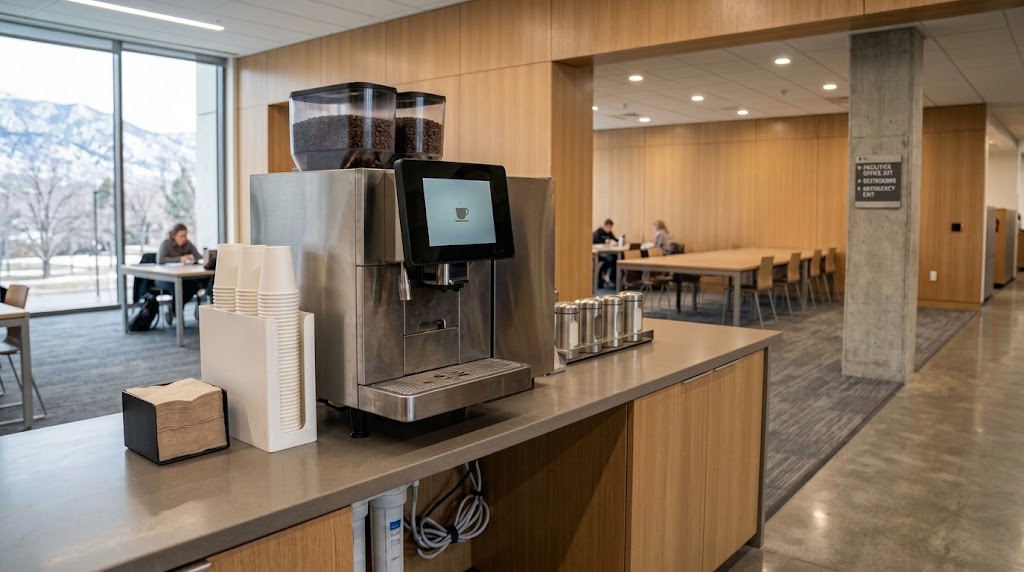
Commercial coffee equipment commonly serviced in healthcare accounts includes Bravilor Bonamat, De Jong Duke, Curtis, and Bunn systems, brands Denver Beverage supports. Manufacturer protocols vary in the details, but the PM schedule below holds as a general framework regardless of which of these systems your facility runs. See our coffee brewing equipment page for equipment details.
- Daily (staff): Clean brew baskets, drip trays, and exterior surfaces. Rinse dispensing nozzles after each service period.
- Weekly (staff): Sanitize dispensing nozzles and any removable components that contact brewed coffee.
- Monthly (technician): Descale internal brew paths. Descaling frequency depends on local water hardness; facilities in Colorado’s high-mineral-content water zones may need this more often than monthly. Your service provider should assess and adjust intervals accordingly.
- Annual (technician): Full-service calibration, internal component inspection, and brewing temperature verification. Calibration ensures brewing parameters stay within manufacturer specifications and produces documentation useful for PM records.
Water Dispensers and Filtered Water Systems
Water dispensers and filtered water systems connected to facility water supplies fall within CMS QSO-17-30 scope, so the schedule below applies regardless of which system your facility uses. Denver Beverage services water and ice equipment in healthcare accounts. See our filtered water and ice page for equipment details.
- Daily (staff): Wipe down dispensing points and exterior surfaces. Check for visible scale or residue buildup around nozzles.
- Weekly (staff): Sanitize dispensing nozzles with an appropriate food-contact sanitizer.
- Quarterly (technician): Replace filter cartridges, or per manufacturer specification, whichever comes first. Filter replacement intervals vary significantly by water quality and usage volume.
- Annual (technician): Full line flush and sanitization per NSF/ANSI Standard 18 requirements for manual food and beverage dispensing equipment. This is the annual documentation anchor for water management plan compliance. Your service provider should issue a written service report confirming tasks completed.
Ice Machines
Ice machines carry the highest regulatory scrutiny of any beverage equipment type in healthcare. CMS QSO-17-30 water management plans typically require documented ice machine sanitization logs, and state health inspectors review ice machine records as part of dietary inspections under the FDA Food Code adoption and enforcement guidance as adopted in Colorado.
- Daily (staff): Wipe down the bin exterior and dispensing area. Do not reach into the ice bin with bare hands or non-sanitized tools.
- Weekly (staff): Sanitize the dispensing chute and ice-contact surfaces accessible without disassembly.
- Quarterly (technician): Full interior sanitization per manufacturer protocol, including bin, evaporator, and water distribution components. Document the date, technician, and tasks completed.
- Annual (technician): Inspection of water inlet valves and condenser coils. Mineral buildup on the condenser reduces efficiency and shortens equipment lifespan. Failing inlet valves are a leading source of equipment failures in high-usage settings.
Fountain and Post-Mix Dispensing Equipment
Fountain equipment in dietary or cafeteria contexts follows a similar upkeep cadence to other beverage equipment, with the added consideration of BIB (bag-in-box) syrup lines and carbonation systems.
- Daily (staff): Clean nozzles and drip trays. Inspect for flat product or off-flavor, which can indicate a line issue.
- Weekly (staff): Full nozzle sanitization using manufacturer-approved sanitizer.
- Quarterly (technician): BIB line flush and carbonation system check. A trained technician should handle this, not dietary staff, as it involves pressurized CO2 systems.
- Annual (technician): Full equipment inspection including syrup delivery components, carbonation levels, and all water-contact surfaces.
Documentation Requirements for Regulatory Inspections
This is where most facilities have a gap, and it’s the gap that creates the most exposure during a survey. Knowing that maintenance was done is not the same as being able to demonstrate it on demand.
What surveyors look for: Joint Commission EC.02.05.01 requires facilities to document PM completion, technician qualifications, and corrective actions taken when equipment fails inspection. For CMS-certified facilities, Legionella water management plan documentation must include equipment on facility water lines, specifically ice machines and water dispensers. State health inspectors reviewing dietary operations will look for sanitization logs on food-contact equipment per the FDA Food Code as adopted by Colorado.
What a compliant PM log contains: Each service entry should capture the following minimum fields.
- Equipment ID and location (e.g., “Ice Machine, Dietary, Building A”)
- Service date
- Technician name, company, and credentials or license number
- Tasks performed
- Findings (pass or needs corrective action)
- Corrective action taken, if applicable
- Next scheduled service date
This is the minimum viable record. A CMMS (computerized maintenance management system) can automate log capture and generate audit-ready reports at scale. For smaller facilities, a spreadsheet maintained per the fields above satisfies the same inspection requirement.
Retention periods: Joint Commission EC records are typically required for three years. For CMS-certified facilities, water management plan records should be retained for at least two years under QSO-17-30 guidance. State requirements may vary, and the facility’s compliance officer should confirm the applicable retention rules.
Third-party vendor documentation: When an outside service provider performs maintenance, their service reports belong in your PM log, not in a separate vendor file. The report must include technician identification, tasks performed, and any corrective recommendations. A vendor who can’t or won’t provide documentation in this format isn’t a compliant partner for a healthcare setting.
How a Proactive PM Program Protects Resident Care Continuity
A reactive maintenance model creates downtime at exactly the wrong moments in a care setting. Think about what’s actually on the line:
- A coffee system down on a nursing station at 6 a.m.
- An ice machine out during a summer heat event
- A water dispenser offline during a resident hydration round
These aren’t minor inconveniences. In skilled nursing and assisted living contexts, beverage availability connects directly to resident hydration protocols and staff workflows.
Proactive preventive maintenance catches filter clogs, descaling buildup, and failing components before they cause an outage. Predictive maintenance takes this further: facilities that track equipment service histories and lifespans can anticipate replacement needs instead of reacting to emergency failures. That shift from reactive to proactive pays off operationally, and it holds up better in a compliance review too.
Denver Beverage operates a structured PM program built around healthcare facility requirements:
- Field coverage: 13 field technicians providing 7-day service coverage, with equipment service concentrated across Colorado’s Front Range.
- Credential: State of Colorado preferred vendor status for healthcare, serving skilled nursing, rehab, and assisted living facilities with 75 or more beds across the Front Range.
- Documentation: Service reports are issued in a format that meets Joint Commission and CMS documentation requirements, including technician ID, tasks performed, and corrective recommendations, so reports go directly into a facility’s PM log without translation.
For equipment repair outside a PM visit, Denver Beverage’s commercial kitchen and beverage equipment repair program covers urgent service needs on the same 7-day coverage schedule.
If you’d like to talk through what a structured PM program would look like for your facility’s specific equipment mix, reach out to the Denver Beverage healthcare team.
Ready to Build a Documentation-Ready PM Program?
If your facility is still tracking beverage equipment maintenance informally, a structured PM program can close that gap before your next survey, not during it, when a surveyor is standing in your dietary department asking for records you don’t have.
Talk to Denver Beverage’s healthcare team about a PM program built for your equipment mix.
Frequently Asked Questions
How often should ice machines be sanitized in a healthcare facility?
Ice machines need daily exterior wipe-downs and weekly sanitization of dispensing chutes and ice-contact surfaces by trained staff, quarterly full interior sanitization by a qualified technician, and an annual technician inspection of water inlet valves and condenser coils. For CMS-certified facilities, every quarterly and annual service must be logged with the technician’s name, tasks performed, and date, since it feeds into the Legionella water management plan required under QSO-17-30.
What documentation does The Joint Commission require for beverage equipment maintenance?
The Joint Commission’s EC.02.05.01 standard requires facilities to document PM completion, technician qualifications, and corrective actions for utility-connected equipment, including beverage equipment on water lines. Each log entry should capture equipment ID and location, service date, technician name and credentials, tasks performed, findings, corrective action if needed, and the next scheduled service date, retained for three years.
Does my facility’s Legionella water management plan need to include beverage equipment?
Yes, for CMS-certified facilities. CMS Survey and Certification Memo QSO-17-30 requires water management plans to cover all equipment connected to the building water supply, including ice machines and water dispensers, regardless of whether they’re in a patient area or a dietary department. Sanitization logs for this equipment belong in the water management plan documentation, not a separate file.
What’s the difference between maintenance tasks my dietary staff can perform and tasks that require a qualified technician?
Trained dietary or facilities staff can handle daily cleaning of brew baskets, drip trays, dispensing nozzles, and ice bin exteriors, plus weekly nozzle sanitization when staff are trained on the correct sanitizer and contact time. Descaling internal brew paths, replacing filter cartridges, full interior ice machine sanitization, BIB line flushing, pressurized CO2 inspection, and annual calibration all require a qualified technician, since they involve internal components, pressurized systems, or chemical concentrations that need technician-level training and written service documentation.
How do I choose a beverage equipment service provider that understands healthcare compliance requirements?
Look for a provider whose service reports match the minimum PM log fields, equipment ID, date, technician credentials, tasks performed, findings, corrective action, and next service date, and confirm those reports satisfy Joint Commission EC.02.05.01 and CMS QSO-17-30 water management plan requirements. Denver Beverage holds State of Colorado preferred vendor status for healthcare, serves skilled nursing, rehab, and assisted living facilities across the Front Range, and issues service reports designed to go directly into a facility’s PM log.