Your beverage equipment goes down or starts underperforming, and now you’re facing a commercial equipment repair vs replace decision. Now you’re deciding whether to spend money on a repair or cut your losses and replace it. The answer depends on three things: how old the equipment is, what the repair will cost relative to its replacement value, and how often you’re calling for service.
This guide gives you a usable framework to answer that question for the specific beverage equipment in your facility.
Commercial Beverage Equipment Lifespan Benchmarks by Type
Before running the numbers on a repair estimate, you need to know where your equipment sits in its expected service life. Here are realistic ranges for the main categories of commercial beverage equipment, under normal use with regular preventive maintenance.
| Equipment Type | Expected Service Life |
| Fountain dispensers and carbonated beverage systems | 10 to 15 years; ice mechanisms often fail earlier at 7 to 10 years |
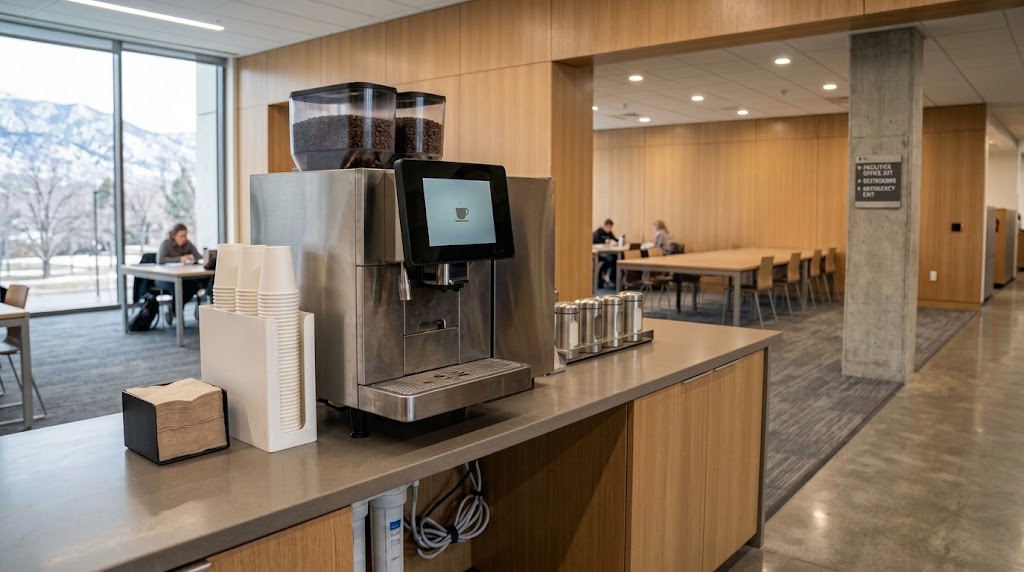
| Coffee brewing equipment (batch and airpot brewers) | 5 to 8 years commercial-grade; bean-to-cup machines (e.g., De Jong Duke) 7 to 10 years with a full-service program |
| Draft beer systems (lines, towers, keg coolers) | Lines and components: 5 to 7 years; refrigeration units: 10 to 15 years |
| Refrigeration units (undercounter coolers, reach-ins for beverage storage) | 10 to 15 years |
| Ice machines | 7 to 10 years; notably maintenance-intensive, and failure frequency often signals replacement before nominal end-of-life |
| Beverage gas regulators and dispensing hardware | 5 to 10 years, depending on the environment and carbon dioxide (CO2) exposure |
These ranges assume scheduled preventive maintenance. Equipment running in high-humidity or high-mineral-content-water environments, or without regular service visits, typically reaches end-of-life faster.
The Repair Cost Threshold: The 50% Rule
The 50% rule is the standard threshold procurement and operations teams use to make the commercial equipment repair vs replace call: if a single repair costs more than 50% of the equipment’s current replacement value, replacement is almost always the better financial decision.
What this looks like in practice:
- Situation: a compressor failure on a fountain dispenser that’s 12 years old
- Repair estimate: $800
- Replacement cost: $1,400 to $1,800
- Repair as a share of replacement: 44% to 57%, with the unit already at the top of its expected service life
- What that math means: you’re likely buying 6 to 12 months before the next major failure, not a working piece of equipment
Why repair frequency matters, independent of cost:
Repair frequency matters on its own, separate from cost per visit. If your team has called for service on the same piece of equipment three or more times in 18 months, add up the cumulative repair spend, not just the latest invoice. Repeated downtime on the same unit changes the math significantly, even when individual repair costs look manageable on their own.
Signs Your Equipment Has Reached End-of-Life
Not every replacement decision starts with a breakdown. These operational indicators signal that equipment is degrading, even if it hasn’t fully failed yet.
- Inconsistent output: dispensing temperatures or carbonation levels that stay inconsistent even after a recent service visit
- Recurring refrigeration issues: failures or compressor cycling that keep coming back, even right after a repair
- Corrosion and sanitation risk: corrosion, mineral scaling, or worn seals on food-contact surfaces, once equipment can’t be properly cleaned and sanitized, you’re looking at a sanitation compliance issue, not just a performance one, and the FDA Food Code guidelines on equipment sanitation and food-contact surfaces set the enforceable standard here
- Parts availability: lead times on your fountain or coffee equipment components stretching past two to three weeks, or parts getting discontinued outright, means repair stops being a reliable option no matter what it costs
- Rising energy use: energy bills creeping up compared to what a comparable new unit would draw
When Rental or a Managed Program Changes the Math
A managed equipment program, where the equipment is installed and maintained as part of a broader supply relationship, is a third option many operators don’t initially consider. It’s worth evaluating seriously in a few specific situations.
When a managed program makes sense
- You don’t want to carry the capital asset on your books
- The equipment will need professional service regardless of who owns it
- A replacement unit’s purchase price is high enough that a monthly program cost is easier to absorb operationally
For coffee beverage systems, Denver Beverage places equipment as part of its coffee brewing equipment programs, with 7-day service coverage across the Front Range included. Fountain and carbonated beverage systems are also candidates for this model in the right supply relationship.
This isn’t the right fit for every operator, but if you’re replacing aging equipment and the capital outlay is a constraint, it’s worth running the comparison before committing to a purchase.
How to Get a Repair or Replacement Assessment
An on-site assessment gets you real numbers instead of a guess. Denver Beverage’s technicians can evaluate equipment condition directly and hand you a repair estimate alongside a replacement cost comparison, so the decision isn’t made blind. If you’d like to talk through what makes sense for your specific equipment, reach out to the Denver Beverage team directly.
Ready to Get a Straight Answer on Your Equipment?
A repair estimate and a replacement comparison side by side is the fastest way to know which option actually makes sense for your equipment and your budget. Talk to Denver Beverage about an on-site assessment for your equipment.
Frequently Asked Questions
What’s the average cost of commercial beverage equipment repair?
Repair costs vary significantly by equipment category. Diagnostic visit fees are typically separate from parts and labor. A minor repair typically costs a fraction of a compressor or refrigeration repair, and ice machine repairs tend to fall somewhere in between, depending on parts and labor. Denver Beverage provides a written estimate before any work begins, so you’re not committing to a repair cost you haven’t approved.
Does using an independent repair company void my equipment warranty?
No, generally not. Under the Magnuson-Moss Warranty Act, a manufacturer can’t void your warranty just because an independent technician did the repair, as long as OEM-equivalent parts were used. Warranty terms still vary by manufacturer, so verify the specific language in your own documentation. The FTC’s Bureau of Consumer Protection publishes guidance on this directly.
How often should commercial beverage equipment be serviced preventively?
Preventive service frequency depends on equipment type. Coffee brewing equipment should be serviced quarterly at minimum, and fountain dispensers follow the manufacturer’s schedule, typically quarterly as well. Draft beer systems need line cleaning every 90 days plus a full system inspection annually. For beverage gas supply and regulator hardware, annual inspection is standard, with more frequent checks in high-volume or high-humidity environments.
What happens if replacement parts are no longer available for my equipment?
This is end-of-life in practice: once parts lead times stretch out significantly, or a manufacturer discontinues components for your model, repair is no longer a reliable path regardless of what the current job would cost. Replacement or a managed program should move to the top of your evaluation at that point, not the bottom.
Does Denver Beverage handle both repair and new equipment installation?
Yes. Commercial kitchen and beverage equipment repair is available 7 days a week across the Front Range, and Denver Beverage also installs new equipment across the Front Range, managing the full transition from a failed unit to a replacement without coordinating separate vendors.