Most commercial fryer failures fall into three categories: temperature problems, pilot light or ignition failures, and oil-related issues. This guide walks through each one so you can work out what you’re dealing with. You’ll also see which problems you can check yourself and which are best left to a technician.
Denver Beverage’s commercial kitchen and beverage equipment repair team covers the Front Range and the I-70 corridor with 7-day service coverage. If a fryer problem is still there after you’ve worked through a section, that page is where to go next.
Temperature Problems: Fryer Won’t Hold or Reach Temperature
Temperature control problems are among the most common fryer faults. The right diagnostic path depends on whether your fryer runs on gas or electric, and whether it won’t reach temperature at all or reaches it but can’t hold it.
Fryer Won’t Reach Target Temperature at All
A fryer that never gets up to temperature is usually missing heat, not holding it. That points to the heat source, so the first check depends on your fuel type. Start with the one that matches your unit:
- Gas fryer: Start with the burner assembly and gas supply. A partially blocked burner port or low gas pressure will keep the unit from reaching temperature even if every other component is working.
- Electric fryer: Check the heating elements. A failed element produces a similar symptom, where the unit runs but never gets where it needs to be. Heating element failure is the most common electric fryer temperature fault.
Fryer Reaches Temperature but Won’t Hold It
This is usually thermostat drift or outright thermostat failure. The fryer climbs to the setpoint, then drops below it faster than normal load would explain. A high limit switch that trips intermittently produces a similar symptom.
The high limit switch is a safety device. If the fryer climbs past a safe maximum temperature, it shuts off power to the burners or elements. You can reset it yourself. Look for the reset button on the back or side of the unit, press it, and turn the power back on.
If the fryer trips again soon after, stop there and call a technician. A switch that keeps tripping is telling you the underlying problem is still there.
Replacing a thermostat isn’t a simple swap. The new one has to be calibrated to your specific fryer, so this is a job for a technician, not a DIY fix.
Inconsistent Temperature Across the Vat
Uneven temperature can point to a failing thermostat, sediment or grease buildup on the heating elements (electric) or burner assembly (gas), or degraded fry oil. If the oil hasn’t been changed or filtered recently, read the oil section below before assuming a mechanical fault.
Gas vs. Electric Fryer Temperature Faults: A Practical Distinction
Gas and electric fryers heat in different ways, so their temperature faults tend to start in different places. Knowing which type you have narrows the diagnostic path before a technician arrives, and it helps you describe the problem accurately when you call:
- Gas fryers: Temperature faults most often trace to the burner assembly, the thermocouple, or the gas valve.
- Electric fryers: Temperature faults most often trace to the heating elements or the control board.
Pilot Light and Ignition Problems
This section covers gas fryers only. Electric fryers don’t have pilot lights. If you’re troubleshooting an electric fryer for ignition-related symptoms, the issue is the control board or the heating circuit, not a pilot light malfunction.
Pilot won’t light at all
Check gas supply first. If other gas equipment in the kitchen works normally, supply isn’t the issue. Next, check the pilot orifice for grease buildup or debris. With the unit fully cooled and the gas off, this is one cleaning step you can safely attempt yourself. A clogged orifice is a common cause of gas fryer ignition problems, and clearing it doesn’t need a technician.
Don’t inspect gas lines or connections yourself. If you suspect a gas line issue, note it for the technician.
Pilot lights but won’t stay lit
In most cases, this is thermocouple failure. The thermocouple is a safety device that senses whether the pilot is burning and holds the gas valve open when it is. If it isn’t sensing heat properly, the gas valve closes and the pilot goes out. If cleaning the pilot orifice doesn’t fix it, this is a technician task.
Pilot lights but main burners don’t ignite
If the pilot stays lit but the main burners won’t come on, the problem is usually a gas valve fault or a failed igniter. Neither is something to work on yourself, because there’s no operator-level check that resolves them safely. Call a technician and let them know what you’re seeing.
Oil Problems: Degradation, Smoking, and Filtration
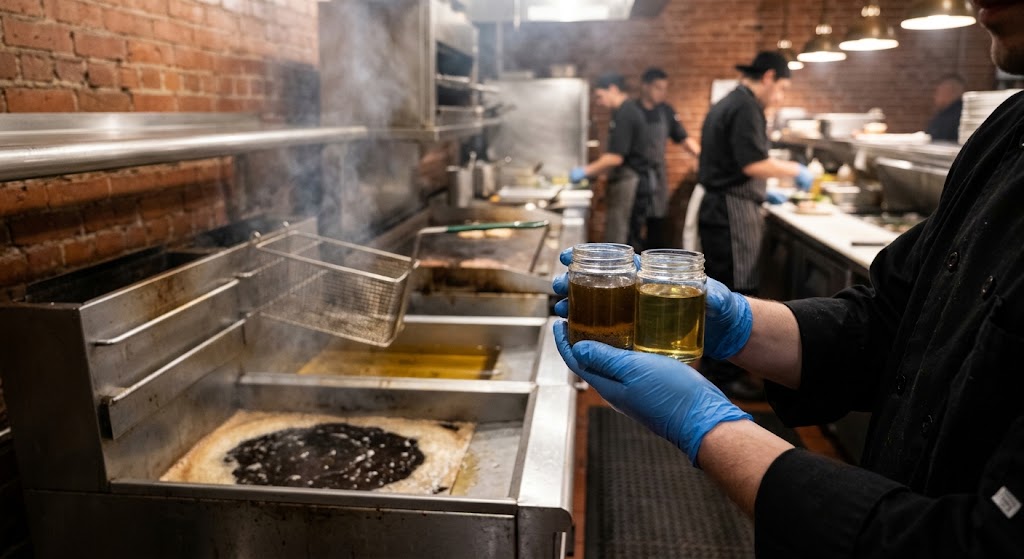
Many fryer malfunctions that look mechanical are actually caused by degraded fry oil. This is the fault category that gets overlooked most often. If you service the unit without addressing oil quality, the same symptoms come back.
How to tell whether oil degradation is the underlying cause
Ask when the oil was last changed and when the filtration system was last cleaned. If the answer is “a while ago” and symptoms appeared gradually rather than suddenly, start with the oil before assuming a component has failed. These are the clearest signs that oil is driving the problem:
- Smoking: Excessive smoke at normal operating temperature.
- Oil condition: Oil that’s darkened or has developed foam.
- Fry quality: Quality that declined before any temperature readings changed.
Degraded fry oil doesn’t just affect food quality. It can cause erratic temperature behavior that mimics a thermostat fault, because heavily carbonized oil conducts heat differently than fresh oil and can create localized hot or cold zones in the vat.
Oil filtration as a maintenance factor
Built-in oil filtration systems need their own maintenance. A clogged filtration system can produce temperature swings that look exactly like a thermostat problem. If your fryer has a built-in filtration unit and it hasn’t been serviced recently, check that before scheduling a repair call.
When oil change and filtration don’t resolve the symptoms
If you’ve changed the oil, serviced the filtration system, and the symptoms persist, the temperature control system needs inspection. At that point, you’re looking at a real mechanical fault, not an oil-management issue.
Repair vs. Replace: A Framework for the Decision
Most operators reach this question once the repair quote lands on the counter. A simple way to think about it is to put the quote next to the price of a comparable new unit. A new commercial fryer typically runs $2,000 to $10,000+, depending on size and configuration.
If the repair costs only a small fraction of that, fixing the fryer is usually the better call. A common rule of thumb says a repair costing more than 50% of replacement deserves a closer look.
Age of the unit
Most commercial fryers have a serviceable life of 10 to 15 years with proper maintenance. A thermostat or thermocouple replacement on a younger unit is a straightforward repair decision.The same repair on an old unit that is already showing wear elsewhere is a different calculation.
Type of repair needed
A thermocouple or fryer thermostat replacement is a low-cost repair that almost always makes sense. A gas valve or control board replacement costs more but is still typically worth it on a mid-life unit in otherwise good condition. A heat exchanger replacement on an older fryer warrants a closer look at total cost versus replacement.
Frequency of failures
One repair call is maintenance. A pattern of repeat failures on the same unit, particularly on different components, signals that the unit is approaching end of life. Track your service history: if you’re calling for commercial fryer repair service more than once or twice a year on the same unit, that’s the conversation to have with your technician.
Denver Beverage Fryer Repair: What to Expect
When a fryer goes down in the middle of service, you want to know who’s coming, how soon, and what the work is backed by. Denver Beverage’s own technicians handle fryer repair, and they’re CFESA-trained. Here’s what to expect when you call:
- Service area: The Front Range and the I-70 corridor.
- Service coverage: 7-day service coverage.
- Response commitment: 24-hour service response.
- Labor warranty: 90 days on all repairs.
- Technician credential: CFESA-trained.
- Who does the work: Denver Beverage’s own technicians, not third parties.
Denver Beverage serves restaurants and bars across the Front Range. If you also run commercial warewashing equipment, Denver Beverage’s own ADS (American Dish Service) leased dish machines start at $129 a month, with free repairs included. See our commercial dishwasher repair service page for details.
Get Your Fryer Back on the Line
A fryer that’s down mid-service costs you every hour it stays that way. If the checks above haven’t solved it, call 303-295-3737 or send a request online, and a Denver Beverage technician can get you on the schedule.
Frequently Asked Questions
How much does it cost to repair a commercial fryer?
Repair costs vary by fault type. A thermocouple or thermostat replacement is relatively low-cost, while a gas valve or control board replacement costs more. As a general rule, repair is the right call when it costs less than 50% of a comparable new unit and the fryer isn’t near end of life. Denver Beverage provides a diagnosis before committing to a repair, so call 303-295-3737 for a quote.
What are the most common problems with commercial deep fryers?
The three most common categories are temperature failures, pilot light and ignition issues, and oil degradation that masks equipment symptoms. Temperature faults most often trace to the thermostat or, on electric units, heating element failure. Pilot light problems most often trace to thermocouple failure. Each has a clear diagnostic path before a technician visit is needed.
How do I know if my commercial fryer thermostat needs replacing?
A fryer that reaches temperature but won’t hold it consistently is the clearest sign, especially when the swings can’t be explained by load or oil condition. A high limit switch that trips repeatedly is another indicator. Thermostat replacement needs a technician and calibration to the specific unit, so it isn’t a swap-and-go repair.
Can a commercial fryer be repaired on-site, or does it need to go to a shop?
Most commercial fryer repairs are done on-site. Denver Beverage’s technicians carry common replacement parts and repair the fryer at your location. Taking a floor fryer to a shop is rarely necessary and adds downtime most kitchens can’t absorb.
How often should a commercial fryer be professionally serviced?
A preventive maintenance visit once or twice a year is standard for high-volume fryers. A typical visit covers cleaning the burner assembly, checking thermostat calibration, inspecting gas connections, testing the high limit switch, and evaluating the oil filtration system. Operators who skip preventive maintenance tend to see more emergency calls and shorter equipment life.