An emergency repair call typically costs two to three times what a scheduled visit would have run you. Add spoiled product, a possible health department visit, and a shutdown mid-service, and one skipped monthly check turns into an expensive problem fast. This checklist is organized by time interval and equipment category, so find the section that matches your operation and put it to use today.
Each equipment section covers the specific components to inspect, the observable symptoms that flag a problem, and what those symptoms typically point to. Annual tasks that require a certified technician are called out explicitly, along with what to verify when you’re booking that service.
Monthly Inspections
Monthly checks take under an hour per equipment category and catch small faults before they turn into major failures 30 days down the line.
Fountain Systems
- Brix ratio at each nozzle: Draw a sample and taste it. A syrup-to-water ratio that’s off points to a failing flow control valve or a BIB running low, not a calibration issue with the BIB itself.
- CO2 line connections: Check every fitting for frost or moisture. Frost on a connection indicates a slow CO2 leak. Carbonation pressure should read 95 to 105 PSI at the primary regulator. Replace the CO2 tank when the tank reads below 200 PSI.
- Nozzles and diffusers: Remove and rinse each nozzle. Syrup residue buildup causes off-flavors and nozzle clogging. A nozzle that won’t flush clean needs replacement.
- Power check: If a dispenser isn’t powering on, check the breaker and the GFI outlet. A tripped GFI outlet is a separate and common cause from a tripped breaker; check both every time.
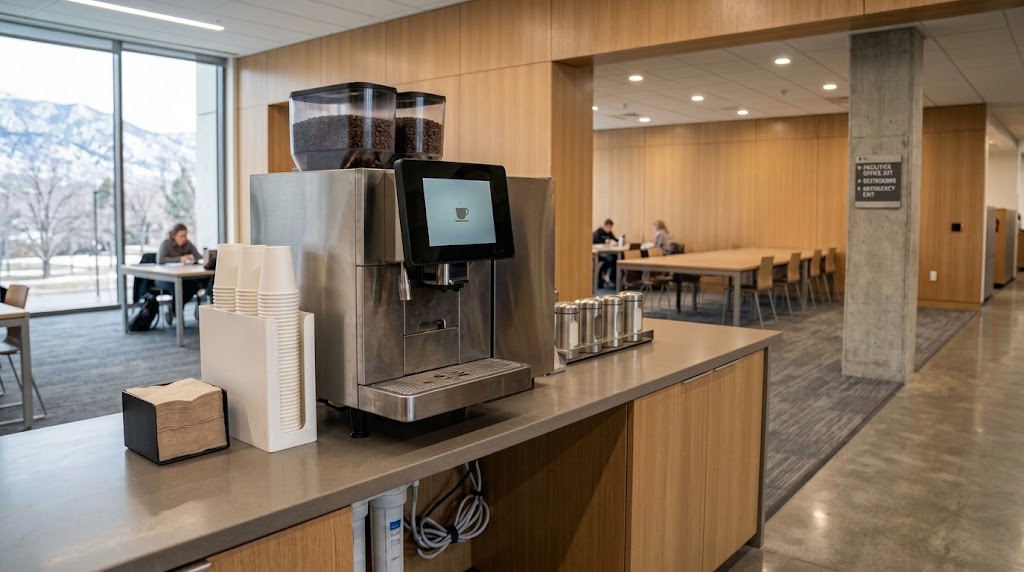
Coffee Machines
- Brew basket and spray head: Remove and rinse. Scale or coffee oil buildup on the spray head reduces extraction pressure and produces flat, bitter coffee.
- Drip tray and drain line: Clear any blockage in the drain line. A backed-up drain is the most common cause of overflow faults on commercial brewers.
- Grinder burrs (bean-to-cup units): Run a purge cycle and listen for grinding inconsistency. Uneven grind points to worn burrs, which affect extraction and shot quality.
- Water supply line connections: Check for drips at each fitting. A slow drip left unaddressed leads to scale acceleration in the boiler.
Dish Machines
- Spray arms and diffusers: Remove and inspect each arm for clogged nozzles. A blocked nozzle creates uneven wash coverage and raises the risk of a failed sanitation cycle.
- Door gaskets: Run a finger along the full gasket perimeter. Cracks or tears let steam escape, reduce internal temperature, and leave the machine working harder to reach sanitizing temp.
- Rinse aid and detergent levels: Check dispenser reservoirs and refill as needed. Running low on either mid-cycle is the leading cause of spotting and sanitation failures on routine inspections.
- Wash and rinse temperature: High-temperature machines must reach 160°F at the wash tank and 180°F at the final rinse. Note the reading. A temperature that’s trending down over consecutive checks signals a failing heating element.
Ice Machines
- Air filter: Remove and rinse the air filter. A clogged filter reduces airflow to the condenser, causes the unit to run hot, and cuts ice production by up to 30%.
- Water inlet valve screen: Check for mineral scale buildup. A partially blocked screen reduces water flow and produces thin, malformed cubes.
- Ice bin door seal: Inspect the bin door gasket for cracks. A compromised seal causes ice melt, raises energy consumption, and can create a standing water condition in the bin.
- Exterior condenser coils (air-cooled units): Brush or vacuum visible debris from the coil face. A dirty condenser is the single most common cause of ice machine shutdown in Colorado’s drier climate.
Draft Beer Systems
- CO2 pressure at the primary regulator: Should read 95 to 105 PSI. Secondary regulator pressure at the keg coupler should hold at 60 PSI. A reading outside either range affects carbonation and pour quality.
- CO2 tank level: Replace when the tank reads below 200 PSI. A tank running low under a busy service shift causes inconsistent carbonation and flat beer.
- Keg couplers: Check each coupler for leaks at the probe and body seal. A hissing coupler wastes CO2 and loses carbonation from the keg. Tighten or replace the seal.
- Faucets and shanks: Pull each faucet handle and check for yeast buildup inside the faucet body. Buildup between cleanings is normal; visible mold is not. A moldy faucet means the cleaning interval needs shortening, not skipping.
Water Filtration
- Filter change date label: Confirm the filter was changed on schedule. Most commercial filters run on 6-month replacement cycles, but high-volume or high-sediment locations may need quarterly changes.
- Flow rate at the outlet: A noticeably reduced flow rate from one month to the next indicates the filter is loading up faster than expected. Note it and schedule an early change.
- Housing O-ring condition: When changing filters, inspect the housing O-ring. A cracked or misseated O-ring causes a slow leak that’s easy to miss until water damage appears.
Quarterly Inspections
Quarterly checks dig deeper into how each system is actually performing, mechanically and chemically. Most tasks take 15 to 30 minutes per piece of equipment, and they catch the wear patterns a monthly visual check simply can’t.
Fountain Systems
- Flow control valves: Test each valve for consistent flow across all flavors. A valve delivering inconsistent flow produces inconsistent brix from pour to pour. Replace valves that can’t hold a consistent rate.
- CO2 line integrity: Inspect the full run of CO2 tubing from tank to dispenser for crimps, abrasion, or connection points that show any sign of movement. A line that’s shifted at its fitting is a CO2 leak waiting to develop.
- Carbonator tank: Check the carbonator motor for unusual noise during the carbonation cycle. A motor running louder than normal or cycling on more frequently points to a carbonator pump nearing the end of its service life.
- Drip tray drain: Remove and clean the drain line fully. A quarterly flush prevents the buildup that monthly rinses can miss.
If a quarterly check turns up a fault you can’t clear, Denver Beverage’s commercial kitchen and beverage equipment repair team covers the Front Range 7 days a week.
Coffee Machines
- Descaling cycle: Run a full descale on drip and batch brewers. Scale accumulation on heating elements is the primary cause of temperature drop and slow brew cycles. The frequency depends on local water hardness; Denver’s water is moderate, but high-volume machines should descale quarterly regardless.
- Group head gaskets (espresso and bean-to-cup units): Press a portafilter into the group head and check for resistance. A gasket that lets the portafilter seat loosely is worn and will cause extraction bypass and pressure loss.
- Steam wand and milk system: Backflush and descale the steam circuit on any machine running a milk or cappuccino program. Milk protein buildup inside the steam circuit restricts flow and is a health inspection risk.
Need service or equipment support for your coffee program? Denver Beverage’s coffee brewing equipment page covers the machines and support options available.
Dish Machines
- Wash and rinse arms, full flow test: Cap the arm outlet and check that water pressure is equal across all nozzle points. Unequal pressure means a nozzle is partially blocked and won’t clear with rinsing alone.
- Chemical dispensing system: Test detergent and rinse aid dosing with test strips or a titration kit. A dispenser that’s over- or under-dosing by more than 10% needs recalibration. Over-dosing is a health code issue; under-dosing fails sanitation.
- Tank water quality: Drain, inspect, and refill the wash tank. Accumulated soil load in the tank water degrades wash temperature and sanitizer concentration even when the machine is otherwise functioning correctly.
- Door hinges and latch: Check hinge tension and latch engagement. A door that doesn’t seal fully under wash pressure causes temperature loss and splash contamination outside the machine.
For faults found during a quarterly dish machine check, Denver Beverage’s commercial dishwasher repair service team handles repairs across the Front Range. For a broader equipment fault, the same team operates under commercial kitchen and beverage equipment repair.
Ice Machines
- Evaporator plate inspection: Look for scale deposits on the evaporator surface. Moderate scale reduces freeze cycle efficiency. Heavy scale means the descale schedule needs tightening.
- Harvest cycle timing: Time two or three harvest cycles and compare to the manufacturer’s rated cycle time. A harvest running significantly longer than spec points to low refrigerant, scale buildup, or a failing harvest assist component.
- Water distribution system: Remove and inspect the water distributor tube and nozzles above the evaporator. Blocked distribution points cause uneven ice formation and can lead to bridging in the bin.
- Bin thermostat and cutoff: Verify the bin thermostat cycles the machine off when the bin is full. A machine that keeps running past a full bin causes ice bridging and can jam the harvest mechanism.
Draft Beer Systems
- Beer line cleaning: Line cleaning should happen on a two-week cycle at minimum for active taps. A quarterly inspection is the right time to verify the cleaning log and confirm that interval is being held. Lines that haven’t been cleaned in more than three weeks show elevated bacteria counts and develop off-flavors.
- Regulator gauges: Inspect both primary and secondary gauge faces for cracks, fogging, or a needle that won’t return to zero when the gas is off. A faulty gauge gives a false pressure reading and makes CO2 management unreliable.
- Coupler seals and washers: Replace any coupler washer that shows flattening or cracking. A worn washer is the most common source of slow CO2 loss at the coupler.
- Tower and tap shank: Disassemble each shank quarterly and inspect for yeast stone deposits. Yeast stone doesn’t rinse out; it needs a caustic line cleaning solution and a longer soak time than a standard cleaning cycle provides.
For line cleaning scheduling and draft system faults, Denver Beverage’s draft beer system service covers installation, service, and ongoing maintenance across the Front Range. CO2 supply questions go to beverage gas supply.
Water Filtration
- Filter replacement (if on a quarterly schedule): High-sediment locations or high-volume accounts should change filters quarterly rather than semi-annually. Don’t wait until flow restriction appears; a loaded filter is already affecting water quality before the flow drop is noticeable.
- Pre-filter and post-filter pressure differential: Install gauges if they aren’t already in place. A pressure drop of more than 10 PSI across the filter housing signals a filter that’s loaded well before the scheduled change date.
- Housing and fittings inspection: Check every fitting in the filtration system for drips or staining. Mineral staining around a fitting indicates a slow leak that will worsen under normal line pressure cycling.
For filtration system issues or scheduled filter service, Denver Beverage’s filtered water and ice page covers the full range of water and ice filtration services available.
Annual Inspections
Annual inspections go beyond what operator-level checks can catch, and several tasks here call for a certified technician. Each task below notes whether it’s something your staff can handle or something to hand off, plus what to verify when you book that service.
Fountain Systems
- Full system calibration: Brix ratios, pressure settings, and flow rates across the entire unit should be verified and documented by a technician annually. Monthly taste checks catch drift; annual calibration catches systematic problems that have drifted gradually enough to miss.
- Carbonator pump service: Inspect the carbonator pump impeller, motor bearings, and pressure relief. This is a technician-level task. Ask your service provider to document the pump output pressure at the completion of service.
- CO2 secondary regulator rebuild: Secondary regulators drift over time. An annual rebuild or replacement keeps secondary pressure stable at 60 PSI and prevents the gradual pressure creep that causes over-carbonation.
Coffee Machines
- Full descaling of boiler and heating elements: A technician-performed descale goes beyond operator-level cycling. The technician disassembles scale-contact components and inspects for pitting or element degradation that a chemical descale alone won’t reveal.
- Pump pressure check (espresso and bean-to-cup units): Pump pressure should be verified at 9 bar for espresso extraction. A pump delivering low or inconsistent pressure requires rebuild or replacement. This is a technician-level task.
- Group seals, O-rings, and gaskets: Full replacement of wear seals on espresso machines should happen annually regardless of visible condition. Gaskets that look acceptable can still fail under thermal cycling, and a mid-service seal failure is a much larger problem than a planned annual replacement.
Dish Machines
- Heating element inspection: A technician should test element resistance and compare it against the manufacturer’s spec. An element reading outside spec is drawing excess power or approaching failure, neither of which shows up in daily temperature readings until the element fails.
- Pump motor and seal inspection: Disassemble and inspect the wash pump motor and seal assembly. Seal wear is a gradual process; a pump that’s running normally during daily operation may be three months from a seal failure that floods the machine.
- Backflow preventer: A licensed plumber or technician must inspect and test the backflow preventer annually. This is a regulatory requirement in most Colorado jurisdictions, not just a maintenance best practice. Ask your technician to provide a written test result you can keep on file.
- Health inspection documentation: The FDA Food Code sets the baseline sanitation standards that commercial dish machines are inspected against. Keep annual service records that show temperatures achieved, chemical concentrations tested, and backflow preventer results. A health inspector asking for maintenance records is a standard part of a routine inspection.
Ice Machines
- Refrigerant system check: Refrigerant handling requires EPA Section 608 certification. You cannot perform this task yourself, and not all commercial equipment technicians hold this credential. When booking an annual ice machine service, confirm that your technician is EPA 608 certified before scheduling. Ask for the certification number.
- Full evaporator and condenser cleaning: Beyond quarterly coil brushing, annual service should include a chemical cleaning of both the evaporator and the condenser coil to remove bonded scale and biofilm that physical cleaning doesn’t reach.
- Water inlet valve replacement: Even if the valve is functioning, annual replacement is a low-cost way to avoid the mid-service inlet valve failure that stops ice production entirely during a busy shift.
- Bin sensor and safety control calibration: A technician should verify that all bin level sensors and high-temperature safety cutoffs are operating within spec. These are the controls that prevent ice machine damage from a refrigerant fault or a drain failure.
Draft Beer Systems
- Full line replacement evaluation: Beer lines degrade over time regardless of cleaning frequency. Ask your technician to inspect the line walls annually for pitting, scoring, or permanent haze that doesn’t clear with cleaning, they can advise on whether replacement is needed based on line age, material, and condition.
- Glycol chiller service (glycol-cooled systems): The glycol reservoir should be tested annually for proper concentration and pH. Degraded glycol loses its inhibitor properties and causes corrosion inside the trunk line. This is a technician-level task. Glycol concentration testing requires a refractometer and, for full system checks, a technician familiar with the chiller unit.
- Regulator full inspection and rebuild: Annual regulator service should include a full disassembly, diaphragm inspection, and reassembly. A regulator that passes a quarterly visual check can still have a faulty diaphragm that causes pressure fluctuation under load.
- Tap tower and shank replacement evaluation: Have your technician inspect shank threads and tower fittings annually for corrosion or cross-threading. Corroded shanks leak CO2 and beer and can’t be cleaned to a sanitary standard, and should be replaced rather than cleaned.
Water Filtration
- Backflow preventer inspection: This is a regulatory requirement and must be performed by a licensed technician. Ask for a written test record at the completion of service. Keep this on file alongside your health department documentation.
- Scale inhibitor cartridge evaluation: On systems using a scale inhibitor stage, the cartridge media should be evaluated annually for remaining capacity. A depleted scale inhibitor allows hardness minerals to pass through to downstream equipment, accelerating scale buildup in boilers, ice machines, and coffee equipment.
- Full system pressure and flow test: A technician should test inlet and outlet pressure across all filtration stages and compare the readings to the system’s baseline. A system that was delivering good flow rate at installation and now shows a 20% reduction may have a filter housing problem, not just a filter change issue.
What to Do When an Inspection Flags a Problem
Finding a fault during a scheduled inspection puts you in a much better position than finding one mid-service. You get to choose how to respond instead of scrambling to react to an emergency.
- Minor fault, equipment still in spec: Schedule a non-emergency repair visit. Most service providers can book a Front Range visit within a few business days for a non-urgent fault, which keeps repair costs significantly lower than an emergency call.
- Fault serious enough to risk product quality or sanitation: Pull the equipment from service proactively. A dish machine running below sanitizing temperature or an ice machine with a compromised bin seal should come out of service until repaired, not stay in service until the health inspector flags it.
- Repair cost approaching or exceeding the equipment’s remaining value: Run the replacement math before booking the repair. A technician who inspects the unit can give you a realistic remaining-life estimate alongside the repair quote.
Denver Beverage’s commercial kitchen and beverage equipment repair team covers the Front Range 7 days a week and can help you make the repair-versus-replace call before you commit to either.
If you’ve run through this checklist and want a professional set of eyes on what you found, reach out to Denver Beverage’s service team.
Ready to Build Out Your Maintenance Program?
Turning this checklist into an actual PM calendar for your specific equipment mix takes some trial and error the first time through. If you’d rather start from one that’s already built out, that’s something Denver Beverage can help put together.
Talk to Denver Beverage about setting up a maintenance schedule for your equipment mix.
Frequently Asked Questions
How often should commercial ice machines be professionally serviced beyond these self-inspections?
Commercial ice machines should get professional service twice a year beyond these self-inspections: once mid-year to clean the refrigerant system and evaporator, and once annually for the full inspection described above. High-volume locations or machines in dusty environments often need that extra coil cleaning to avoid losing ice production capacity through the summer.
What’s the difference between a preventative maintenance agreement and calling for repair as needed?
A preventative maintenance agreement schedules regular technician visits at a fixed interval, typically quarterly or semi-annually, at a lower per-visit cost than on-demand repair calls. Calling for repair as needed means paying emergency or priority rates when something breaks, with no planned inspection interval in between. The cost difference becomes significant once you account for the emergency premium and the equipment downtime.
How do I know if a repair is worth it or if it’s time to replace the equipment?
The standard benchmark is whether the repair cost exceeds 50% of the equipment’s replacement cost. If the unit is also past its expected service life (typically 8 to 12 years for ice machines and dish machines, 5 to 7 years for carbonators), a repair at that cost makes less sense than replacement. A technician inspecting the unit can tell you where it sits on that curve.
Which of these inspections require a certified technician versus something my staff can do?
Staff can handle monthly visual checks, nozzle cleaning, filter changes, temperature log readings, and CO2 level monitoring. Technician-required tasks include refrigerant handling (EPA Section 608 certification required), backflow preventer testing, pump and motor disassembly, regulator rebuilds, and any electrical diagnosis beyond checking the breaker and GFI outlet.
How do I document these inspections for a health department visit?
Keep a dated log for each piece of equipment showing what was checked, the reading or observation, and any corrective action taken. For dish machines specifically, temperature logs and chemical concentration test records are the two items health inspectors most commonly request. For annual tasks completed by a technician, keep the service invoice or a written completion report on file. The FDA Food Code, as covered above, outlines the sanitation standards your records should be able to demonstrate compliance with.
What should I look for when vetting a commercial kitchen equipment repair company?
Confirm they hold EPA Section 608 certification if they’re servicing refrigeration or ice machines. Check whether they have factory-authorized training on the specific brands you run. Find out if they offer 7-day service coverage, since equipment doesn’t break on a Monday-through-Friday schedule. Get a straight answer on the typical response time for a non-emergency Front Range call. A company that can’t answer those questions directly is worth passing on.