When foam pours down the drain instead of into a glass, you lose beer you already paid for. On a busy night, that loss repeats with every pour, and it keeps adding up until someone finds the real cause. This guide walks through the five real causes of a foamy tap and how to diagnose each one, so you can fix the problem or know when it’s time to call a technician.
How Much Foam Is Actually Costing You
Draft beer is one of the highest-margin items on a bar menu, and foam poured down a drain is margin poured down a drain. Here’s what that looks like with illustrative numbers:
- The pour: A standard draft pour is 16 oz, and roughly 25% of a foamy pour may be lost as waste. That’s about 4 oz per pint.
- Per shift: At a busy bar serving 100 draft pints per shift, that’s 400 oz, or roughly 3.1 gallons, of beer down the drain.
- Against a keg: A half-barrel keg holds 1,984 oz (15.5 gallons), so 400 oz is about 20% of a half-barrel every shift.
- In dollars: With wholesale keg costs somewhere in the range of $100 to $200, that’s meaningful product loss before a single ticket closes.
- Over a week: Across a six-day service week, that adds up to more than 18 gallons of wasted beer from a single tap system.
These are illustrative estimates, not an audit, but they show why a foaming tap is worth fixing fast. Every ounce of foam you pour off is beer you bought, kegged, and chilled but never sold, and it keeps adding up every shift the problem goes unfixed.
The cost also shows up in slower service, because every foamy pour has to be pulled again. A tap that foams all night is losing you product on every pull.
It’s a problem Denver Beverage hears about firsthand. A restaurant in RiNo recently got in touch about losing product to foam on two uncooled towers, and the pattern is common enough that uncooled towers get their own section below.
The Five Causes of Foamy Draft Beer
Foam is almost never random. One of five things is out of balance, and each one leaves its own clues in how and when the beer foams. Work through them with the diagnostic order further down, which starts with the quickest checks.
1. Warm Beer and Warm Lines
Beer should be cold at the faucet, not just at the keg, with an ideal serving temperature of 38 to 42°F. When beer warms as it travels through an uncooled line or sits in a warm tower, CO2 breaks out of solution before the pour, and every pull releases foam instead of beer.
Diagnosis: If the first pour from a new keg is all foam and later pours settle down, the tower or trunk line is warming between uses. If every pour foams regardless, the keg temperature itself may be the problem.
2. Uncooled Towers
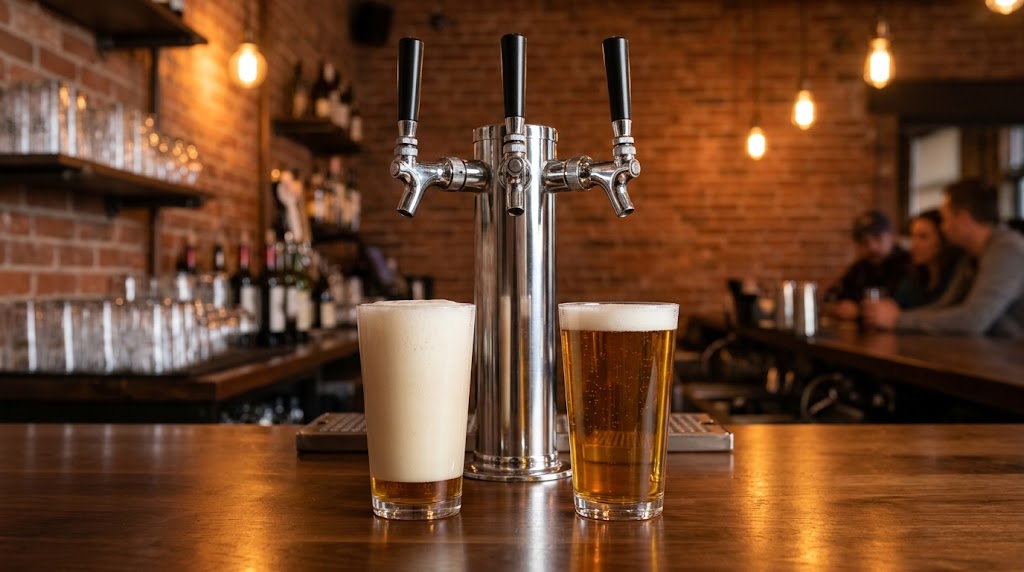
A beer tower (the chrome column rising above your bar) has no cooling of its own unless it’s a glycol-cooled tower or has an integrated tower fan. At ambient bar temperature, a standard tower warms the beer sitting in the shank and faucet between pours. That warm beer can’t hold its CO2, so the first 2 to 4 ounces of each pull foam off.
Two uncooled towers compound the problem. If both are running warm, you lose product at the start of every pour, on both towers, all service long.
Fixes:
- Glycol-cooled towers: The correct long-term solution for a permanent installation.
- Tower fans: They circulate cold air up through the tower.
- Purging the line before each pour: A temporary workaround, but it still wastes product.
A technician can assess which cooling option fits your setup, so don’t attempt a tower modification or glycol line installation without a professional evaluation.
3. CO2 Pressure Out of Balance
Over-pressure forces CO2 out of solution as beer depressurizes at the faucet, producing foam regardless of temperature. Under-pressure leads to flat beer and agitation-driven foam at the tap. Either way, the pour is off.
Pressure (PSI) should be set based on the beer’s carbonation level and the line length. A wrong regulator setting after a keg change or a recent adjustment is the first place to look when foam appears suddenly. Gas is supplied as part of a draft program, and a technician can verify that the regulator matches the system.
Diagnosis: If foam started right after a pressure change or a new keg was tapped, CO2 pressure is the likely cause.
4. Beer Line Length and Resistance
A beer line that’s too short, too wide, or kinked lets beer travel too fast from keg to faucet. The rapid depressurization releases CO2 as foam. Line balance (the relationship between line length, inner diameter, and serving pressure) is a system design question, not something to adjust by trial and error on a commercial system.
If a professionally installed system starts foaming after a layout change, moved equipment, or a new keg type, line balance is worth having a technician check. Learn more about how Denver Beverage handles draft beer, cocktail and wine tap installation for new and upgraded systems.
5. Dirty Lines and Faucet Parts
Bacteria, yeast, and beer stone inside a dirty beer line create points where CO2 escapes as bubbles. The result is foam that feels off, and beer that often tastes wrong too.
The Brewers Association’s Draught Beer Line Cleaning Log guidance describes an overall two-week line-cleaning cycle. If foam appeared gradually over time and the beer tastes off, dirty lines are the likely cause.
A Diagnostic Order That Works
Work through these checks in order before calling for service. Each one is safe to do from the outside of the system, without handling internal lines.
- Keg temperature: Check it with a thermometer placed inside the cooler, not by reading the dial on the unit.
- The tower: Run your hand along the outside between pours. If it’s warm to the touch, the tower is warming the beer sitting in the shank and faucet.
- CO2 pressure: Check the regulator. If it was recently adjusted or a new keg was just tapped, verify the setting matches the system.
- Line cleaning: Check when the lines were last cleaned. If it’s been longer than the two-week cycle, clean first before diagnosing further.
When to Call a Technician
Some foam problems are beyond a DIY fix, and it helps to know which ones. Uncooled towers need equipment changes. A glycol tower upgrade or fan installation isn’t something to attempt yourself on a commercial system, and line balance adjustments need measurement and recalibration by a trained technician.
If cleaning the beer lines doesn’t clear the foam, the cause is likely mechanical, such as a regulator fault, a faucet seal, or a line restriction. Denver Beverage’s own technicians troubleshoot draft systems, including foaming, temperature issues, wild or flat beer, and altitude-related pour problems. The beverage equipment repair team covers the Front Range and the I-70 corridor, with 7-day service coverage and a 24-hour service response.
If your system was never professionally balanced, the checks above only go so far. A full look at your draft beer system installation and service setup, from the keg to the faucet, is the fastest way to find the real source of the foam.
Stop Pouring Money Down the Drain
Every shift you wait costs you more beer. If you’re losing product to foam, it’s worth having a technician look at the system. Call Denver Beverage at 303-295-3737 to schedule a service visit or ask about a glycol tower assessment, or request service online.
Frequently Asked Questions
Why does my draft beer foam only on the first pour?
A warm tower is the likely cause. Beer sitting in the shank and faucet between pours picks up ambient heat. When you pull the tap, that warm beer releases its CO2 right away and comes out as foam. The next pour draws cooler beer from the line and settles down. A glycol-cooled tower addresses this at the source.
Can I fix a foamy tap by adjusting the CO2 pressure myself?
Sometimes, but only if the foam started right after a pressure change. In that case, adjusting back toward the system’s original setting is a reasonable first step. If temperature or line balance is the real problem, changing the pressure won’t fix it and may make things worse. Call Denver Beverage at 303-295-3737 to have a technician verify the regulator setting on a commercial system.
How often should draft beer lines be cleaned?
The Brewers Association describes an overall two-week line-cleaning cycle. If you’re past that window and the beer has started tasting off, clean the lines before diagnosing any other cause of foam. Denver Beverage handles line maintenance and sanitation for commercial draft systems.
What’s the difference between a glycol-cooled tower and a standard tower?
A glycol-cooled tower runs chilled glycol through the tower column, which keeps the shank and faucet cold even during slow service. A standard tower (the chrome column above the bar) has no cooling of its own. The result is a colder pour from the first pull, with less foam from warm beer in the tower.
How do I know if my foam problem is temperature, pressure, or dirty lines?
Timing is the quickest clue. Foam only on the first pour of the night, or on the first pull after a slow period, points to a warm tower or uncooled lines. Foam on every pour right after an adjustment points to CO2 pressure. Foam that appeared gradually over days or weeks, especially with an off taste, points to dirty lines.