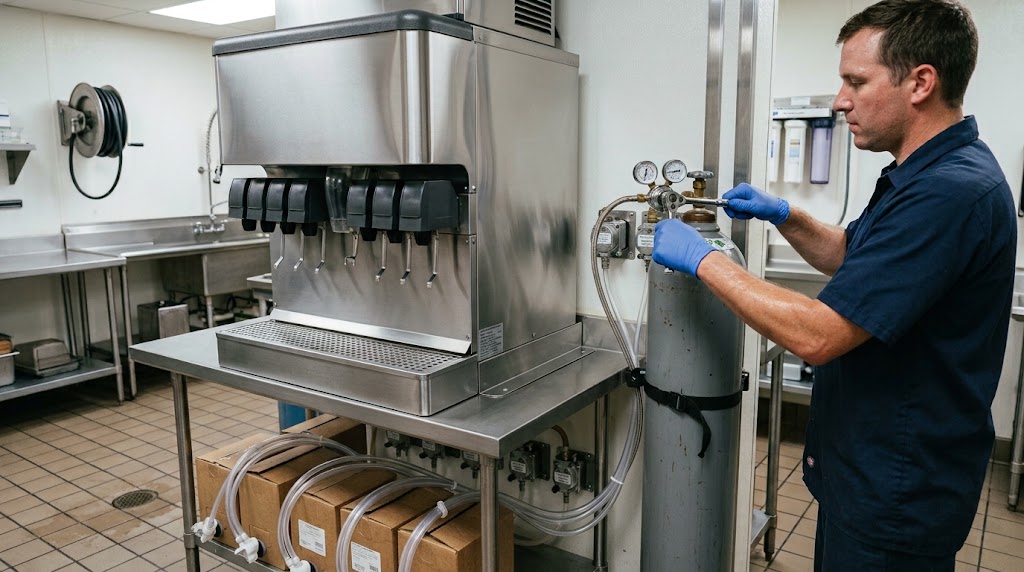
If you run a restaurant or bar in Colorado, a Coca-Cola fountain system is probably one of your highest-volume pieces of equipment, and most operators run one every day without fully understanding how it works. That gap matters. When something goes wrong with product quality, you’ll troubleshoot faster once you know what’s actually happening inside the system, and when you’re evaluating a new setup or switching suppliers, understanding the components means you can ask the right questions before you sign anything.
This guide covers how a post-mix Coca-Cola fountain system actually works, what equipment options exist, how to size a system for your volume, and the operational requirements most suppliers never mention. It’s written for owners and operators, not technicians. For the full picture of how Denver Beverage supports restaurants and bars across Colorado, that’s the page to check.
What Is a Post-Mix Fountain System?
A post-mix system stores syrup concentrate and carbonated water separately, then combines them at the dispense point to produce a finished beverage on demand. Nothing is pre-blended. Every drink is made at the moment you pull the lever.
The alternative is a pre-mix system, where the finished syrup-and-water blend is stored ready to drink, usually in small containers. Pre-mix is simpler but more expensive per serving, takes up more storage space, and isn’t practical at volume. Almost every commercial restaurant fountain setup today is post-mix, and for good reason.
The Five Components and How They Interact
This is where most operators have gaps. Here’s what’s actually inside a post-mix system and how the pieces connect.
CO2 Tank and Pressure Regulator
The CO2 tank supplies the gas that makes carbonation possible, and its pressure changes as it empties:
- Full tank: more than 800 PSI
- Working pressure (after the primary regulator steps it down): 95 to 105 PSI for soda applications, with a secondary regulator sometimes reducing pressure further on individual lines
- Replace the tank: once it reads below 200 PSI
Don’t wait for product to go flat mid-service to make the swap. For more on CO2 supply, sizing, and cylinder handling, see Denver Beverage’s beverage gas supply page.
Water Filtration System
Filtered water isn’t optional here, it’s a precondition for the whole system working right. Municipal water hardness varies a lot across Colorado, and once it climbs above 17 grains per gallon (gpg), you’ll start seeing carbonate scale build up inside the water bath and carbonator, which drags down both carbonation quality and how long the equipment lasts.
NSF/ANSI-certified filtration is the standard for beverage dispensing, and skipping it in a hard-water market is the single most common self-inflicted quality problem in fountain setups.
Carbonator Pump
The carbonator pump is what actually makes your soda fizzy: it forces filtered water and CO2 together inside a pressurized vessel, then the resulting carbonated water gets chilled before it reaches the valve. This is why consistent CO2 pressure matters so much. Let it drop below the working threshold, and carbonation weakens, so the drink arrives flat at the glass.
Bag-in-Box Syrup and Syrup Lines
Bag-in-box syrup, or BIB, is beverage concentrate sealed inside a bag inside a cardboard box. A syrup pump draws that concentrate through syrup lines to the dispense valve, where it mixes with carbonated water at a set ratio to produce the finished drink.
BIB has replaced pre-mix as the commercial standard for three reasons:
- Longer shelf life
- A much smaller storage footprint
- Lower per-serving cost at volume
A typical BIB box replaces what would otherwise take many cases of pre-blended product.
Nozzle and Valve Assembly
The nozzle and valve assembly is where syrup and carbonated water actually combine, and it’s the single point that determines whether your drink tastes right. The valve sets the syrup-to-water ratio, and that calibration gets measured as Brix level with a refractometer, typically 11.5 to 12.5 for cola products.
One thing worth being clear on: the valve is the calibrated component, not the BIB pump. The pump just moves syrup; the valve controls ratio. So if your product’s tasting off and the BIB isn’t empty, the valve calibration is where to look, not the bag.
Equipment Types: What’s Actually Different Between Them
Choosing the right physical configuration is a practical decision, not a spec-sheet exercise. Denver Beverage installs and services Cornelius and Lancer fountain equipment across the configurations below. Here’s what each format actually means for your operation, plus links to Denver Beverage’s beverage equipment page if you want to go deeper on specific models.
- Counter electric: A self-contained unit that sits on your countertop and handles both refrigeration and dispensing in one box. It’s a good fit for lower-volume operations or spaces where a dedicated back-of-house setup just isn’t practical.
- Tower: A dispense tower mounted on the counter, connected to a remote refrigeration unit elsewhere. The tower itself stays slim since the refrigeration equipment lives out of sight, which is why you’ll see this setup a lot in bars and busy casual-dining spots where counter space is tight.
- Soda gun (bar gun): A handheld dispenser on a flexible hose, used almost exclusively at bar stations. It’s fast and compact, but the hose and nozzle need regular cleaning attention to stay that way.
- Draft arm: A fixed-mount dispenser, usually wall- or counter-mounted, for wherever a permanent dispense station makes sense. You’ll see this as the standard in high-volume quick-service settings.
- Coca-Cola Freestyle: Worth calling out as its own category. The machine is a touchscreen-driven platform offering 100-plus flavor combinations, and it runs on a completely different supply chain, flavor cartridges instead of standard BIB syrup. That makes it a separate equipment and supply decision from a standard post-mix setup. If you’re considering Freestyle for your location, that conversation starts with your Coca-Cola representative, not your standard fountain supplier.
Sizing a System for Your Volume
Getting system size right is a real operational decision. Undersize it and you’re rationing pours through your busiest hour. Oversize it and you’re paying for capacity and BIB inventory you’ll never actually use. Here’s a practical framework built around your actual numbers, not a guess.
- Estimate your daily ounce volume: start with covers per day, multiply by your average beverage attachment rate (how often a guest orders a fountain drink), then multiply by average serving size in ounces. A casual-dining restaurant doing 200 covers at 60% beverage attachment with a 16-oz average drink is moving roughly 1,920 oz of fountain product a day.
- Translate that to BIB consumption: a standard 5-gallon BIB box yields roughly 30 gallons of finished product at a typical syrup-to-water ratio. At the volume above, a single cola flavor burns through close to one box every three to four days, so plan your restocking frequency around that instead of guessing.
- Match valve count to simultaneous demand: a bar station hitting peak drink orders needs more valves than a quiet café. It’s not really about total daily volume, it’s about how many drinks need to pour at the same time during your busiest 30 minutes.
- Decide on a single versus remote setup: for lower-volume operations, a single counter-electric dispenser is often enough. As volume climbs, a remote system separates the refrigeration unit from the dispense head, so you can place the dispenser where guests or staff actually need it while the mechanical equipment stays out of the way. Higher-volume restaurants sometimes run multiple dispensers across different service stations.
Operational Requirements the SERP Ignores
Most equipment suppliers don’t cover these three areas at the point of sale. That’s a problem, because each one can create real operational headaches after installation.
CO2 Handling in Commercial Indoor Spaces: CO2 cylinders in commercial foodservice settings fall under OSHA’s compressed gas cylinder handling requirements (29 CFR 1910.101), which include securing cylinders against tipping and maintaining adequate ventilation in semi-enclosed spaces. This isn’t a bureaucratic detail. A CO2 leak in an enclosed back-of-house area or walk-in is a real safety risk. Confirm that wherever you’re storing your CO2 tank meets these requirements before the system goes live.
Water Quality as a Precondition: Skipping a pre-filter in a hard-water market doesn’t just affect taste. It can void equipment warranties and accelerate scale buildup in the carbonator and water bath. NSF/ANSI-certified filtration is the standard for commercial beverage dispensing applications.
If you’re not sure about your local water hardness, your water supplier or equipment technician can tell you. Much of Colorado’s municipal water supply runs hard enough to make filtration necessary, not optional.
Health Department Equipment Review: Installing a fountain dispenser in a commercial foodservice setting in Colorado typically means a health department equipment plan review, and dispensing equipment often needs NSF/ANSI 18 certification to pass inspection. Suppliers don’t always mention this upfront, so it’s on you to confirm it with your local health authority before installation, not after. Colorado counties vary, so check what’s required where you are.
If a system problem does come up after setup, Denver Beverage’s commercial kitchen and beverage equipment repair service covers the Front Range seven days a week. And if you want a fast diagnostic path for common fountain issues before you call for service, the fountain and bar gun troubleshooting guide covers the most common symptom categories.
Talk to a Coca-Cola Fountain Specialist at Denver Beverage
Denver Beverage has been a Coca-Cola foodservice distributor in Colorado since 1986, today one of the largest independent Coca-Cola distributors in the state and a member of the International Beverage Dispensing Equipment Association (IBDEA). If you want help sizing, installing, or troubleshooting a fountain program for your specific restaurant, that’s the conversation to have with our beverage programs team.
Frequently Asked Questions
What is the syrup-to-water ratio in a Coca-Cola fountain machine, and how is it measured?
The ratio is set at the valve and measured as Brix level with a refractometer, typically 11.5 to 12.5 for cola products. If your product is tasting weak or overly sweet even though the BIB syrup and CO2 both check out, the valve calibration itself is almost always the culprit, not the ingredients feeding it.
How do you set up a Coca-Cola bag-in-box fountain system?
A Coca-Cola bag-in-box system connects your CO2 tank through a pressure regulator to the carbonator, runs filtered water into that same carbonator, connects BIB syrup through syrup lines to the dispense valve, and routes the chilled carbonated water and syrup to the nozzle together. In a commercial setting, though, this isn’t a DIY install, equipment placement, line runs, and calibration are handled by a qualified technician.
What supplies do you need to keep a soda fountain system running?
Keeping a soda fountain running takes four ongoing consumables: BIB syrup boxes (one per flavor), CO2 tank refills, replacement water filters, and cleaning supplies for the nozzles and lines. Add a refractometer to that list if you’re doing your own Brix checks. Most operators let a supplier handle restocking on a regular schedule rather than managing it order by order.
How often should soda fountain lines be cleaned and sanitized?
Nozzles and diffusers need to come off and get cleaned daily, and full line sanitization typically happens weekly, though your local health department’s specific requirement is what actually governs it. Skipping this is one of the fastest ways to pick up a health inspection flag, and it lets mold or yeast develop in the lines, which shows up directly in the taste of your product.
Does fountain Coke taste different from bottled Coke, and why?
Yes, it can, and water quality is usually why. A post-mix system makes the finished drink from your local water, so that water’s mineral profile affects the taste directly. A properly calibrated system with filtered water and the correct Brix level is designed to taste like Coca-Cola’s actual spec, so if your fountain Coke tastes noticeably off from the bottle, check your water filter and valve calibration before assuming it’s a supply problem.