Most facility and safety managers who call Denver Beverage start the conversation the same way: “We need a soda fountain,” or “Can you set up a sports drink station for our workers?” Both are reasonable starting points. What changes the calculus is scale, shift structure, and where on the floor your workers actually spend their time.
Industrial facilities that ask for a soda fountain or a sports drink station often end up with a bottleless Bevi water machine instead. This guide walks through why and how to think through the same decision for your facility.
Why Hydration Planning Looks Different in a Warehouse
An office break room and a warehouse floor are not the same hydration problem. In a warehouse or industrial facility, three factors compound in ways that don’t apply to a desk environment:
- Heat and exertion: Heat exposure and physical exertion speed up fluid loss far faster than sedentary work. OSHA’s Heat Illness Prevention campaign identifies heavy physical activity and warm or hot conditions as primary occupational risk factors for heat illness. Indoor industrial areas, especially loading docks, picking lines, and spots near large equipment, can reach temperatures that trigger these risks even without direct sun.
- Shift length and volume: A large crew cycling through multiple shifts means your hydration stations need to handle throughput that would overwhelm equipment designed for a small office. A single countertop unit that works fine at 9 a.m. becomes a bottleneck at shift change.
- Worker movement: In a warehouse, workers often can’t leave their zone for long. If the nearest water source is a long walk away, it won’t get used at the rate it should. Hydration has to be reachable from where the work happens, not just from where it’s convenient to plumb a machine.
Under OSHA 29 CFR 1910.141(b), general industry employers must provide potable water at no cost to workers. That’s the compliance baseline. The operational question is whether your current setup actually meets it in practice, across every zone and every shift.
Choosing the Right Hydration Station: Three Options Compared
Here’s an honest look at the three options facility managers most often evaluate. None of them is universally right. The best fit depends on your floor layout, headcount, and how your shifts run.
Soda Fountain / Coca-Cola Fountain Dispenser
A soda fountain is a high-capacity, familiar piece of equipment. It works well in a dedicated break room or cafeteria with predictable traffic and a fixed plumbed location. Workers come to it, fill up, and return.
The limitation in a warehouse is exactly that: it’s a fixed destination. On a large floor or dock, a single fountain means travel that may not be realistic mid-shift, and it isn’t designed for distributed placement. If your facility has a central cafeteria or a well-defined break space with high throughput, a fountain is a strong option. If your floor is very large with multiple zones, it’s probably not enough on its own.
Denver Beverage supplies Coca-Cola fountain programs for commercial accounts. Our filtered water and ice programs page covers the broader water and dispensing options we offer.
Countertop Sports Drink Station
This is the intuitive first answer for high-exertion industrial work, and it’s not wrong. Electrolyte replenishment matters in physically demanding environments, and workers are more likely to drink something with flavor and variety than plain water when they’re hot and fatigued.
The catch is what it takes to keep one running at industrial scale. With three shifts and dozens of workers per station, restocking, rotating product, and managing waste turn into a daily chore. A countertop sports drink station works well as a supplement to your main hydration setup, but it’s a tough fit as the only source for a large crew. If you’re weighing one for your site, Denver Beverage can tell you what’s currently on the program for your location.
Bevi Smart Dispenser (Bottleless)
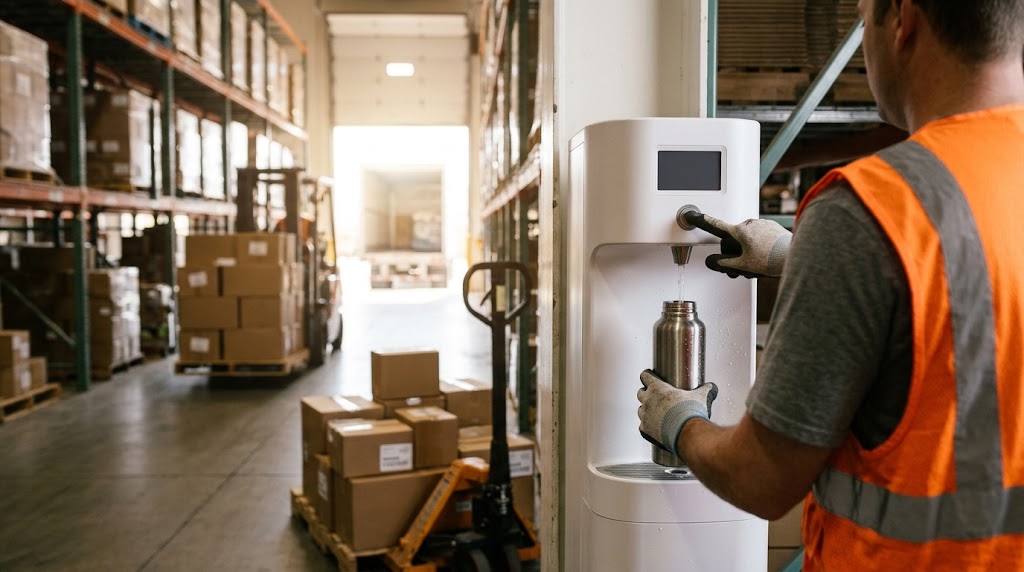
A Bevi is a bottleless machine that connects directly to your water line. There are no bottle deliveries and no restocking runs for water. Workers get filtered still, sparkling, and flavored water on demand. Bevi also reports usage, so a facility manager can see whether stations are getting used and where demand is highest.
Siting and throughput are usually what tip the decision toward a Bevi. It can be placed closer to the work floor than a plumbed fountain, and it handles continuous use without the bottle runs a water cooler needs. That makes it a good fit for a large floor with several work zones.
Where to Put Hydration Stations on a Warehouse Floor
Placement is where industrial hydration planning gets specific. For indoor warehouse environments, four things matter most:
- Maximum travel distance: NIOSH guidance on working in heat recommends about a cup of water every 15 to 20 minutes in high-heat conditions. If the nearest dispenser means a long round trip from the work zone, workers won’t hit that intake rate. Space stations for realistic walking time during active work, not just for whether a unit is technically on the premises.
- Zone-based placement: Loading docks, picking lines, and areas near heat-generating equipment are where hydration matters most. A centralized break room station serves workers well during scheduled breaks. It doesn’t serve them when heat stress risk is highest, which is during continuous work in high-exertion zones.
- The shift-change bottleneck: A single centralized station creates a pile-up when a large crew rotates out at the same time. Multiple distributed units solve this, and a second or third unit is often worth it compared with the friction of a long queue.
- Glove-friendly operation: Where PPE or gloves are standard, ask how easily workers can use a dispenser without removing them. Workers who have to take their gloves off often won’t bother.
Water Temperature and Why It Matters
Water that’s pleasant to drink gets drunk. In a hot warehouse, cool water in the range of 15 to 21°C is consumed at higher rates than ambient-temperature water. That’s a physiological effect, not just a preference.
When you’re choosing between a passive dispenser and a chilled unit, that difference has real procurement implications. Ask whether the equipment you’re considering can deliver cool water. Bevi units dispense chilled water, and Denver Beverage can walk you through what each option provides.
Sanitation and Multi-Shift Maintenance
When a whole crew shares the same dispenser across several shifts, keeping it clean becomes a real responsibility. The common failure is simple: if no one shift clearly owns the cleaning, it doesn’t get done consistently. Assigning ownership at the zone level goes a long way toward solving it.
Good equipment helps, but it only goes so far. For any dispensing equipment Denver Beverage installs, our own CFESA-trained technicians handle installation, maintenance, and repair, not third-party subcontractors. If something needs attention, the same local team that installed it takes the service call.
Denver Beverage offers 7-day service coverage and a 24-hour service response. For a multi-shift facility, that matters, because equipment can’t sit down for days waiting on a technician. Our commercial kitchen and beverage equipment repair team handles ongoing service across the Front Range and the I-70 corridor.
Keeping a high-throughput site healthy takes more than having water available. The equipment has to stay clean, stay running, and get serviced quickly when it doesn’t.
Ready to Plan Your Hydration Stations?
If you’re evaluating hydration stations for a warehouse or industrial facility on the Front Range or the I-70 corridor, Denver Beverage’s team can walk through your floor plan and headcount and recommend what actually fits. Call 303-295-3737 or request a quote online.
FAQ
What does OSHA require for drinking water access on industrial sites?
OSHA requires employers to provide potable water at no cost to workers, and the water must meet drinking water standards set by the relevant state or local authority. The standard doesn’t prescribe the number of stations or their location. OSHA’s Heat Illness Prevention guidance does make clear that accessible, cool drinking water near work areas is the operational expectation, not just a tap somewhere in the building.
How many hydration stations do I need for my workforce?
There’s no single formula. NIOSH guidance recommends about a cup of water every 15 to 20 minutes in high-heat conditions, and that intake rate is only realistic if workers can reach water without a significant detour. For a facility with multiple high-exertion zones or a large crew per shift, a single centralized station is typically not enough. Denver Beverage can review your floor plan and headcount and give you a specific recommendation, so call 303-295-3737.
What’s the difference between a Bevi and a standard soda fountain for a warehouse?
A soda fountain is a fixed, plumbed installation designed for break room or cafeteria use, and it works well when workers come to it. A Bevi is also plumbed to a water line but is designed for flexible placement, handles continuous high-volume use without the bottle runs a water cooler needs, and dispenses still, sparkling, and flavored filtered drinking water. On a large industrial floor where travel distance matters, placement flexibility is usually the deciding factor.
Do Bevi units need to be plumbed in, or can they run without a water line connection?
Bevi machines need a water line connection. Installation takes planning and isn’t immediate, and Denver Beverage handles it with its own technicians. If your facility doesn’t have water access near the intended placement zone, that’s part of the site assessment conversation before any install is scheduled.
Does Denver Beverage install and service hydration equipment at warehouse and industrial sites?
Yes. Denver Beverage supplies, installs, and services water dispensing equipment for commercial accounts, including warehouses and industrial facilities, on the Front Range and the I-70 corridor. Installation is handled by Denver Beverage’s own technicians, with 7-day service coverage and a 24-hour service response. You can also explore our office coffee service for facilities that want to add a coffee or beverage program alongside their water solution.