If you’re stocking an office pantry for the first time, or rebuilding one that nobody uses, finding a list of healthy foods isn’t the hard part. The hard part is figuring out what works in a shared space, for a team with different needs, on a budget that has to justify itself.
This guide is written for office managers making that call. It covers which snack categories to anchor your pantry around and how to handle dietary restrictions without building a specialty shelf. It also shows how to think about quantity and replenishment before you place your first order.
Start With the Anchor Categories, Not the Trending Items
The most common mistake when stocking a new pantry is leading with variety instead of reliability. A pantry that works starts with a small number of high-satisfaction, shelf-stable staples. Rotating or premium items come later, once you know the base is solid.
Mixed nuts and seeds
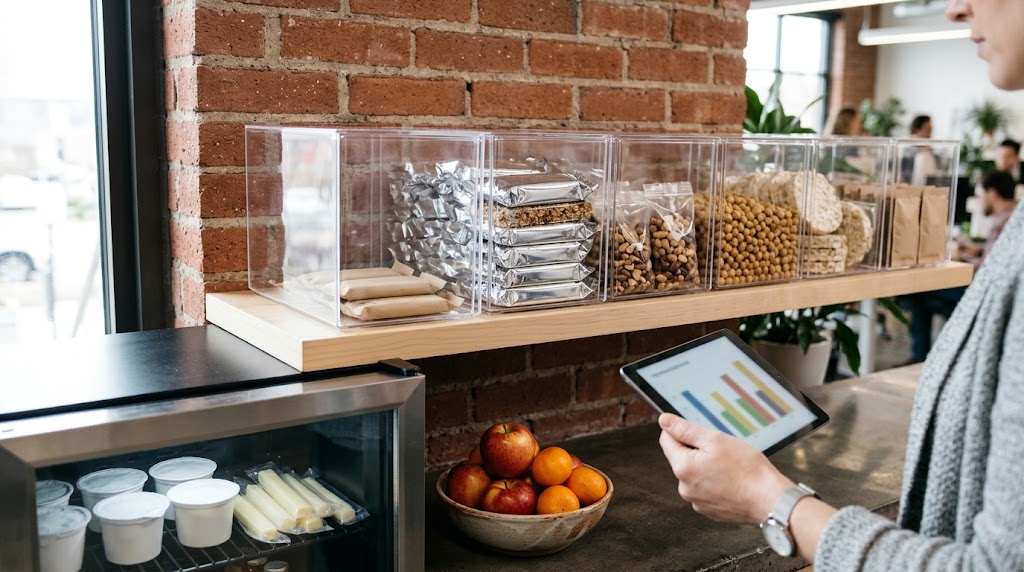
Mixed nuts and seeds are among the most satisfying healthy office snacks you can stock. They’re shelf-stable for months and need no prep. They also come in portion-controlled individual bags that cut down on waste, and they cover protein, healthy fats, and enough calories to actually satisfy.
Nut-free alternatives belong here from the start. Roasted chickpeas, sunflower seeds, and pumpkin seed mixes are solid substitutes for employees with tree nut or peanut allergies. Put them in the base selection, not in a separate allergy corner.
Whole Grain Crackers and Rice Cakes
Whole grain crackers and rice cakes are low-waste and compatible with most dietary profiles. They pair well with dips or protein options, and they don’t need refrigeration. They stay crisp in a sealed container, and they cover the “something crunchy” craving that a lot of afternoon snacking is really about.
Granola Bars and Oat-Based Bars
Granola bars are the fastest, most familiar snack in any shared pantry. Most dietary profiles can find at least one bar that works, from standard oat bars to gluten-free or vegan options. They’re individually wrapped, easy to restock, and long-lasting. Start with two or three varieties that cover different calorie ranges and sweetness levels, then adjust based on what disappears first.
Add Protein-Rich Snacks to Prevent the Mid-Afternoon Slump
Most office pantries underinvest in protein-rich snacks. A snack built mostly on carbohydrates gives you quick energy, and then your blood sugar drops sharply. Protein and healthy fats take longer to digest, so energy holds more steadily through the afternoon. That’s why the mid-afternoon slump is often a pantry design problem as much as a personal discipline one.
Jerky and meat sticks
Jerky and meat sticks are high in protein, fully shelf-stable, and need no refrigeration. They’re one of the most practical protein-rich snacks for a shared office because they don’t spoil, need no prep, and hold up in a pantry basket for weeks.
Individual nut butter packets
Single-serve nut butter packets pair well with crackers or fruit and deliver protein and healthy fats without a refrigerator. For employees who can’t eat tree nuts or peanuts, look for options made with seeds, such as sunflower or pumpkin. Stock these alongside the nut-based versions, not instead of them.
Protein bars
Protein bars vary widely in quality and sugar content. Check the protein and the sugar on the label, and make sure the sugar isn’t offsetting the protein. A useful rule of thumb is to look for options with at least 8 to 10 grams of protein. Stocking two or three bar types gives employees a real choice instead of a single default.
Cover the Dietary Restrictions Your Team Actually Has
Dietary restrictions are a planning variable, not an afterthought. If someone with a nut allergy or gluten sensitivity can’t find anything to eat in your pantry, the pantry fails for that person every single day. Building coverage into the base selection is more practical than running a specialty shelf alongside the main one.
Nut-free options
Roasted chickpeas, seed-based trail mix, fruit snacks, and plain rice cakes are all naturally nut-free. They fit into the standard rotation without separate signage or storage. Label the snack station clearly regardless. Even when a product is certified nut-free, employees with severe allergies need to know that before they pick it up.
Gluten-free options
Most whole nuts and seeds, many protein bars, plain popcorn, and dried fruit are naturally gluten-free. These overlap heavily with the anchor and protein categories above, so gluten-free coverage doesn’t need its own section of the pantry. It takes reading labels and choosing products that work for both groups.
Vegan and dairy-free options
Most of the shelf-stable items above are vegan by default. The exception worth noting is protein bars, since many contain whey, which is dairy-derived. If you have vegan or lactose-intolerant employees, check the label before adding a bar to the rotation. Plant-based protein bars are widely available and can substitute directly.
Fresh Options: Worth It If You Can Manage Them
Greek yogurt, fresh fruit, hummus and vegetables, and cheese sticks round out a well-stocked pantry. They’re also some of the most popular nutritious snacks when they’re available. The tradeoff is management overhead. Perishable snacks need a working refrigerator and someone actively rotating stock.
The food safety guideline is simple:
- Refrigerate: Keep perishables at 40 degrees Fahrenheit or below.
- Discard: Throw out anything left at room temperature for more than two hours.
That’s standard food safety practice, not a high bar. It does mean fresh fruit in a bowl and Greek yogurt in a fridge need different levels of attention. Both need someone checking them regularly.
If your office has a reliable restocking system, fresh options are worth the effort. If restocking is inconsistent, lean on shelf-stable items and treat fresh fruit as a supplement. A pantry with great shelf-stable options that are always available is more useful than one with fresh items that go bad.
How Much to Stock, and How Often to Replenish
This is the planning step an office manager needs before placing an order. Four rules of thumb get you started:
- Quantity per person: Plan for one to two snack items per person per day, adjusted for how often employees are actually on-site. A 30-person office where most people are in three days a week needs a different quantity than one where everyone is in five. Use your real headcount and in-office pattern, not the building’s total capacity.
- Shelf-stable items: Buy these in larger quantities and replenish monthly without much risk of waste.
- Fresh items: These need weekly or twice-weekly attention at minimum.
- What runs out first: If the protein bars are gone by Wednesday and the granola bars last until Friday, that’s employee feedback without a survey. Rotate new varieties in against the staples, not instead of them. Keep the anchor items consistent and experiment with one or two new options per order cycle, not the whole selection each month.
For offices that don’t want to manage this calculation themselves, a managed office snack and pantry service turns the pantry into an employee benefit you don’t have to run. The vendor handles consumption monitoring, ordering, and restocking on a schedule, so the pantry stays full without the manual overhead.
If you’re also thinking about coffee and beverages alongside snacks, Denver Beverage’s office coffee service covers bean-to-cup equipment, local and national coffee brands, and everything that goes with it. For offices that want a fully self-service, cashless option beyond a pantry, micro markets are the next step up, with no upfront cost to install for qualifying locations.
Let’s Stock Your Pantry
Once you know what your team will actually eat, the next question is who keeps the shelves full. If that’s not a job you want, a managed pantry takes it off your list, from choosing the snacks to restocking them. Call 303-295-3737 to find out what’s on the program today, or request a consultation and we’ll talk through what it would look like for your office.
FAQ
What are the best non-perishable snacks for a healthy office pantry?
The strongest non-perishable choices are individual bags of mixed nuts and seeds, whole grain crackers, granola and oat-based bars, jerky and meat sticks, and individual nut butter packets. Together they cover protein, healthy fats, and enough variety for most dietary profiles. They’re shelf-stable for weeks to months, which makes them practical to buy in bulk and restock monthly.
How do I stock a pantry that works for employees with nut allergies?
Build nut-free options into the standard rotation instead of creating a separate allergy section. Roasted chickpeas, seed-based trail mixes, fruit snacks, and rice cakes are all naturally nut-free and fit alongside the main selection. Label the snack station clearly so employees with severe allergies can spot safe options quickly. For nut butter packets, stock nut-based and seed-based versions side by side.
How often should an office pantry be restocked?
Shelf-stable items need restocking less often than fresh items, which need regular attention. As a rule of thumb, plan for one to two snack items per person per in-office day, based on your team’s actual on-site pattern. Track what runs out first, because that tells you more about preferences than any survey.
What’s the difference between a managed pantry service and ordering snacks yourself?
With a managed pantry service, the vendor handles inventory tracking, ordering, and restocking. When you order yourself, all of that lands on you, on top of your other work. The tradeoff is that you choose from the vendor’s product range instead of hand-picking every item. Denver Beverage’s office snack and pantry program works this way, so call 303-295-3737 to find out what’s on the program today.
How do I know which snacks employees actually want?
Watch what runs out. If one item is gone by midweek while another sits untouched until restock day, that’s a clear signal. You can also run a short Slack poll or send a brief email survey asking about preferences and dietary restrictions. Keeping two or three rotating “try it” items alongside consistent staples lets you test new options without overhauling the whole selection.