Your employees have asked for Starbucks by name, and now you’re trying to figure out what a Starbucks coffee program actually looks like for your office. It’s not one machine, it’s a handful of formats, and the right one depends on your headcount, how your office break room actually gets used, and whether this is a free perk or something employees pay for at the machine.
This piece walks through all three equipment options, what Denver Beverage handles as an authorized Starbucks placement partner, and enough on cost to help you self-qualify before you talk to anyone.
Starbucks Coffee Machine Options for Your Office
Starbucks for Business isn’t one machine, it’s three distinct formats, each built for a different kind of workplace and usage pattern.
Starbucks Serenade (bean-to-cup, self-serve)
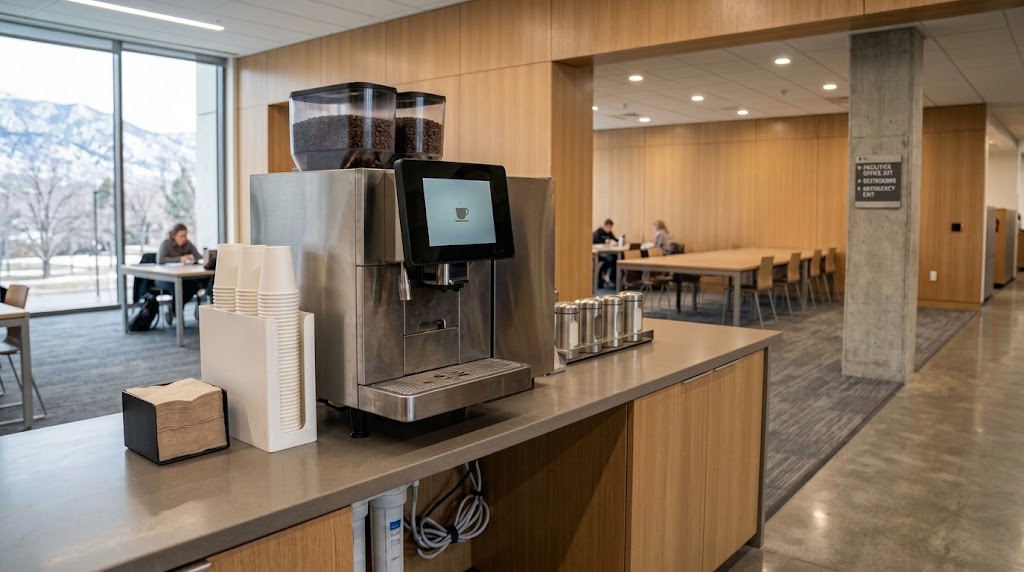
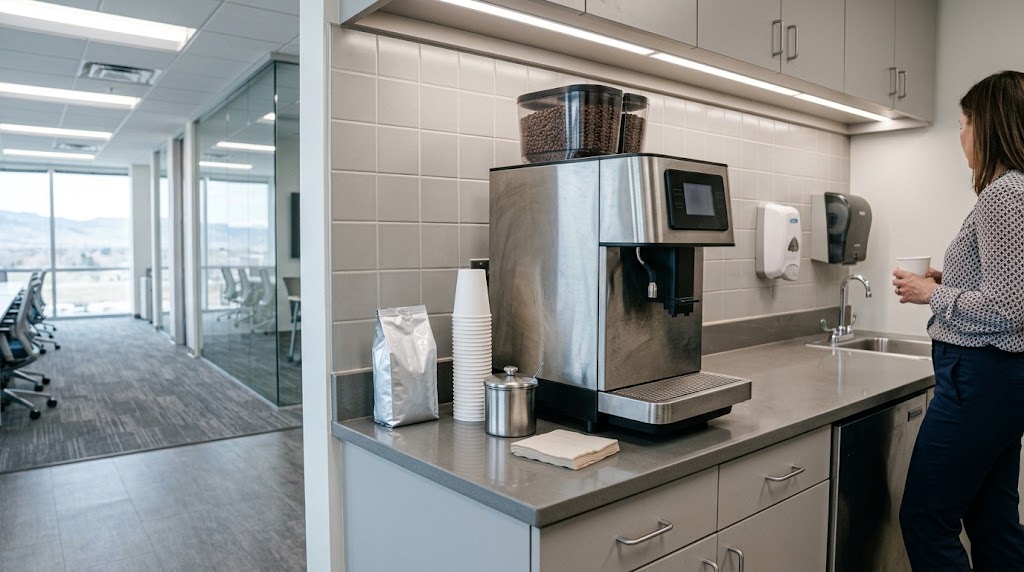
- What it is: A self-serve bean-to-cup machine with a 17-inch touchscreen that grinds whole beans per cup and brews hot coffee, iced coffee, lattes, and chai, no barista required.
- Best for: Mid-to-large office deployments, where the Serenade is typically the anchor product.
- Capacity: Runs at 50 cups per hour, which makes throughput the real sizing question, a 75-person office with a relaxed morning routine is a very different fit than a 250-person office where half the floor hits the break room between 8:00 and 9:00 AM. More on sizing below.
Single-serve options (K-Cup / pod formats)
- What it is: A single-serve coffee maker with a smaller counter footprint, lighter electrical requirements, and no plumbing connection needed.
- Best for: Offices under 50 people, executive suites, and conference rooms where demand is occasional rather than steady, a distinct format, not a downgrade.
- Where it fits best: Secondary break rooms even when a Serenade handles the main one, especially in offices with multiple small break rooms across different floors or departments.
Starbucks Pike Place brewed coffee (filter/batch format)
- What it is: A batch-brew format supplied as fractional pre-measured packs, so dosing stays consistent without weighing beans or guessing at ratios.
- Best for: Large team meetings, all-hands events, and catering setups where individual cup-by-cup brewing would create a queue nobody wants.
- Why it works: It’s the format most offices already know from catered meetings, and it handles volume that bean-to-cup equipment isn’t designed for.
Understanding which of these three Starbucks coffee machine formats fits your situation is the first real decision in setting up an office coffee solution.
What Denver Beverage Handles and What You Don’t Have To
Office managers evaluating a workplace coffee program aren’t shopping for a machine to manage themselves. They’re buying a corporate coffee service where the operational weight sits with the supplier. Here’s what Denver Beverage takes off your plate as an authorized Starbucks placement partner.
Equipment placement
Denver Beverage supplies and installs the equipment. Your office doesn’t purchase the Starbucks coffee machine outright. Placement is part of the program, which means the Serenade or whichever format fits your office arrives, gets installed, and is ready to use without a capital purchase approval or an asset on your balance sheet.
Starbucks coffee supply
Ongoing coffee delivery is scheduled, not ad hoc. Depending on your format, that means whole-bean Starbucks deliveries for the Serenade, K-Cups for single-serve setups, or fractional packs for batch brew. Your team doesn’t manage reorder points or chase invoices from a separate supplier.
Preventive maintenance and service
Denver Beverage’s 13 field technicians handle preventive maintenance and repairs. Equipment service runs 7 days a week across the Front Range. Coffee machine maintenance isn’t something your facilities team needs to schedule or coordinate. If the equipment goes down on a Saturday, that’s still covered.
Water filtration
Bean-to-cup equipment requires filtered water for consistent cup quality and to protect the machine itself. Denver Beverage installs the water filtration connection at setup. It’s part of installation, not an add-on you arrange separately.
If you’d like to see what a single-source office coffee service looks like for your headcount and location, that conversation starts with Denver Beverage’s team.
How Costs Are Structured
There’s no universal price list for a Starbucks workplace coffee program, because the variables that drive cost are specific to your office. Here’s what you need to understand before a supplier conversation.
Market reference on the Serenade
Publicly available pricing for comparable bean-to-cup placement equipment runs into the five figures. That figure is useful context for understanding why most offices access this equipment through a managed placement program rather than a capital purchase.
For most office managers, an equipment line item at that scale requires a capital budget approval cycle that a managed program sidesteps entirely.
Ongoing costs
Ongoing costs in a managed workplace coffee program cover coffee supply (beans, pods, or packs depending on format) and service and maintenance. These are structured as part of the program, not separate invoices your team is chasing from multiple vendors. An office coffee subscription model means one supplier relationship covers the equipment, the supply, and the service.
How volume affects cost
Cost scales with consumption. A 100-person office running the Serenade as a free employee perk has a different cost profile than a 300-person office where the machine operates as a paid amenity with credit-card payment at the machine. The format you choose, your headcount, and whether the program is subsidized or employee-funded all factor into what an actual quote looks like.
What produces a real number is a supplier conversation. Denver Beverage can quote based on your headcount, your usage pattern, and which format fits your office. See our coffee brewing equipment page for more on the equipment side of the program.
Sizing the Right Starbucks Format to Your Office
The 50-cup-per-hour throughput of the Serenade is the number that matters most when you’re deciding which format fits your office. A 50-person office with staggered arrival times is a very different throughput scenario than a 300-person office with a compressed morning window.
Use the table below to match your situation to the right format before talking to a supplier.
| Office situation | Best-fit format | Why |
| 50 to 150 employees, free employee perk, morning peak | Starbucks Serenade (bean-to-cup) | 50 cups/hour handles a moderate morning rush without queuing |
| Fewer than 50 employees, or executive suite / meeting-room use | Single-serve (K-Cup / pod) | Lower throughput, smaller footprint, no plumbing required; suited to occasional demand rather than a sustained morning rush |
| Large team meetings, all-hands events, client catering | Pike Place brewed / fractional packs | Batch format scales for groups; individual brewing doesn’t; pre-measured packs keep preparation consistent |
Offices spread across multiple floors, or with a main break room plus a few smaller satellite areas, often do better with a mixed setup than a single format: a Serenade for the main break room, single-serve for the conference rooms and executive suites where demand is lighter.
Installation and Facilities Requirements
Before installation day, your facilities team needs to confirm two things for a bean-to-cup setup. Getting these sorted in advance means the installation goes in cleanly without a return visit.
Electrical
The Serenade requires a standard 120V / 15-amp outlet. A dedicated circuit is strongly recommended for commercial use. Your facilities team should confirm this with your building’s electrician before installation, not after. In many office buildings, the nearest outlet in a break room is already shared with a refrigerator, microwave, or dishwasher, which makes a dedicated circuit worth verifying upfront.
Water line
Bean-to-cup equipment needs a water line connection. Denver Beverage installs the water filtration connection at setup, so your team doesn’t need to arrange that separately. Your facilities team just needs to confirm that a water line is accessible in or near your break room before the installation date.
Single-serve and batch-brew formats
Single-serve and Pike Place batch-brew setups have lighter requirements. Neither needs a plumbing connection, and both work with a standard outlet without a dedicated circuit. If a dedicated circuit or water line access isn’t practical in your break room, either of these formats keeps a Starbucks branded coffee option available without the infrastructure requirement of a bean-to-cup machine.
Rounding out your break room beyond coffee is straightforward through Denver Beverage’s breakroom supplies and snacks and pantry supply programs, both of which run on the same scheduled delivery model as the coffee supply.
What’s Next: Getting a Quote for Your Office
Every Starbucks program is priced around your headcount, format, and usage, so the real next step is a conversation, not a guess. Denver Beverage’s office coffee service team can put together what that looks like for your office. Talk to Denver Beverage’s coffee team for a quote.
Frequently Asked Questions
Can you get a Starbucks coffee machine for your office?
Yes, through an authorized Starbucks placement partner like Denver Beverage, Colorado offices can access Starbucks equipment as part of a managed program that covers equipment placement, coffee supply, and preventive maintenance. That means no capital purchase approval required and no equipment asset on your balance sheet.
How much does a Starbucks office coffee program cost?
Costs depend on the equipment format you choose and your consumption volume. Comparable bean-to-cup placement equipment runs into the five figures at retail, which is why most offices access it through a managed placement program instead of a capital purchase. A supplier conversation with Denver Beverage turns that into an actual quote based on your headcount and usage pattern.
What is the Starbucks Serenade?
The Serenade is Starbucks’s self-serve bean-to-cup machine built for commercial settings like offices and hotels. It grinds whole beans per cup, brews hot and iced drinks including lattes and chai, and uses a 17-inch touchscreen for self-service ordering. Running at 50 cups per hour, it’s built for offices with a moderate to active morning peak.
Does Starbucks offer a business coffee subscription service?
No, not directly. Starbucks doesn’t sell to most businesses on its own, workplace programs run through authorized distributors and placement partners instead. In Colorado, Denver Beverage manages equipment placement, scheduled supply delivery, and 7-day equipment service as a single-source corporate coffee service, so there’s no separate Starbucks business subscription to manage on your end.
How do you set up a Starbucks coffee station in the workplace?
Through Denver Beverage, setup covers equipment placement, water filtration installation, and initial supply stocking. Before installation day, your facilities team needs to confirm a dedicated 120V/15-amp circuit and water line access for a bean-to-cup setup, single-serve and batch-brew formats have lighter requirements and don’t need a plumbing connection.