If you’re evaluating a Starbucks coffee program for your business, you already know what the brand does for guest perception. The real question isn’t whether Starbucks belongs in your operation. It’s which delivery format fits how your facility actually runs.
Two formats come through the We Proudly Serve Starbucks foodservice program: a self-serve bean-to-cup machine that runs with no staff involvement, and a barista-served setup where a trained team member makes drinks to order. Worth clarifying up front, since it trips up a lot of readers: neither path puts you into a direct Starbucks corporate agreement or a franchise arrangement.
The We Proudly Serve program is a foodservice solution offered through authorized partners like Denver Beverage, not a licensed store and not a franchise. That distinction changes the scope of what you’re actually committing to. You can explore our full coffee programs and coffee brewing equipment pages for the broader picture, but this article is about choosing between the two formats specifically.
Self-Serve vs. Barista-Served: The Two Formats for a Starbucks Coffee Program for Business
Both formats deliver Starbucks coffee to your guests or employees, but they operate very differently from a staffing, space, and service-hours perspective.
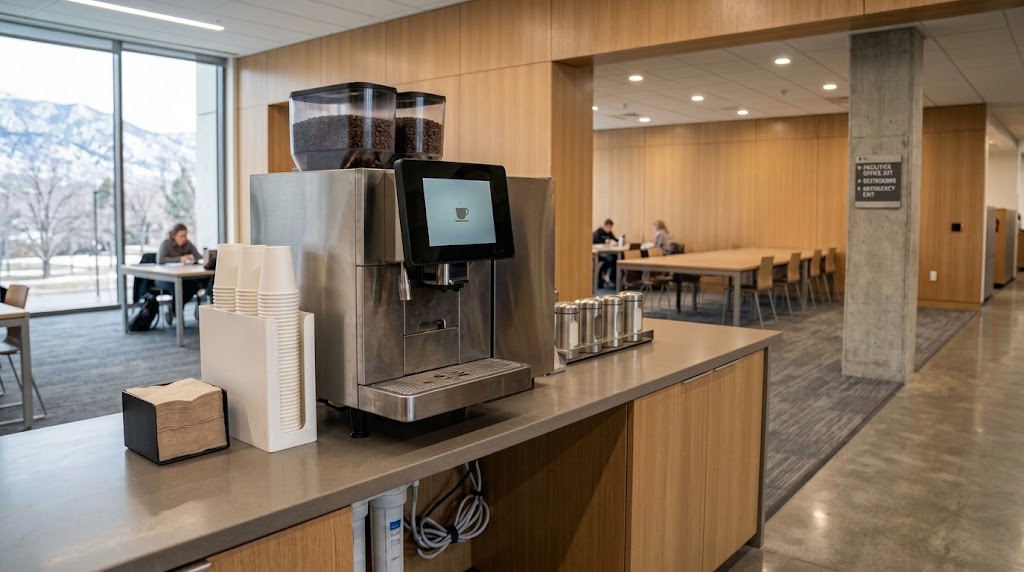
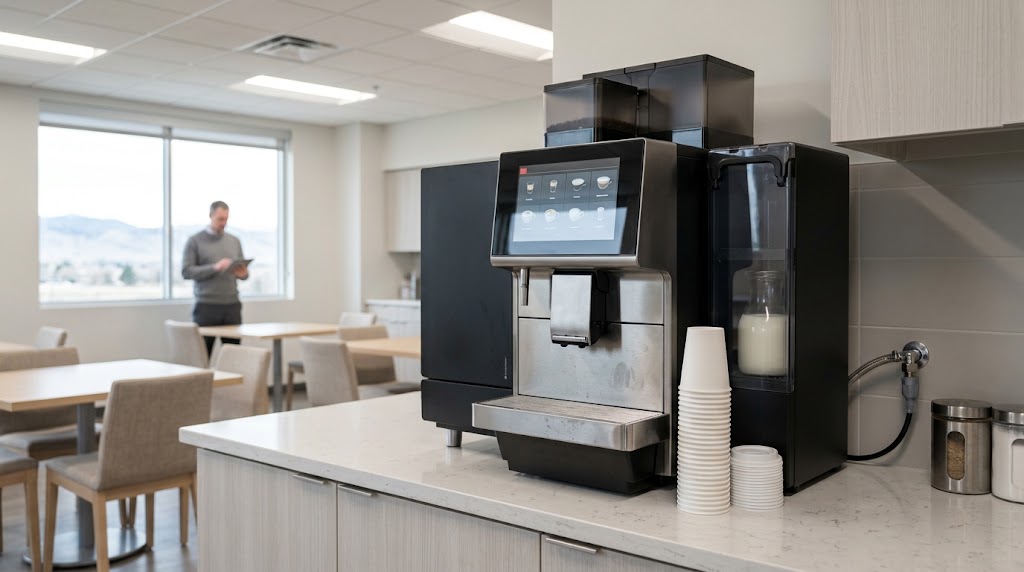
Self-serve: A Starbucks self-serve coffee machine, typically a bean-to-cup model, dispenses espresso-based drinks or brewed coffee whenever a guest presses the button, no staff involved at any point during service. Denver Beverage handles the equipment installation, restocking, and scheduled maintenance, so this format is built to run quietly in the background.
Barista-served: A trained team member operates commercial espresso equipment and prepares drinks to order, which means dedicated labor, a counter or bar setup, and defined service hours. It’s the right fit where the coffee experience itself is part of the guest-facing service, not just a background amenity.
The table below compares the two formats across the criteria that matter most before making a decision.
| Decision Criteria | Self-Serve | Barista-Served |
| Staffing required | None during service | Trained operator every shift |
| Space footprint | 12 to 24 inches countertop | Dedicated counter/bar station |
| Service hours | 24/7 or continuous | Staffed hours only |
| Volume capacity | 25 to 150 cups/day per unit (general benchmark) | High volume; scales with staffing |
| Experience tier | Convenient, consistent | Premium, customizable |
| Equipment managed by | Denver Beverage | Denver Beverage + facility staff |
Which Venues Fit Each Format, and Why
This is the question most foodservice decision-makers are actually trying to answer before they call anyone. The format you choose should follow from your venue type and operating model, not from preference alone.
Self-serve works best when:
- Offices: A corporate breakroom needs 24/7 access without dedicated coffee staff. For offices with 100 or more employees on-site, an office coffee service built around a self-serve machine eliminates the labor cost of a manned coffee station, while keeping the Starbucks brand front and center as an employee coffee benefit.
- Hotels: A hotel lobby or guestroom floor needs beverage access outside staffed service hours, one of the most common self-serve placements Denver Beverage installs on the Front Range. Our hotel beverage programs often pair a self-serve unit on a guestroom floor with barista service in the lobby café.
- Healthcare: A healthcare facility needs consistent access for staff or residents without adding workload to an already stretched dietary department, and on-demand coffee dispensing at a nursing station or staff lounge does exactly that without a barista. Our healthcare beverage programs use self-serve units this way regularly.
- Volume: Moderate, predictable demand is the sweet spot for this format. As a general benchmark, a self-serve bean-to-cup machine comfortably handles the kind of throughput a breakroom or floor-level placement generates, typically 25 to 150 cups per day depending on the unit.
Barista-served works best when:
- Guest experience: The coffee program is part of a premium guest-facing experience, the kind of depth an upscale hotel lobby café, a patient-family lounge, or a catered meeting setup gets from a full beverage menu, including iced drinks, seasonal specials, and espresso customization.
- Volume: Volume is high enough to justify dedicated labor, or labor is already in place and can be cross-trained through the We Proudly Serve barista training program.
- Brand experience: The venue wants a Starbucks Away From Home program that functions as a branded retail experience, not a background amenity.
Neither format is always the only answer: Denver Beverage installs both formats in the same property regularly. A hotel might run a self-serve unit on a guestroom floor for 24/7 access, then staff a barista-served program in the lobby café during staffed hours, a real deployment pattern, not an upsell. If your venue’s needs split across those two scenarios, a hybrid setup may be the right call.
Staffing and Space: The Two Constraints That Decide the Format
Most format decisions come down to two practical constraints: who you have to run the program, and where you have to put it.
Staffing:
- Self-serve: Requires zero dedicated staff. Denver Beverage handles equipment service, restocking, and cleaning on an ongoing basis, so your team never touches the machine operationally, that’s the whole point of the format.
- Barista-served: Requires a trained operator every shift the program runs. The We Proudly Serve program includes barista training, but someone still has to be scheduled, a meaningful commitment if your facility doesn’t already have labor allocated to a beverage station. This format only works where that labor exists or can be added.
Space:
- Self-serve: A Starbucks self-serve coffee machine typically needs a countertop footprint of 12 to 24 inches wide, depending on the model, plus a standard electrical connection and a water line, or a reservoir-fill setup where plumbing isn’t accessible. No ventilation or special clearance is needed beyond a small buffer around the unit.
- Barista-served: Closer to a café build-out than an appliance installation. It needs a dedicated counter or bar station, espresso equipment, a water line, a drain, and enough clearance for a barista to work.
Denver Beverage handles the site assessment and equipment recommendation for both formats, including confirming that placement meets local health department and electrical requirements, so you don’t need to sort out the compliance details before calling.
Volume Thresholds: When Self-Serve Stops Being Enough
These figures are general operational benchmarks, not Denver Beverage specifications. Use them as a decision framework, not a hard cutoff.
Under 50 cups per day: A quality self-serve bean-to-cup machine handles this volume comfortably. Adding barista labor at this scale is usually cost-inefficient unless the experience tier specifically demands it, such as in a premium executive lounge where the service gesture itself matters.
50 to 200 cups per day: Self-serve is still viable, but equipment selection and placement matter more. A single unit may need to be sized up, or two units placed in different locations. Denver Beverage sizes foodservice coffee equipment based on actual throughput data from the site assessment, not a rough estimate.
Above 200 cups per day: A barista-served or hybrid setup starts to make more sense at this scale. It’s not that self-serve can’t handle the volume. It’s that a dedicated Starbucks coffee program for business at this throughput may justify its own staffed service hours, and the experience lift from barista service becomes economically defensible. A hotel café running 200-plus covers a day is a different operation from a hospital staff lounge.
The We Proudly Serve Starbucks Program: What It Actually Includes
Many decision-makers searching this topic don’t know what the We Proudly Serve program provides versus what they have to supply themselves. Here’s what’s included when Denver Beverage sets up a program at your facility.
- Coffee: 100% Arabica beans sourced to Starbucks standards, the same espresso roast profile used in Starbucks retail locations.
- Equipment: Selected and installed by Denver Beverage based on the format you choose. Self-serve units are sized to your throughput, and barista-served setups use commercial espresso equipment matched to your volume and counter configuration.
- Training: Barista training for your staff is included as part of the barista-served format.
- Ongoing service: Denver Beverage manages equipment maintenance, supply restocking, and service visits on a continuing basis. With 13 field technicians covering the Front Range and 7-day equipment service, this isn’t a setup-and-leave arrangement.
- No direct Starbucks corporate contract required: The We Proudly Serve program is a commercial coffee solution available through authorized foodservice partners, and Denver Beverage operates as an authorized Starbucks Away From Home partner across the Front Range. You don’t need a Starbucks business account or a corporate licensing agreement to participate.
- Equipment cost structure: Equipment is typically provided as part of the ongoing supply relationship rather than purchased outright. If your facility prefers to lease equipment instead, that option can be discussed during the site assessment, and the exact structure depends on volume, format, and configuration.
If you want to see the program’s own documentation before moving forward, the We Proudly Serve Starbucks program overview answers common questions.
Ready to Choose the Right Starbucks Format for Your Business?
The right answer usually comes down to your specific volume, staffing, and space, not a general rule. Denver Beverage can walk your venue through a site assessment and recommend the format that actually works. Talk to our team to find the best fit for your business.
Frequently Asked Questions
How do I get a Starbucks coffee machine for my business?
You get a Starbucks coffee machine for your business through an authorized Starbucks Away From Home partner like Denver Beverage, an authorized placement partner for the We Proudly Serve Starbucks program across the Front Range. The process starts with a site assessment, after which Denver Beverage handles equipment selection, installation, and ongoing service. No direct Starbucks corporate relationship is required to get started.
What’s the difference between a Starbucks licensed store and the We Proudly Serve coffee program?
The core difference is commitment level. A Starbucks licensed store is a full retail Starbucks location requiring a direct agreement with Starbucks corporate, real capital investment, and ongoing operational compliance as a licensed retailer, while the We Proudly Serve program carries no franchise fees and no direct Starbucks corporate contract. Most hotels, offices, healthcare facilities, and restaurants that serve Starbucks coffee use the We Proudly Serve path rather than a licensed store agreement.
What is the Starbucks Away From Home program for offices and hotels?
Starbucks Away From Home is the channel covering non-retail Starbucks placements, including offices, hotels, healthcare facilities, and universities, and the We Proudly Serve program operates within it. Denver Beverage is an authorized placement partner within Starbucks Away From Home across the Front Range, serving operations from single-location restaurants to multi-property hotel groups.
Can a small business get a Starbucks coffee program?
Yes, a small business can get a Starbucks coffee program through We Proudly Serve, which doesn’t require corporate or franchise scale. Volume requirements exist because equipment is sized to realistic throughput, but no minimum size threshold rules out a single-location operation. Denver Beverage serves locally owned restaurants, independent hotels, and small healthcare facilities alongside larger accounts, and the site assessment determines what format and equipment configuration fits your actual volume.
How much does a commercial Starbucks self-serve coffee machine cost?
There’s typically no separate purchase price: equipment is provided as part of the ongoing supply program rather than bought outright, with Denver Beverage covering installation and maintenance as part of that relationship. Cost structure varies by volume, format, and site configuration, and a site assessment is the starting point for a specific pricing conversation.