If you’re reading this, your current office coffee provider probably isn’t pulling its weight. Calls go unanswered, restocking is hit or miss, you have two or three locations to coordinate, and the last thing you need is a drawn-out changeover that leaves your team without coffee.
Here’s the good news: switching office coffee providers is less complicated than it feels from the outside. The friction is usually the uncertainty, not the logistics. Denver Beverage works with commercial offices, so everything below is written for businesses running a workplace program.
Why Offices Switch, and Why They Wait
Most offices don’t decide to switch overnight, and most don’t act the moment they decide. The trigger is rarely a single bad day. It builds, one small failure at a time:
- Slow response: A workplace coffee machine goes down, and nobody gets back to you for days.
- Missed restocks: The kitchen is bare on a Monday morning.
- Poor communication: A service request bounces around for a week before anyone calls back.
- Low priority: Smaller offices get treated as an afterthought.
Offices managing several locations feel this harder, because every site is its own coordination problem.
Even so, many offices put off switching long after the service has stopped working. Some assume every office coffee provider handles things the same way. Others assume the switch will cause more disruption than it’s worth. Both hesitations are understandable, and both tend to fade once the actual steps are mapped out. Most of the effort in switching is up-front planning, not the changeover itself.
Step 1: Check Your Current Contract Before You Do Anything Else
Before you contact your current provider or a new one, pull your coffee service contract and read it. Look for three things specifically:
- Notice requirements: Check whether written notice is needed to end the agreement and how far ahead it has to be given. Your contract states the requirement.
- Auto-renewal clause: Some agreements renew on their own unless notice is given before a set date. If you’re close to the end of a term, this is the first thing to catch.
- Equipment return: If your current provider supplied the coffee machine, the contract should say how and when they retrieve it. That retrieval date is what lets you sequence the new installation.
The goal of reading the contract first is to avoid surprises, not to find a way out of your obligations. A new provider that sets up commercial office accounts will know how to help you time the handover.
Step 2: Audit What You Actually Need, Not What You Inherited
The switch is the right moment to reassess the program instead of copying it. Equipment set up years ago under different circumstances often goes unreviewed until something breaks.
Start with the practical questions:
- How many locations are you managing, and how many people are on-site at each?
- Is the current coffee brewing equipment what you’d choose today, or did it simply come with the old contract?
- Do some sites run different machines that you’d rather standardize?
Then consider what you might add. A switch is a natural time to look at a snacks and pantry supply program or filtered water and ice service alongside coffee. Knowing the full scope of what you want before the next vendor conversation makes it easier to compare options.
Step 3: Coordinate the Handover So There Is No Gap in Service
A gap in service during a provider switch isn’t inevitable. It usually comes from poor sequencing, and it’s avoidable with some coordination. Three things keep the handover clean:
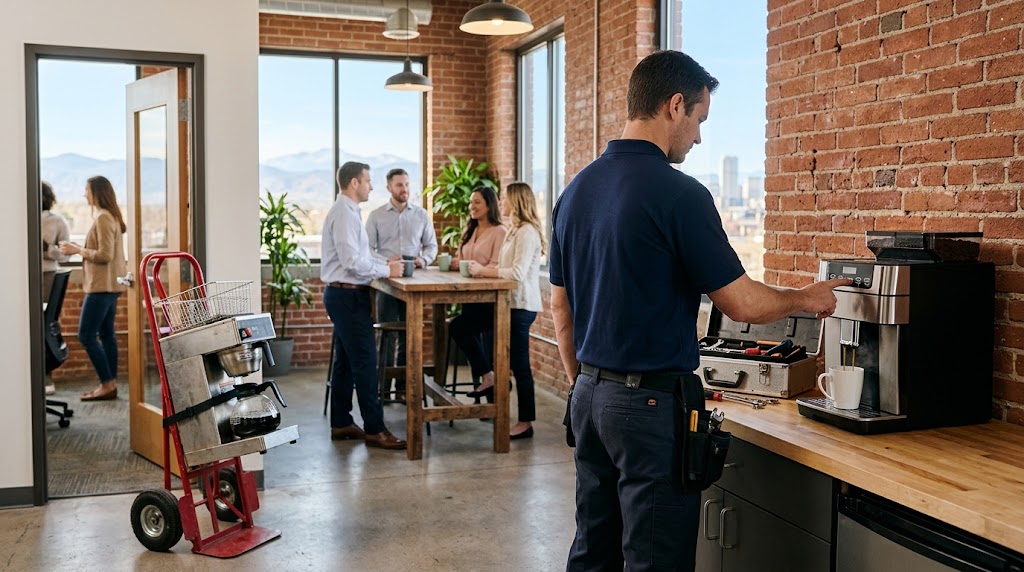
- Two timelines to line up: Equipment retrieval by the outgoing provider and installation by the incoming one. If they aren’t coordinated, you can end up with two machines in the same kitchen or none at all. Tell your new provider when your current provider is collecting their equipment, and plan the installation around that date.
- An early call: Installs take planning and are rarely immediate. Calling a new provider before your current contract has run out gives the installation team time to schedule properly, and waiting until the last week rarely works well for anyone.
- One point of contact: Multi-location accounts benefit from someone who knows which sites have which equipment and which had a service call recently.
On Denver Beverage’s side, its own technicians handle installation, not subcontractors, so the same local team that installs your equipment also maintains and repairs it. For qualified accounts, the equipment is provided at no charge.
What to Expect When You Move to Denver Beverage
Here’s what working with Denver Beverage looks like once the switch is done. You get a choice of machines to suit your office, from bean-to-cup to drip brewers, and the coffee brewing equipment page lists them all. Your office coffee service is then set up around the machines you choose.
Then there’s the coffee itself. You can choose from Ozo Organic Coffee, Queen City Collective, Boyer’s, and Boulder Organic, along with Lavazza, Peet’s, and Starbucks, and Denver Beverage is the exclusive foodservice distributor for Boyer’s. Everything your station needs comes through one place: fractional pre-measured packs, creamers, bulk beans, filters, cups, and lids.
If you’d like to cut down on vendors, the same account can cover Bevi smart water machines, water filtration, and pantry snacks too. That means one team to call when something needs attention, and the office coffee services overview shows the full range.
That team is 13 CFESA-trained service technicians, with 7-day service coverage across the Front Range and the I-70 corridor and a 24-hour service response. Repairs carry a 90-day labor warranty. Denver Beverage has been Colorado-owned and family-run since 1986 and serves 2,400+ customers.
Ready to Make the Switch?
Once the contract question is settled, the next step is trying the coffee. Denver Beverage offers free coffee taste testing, so you can try it before you decide. Call 303-295-3737 or request a free coffee taste test to start the conversation. Quote requests get a response within 24 hours.
Frequently Asked Questions
How do I cancel my office coffee service contract?
Read the notice section of your current agreement first, including any auto-renewal clause, then give notice in writing so there’s a clear record of the date. Ask your current provider when they plan to retrieve their equipment, because that date drives the timing of the new installation. Calling Denver Beverage at 303-295-3737 early in the process helps the team plan the handover with you.
Does switching office coffee providers mean a day without coffee?
It doesn’t have to. The key is coordinating equipment removal and installation timing before either happens. When the outgoing provider’s retrieval date and the new installation date are planned together, the gap can be kept as short as possible. Denver Beverage’s own technicians handle installation, which keeps scheduling in one team’s hands.
Does Denver Beverage require a contract?
Denver Beverage uses a service agreement that’s standard for commercial accounts, and the specific terms are worked out when a quote is put together. The team can walk you through them on a call at 303-295-3737.
How quickly can new equipment get installed?
Installation takes planning and isn’t usually instant. The Denver Beverage team works around your office’s schedule, and planning begins as soon as the account is set up. The earlier you call in the switching process, the more scheduling flexibility there is.
Can Denver Beverage handle multiple office locations under one account?
Yes. Multi-location offices can work with one account and one point of contact. Coffee supply, equipment, Bevi smart water machines, water filtration, and pantry snacks can all be part of the same account. Call 303-295-3737 to talk through how your locations would fit together.