
The companies seeing the strongest voluntary return-to-office numbers right now aren’t the ones with the strictest attendance policies. They’re the ones who have made the office worth showing up to. For a growing number of HR and operations leaders in Colorado, that calculation starts in the breakroom.
Office refreshment programs have moved well past the “nice-to-have” category. When employees are making a daily decision about whether to commute, the quality of their in-office experience is one of the few levers an employer can actually control. This piece lays out the business case for investing in that experience, with the data HR and operations teams need to justify it internally.
Why Employees Weigh the Commute Against the Office Experience
Hybrid workers are running a cost-benefit calculation every morning. The commute has a real, quantifiable cost: time, transportation expense, and friction. For the office to win that calculation on a non-mandatory day, it needs to offer something tangible that a home setup can’t match.
Research from Gallup’s State of the Global Workplace report consistently shows that workplace environment and daily quality-of-life factors are significant contributors to employee satisfaction and retention. Amenities are not the whole story, but they show up reliably in satisfaction surveys and in the reasons employees give for preferring the office over remote work.
Home offers real advantages hybrid workers weigh every morning: no commute, more control over the environment, fewer interruptions. An employer can’t out-compete someone’s living room on quiet or convenience. What they can control is the office experience itself, and a stocked, reliable breakroom is one of the few levers that’s entirely within their power to fix.
What a Refreshment Program Actually Covers, and Why It Matters for Retention
The gap between “a coffee machine in the breakroom” and a managed refreshment program is greater than most operations teams realize until they see the difference.
A complete program for a Colorado office typically includes:
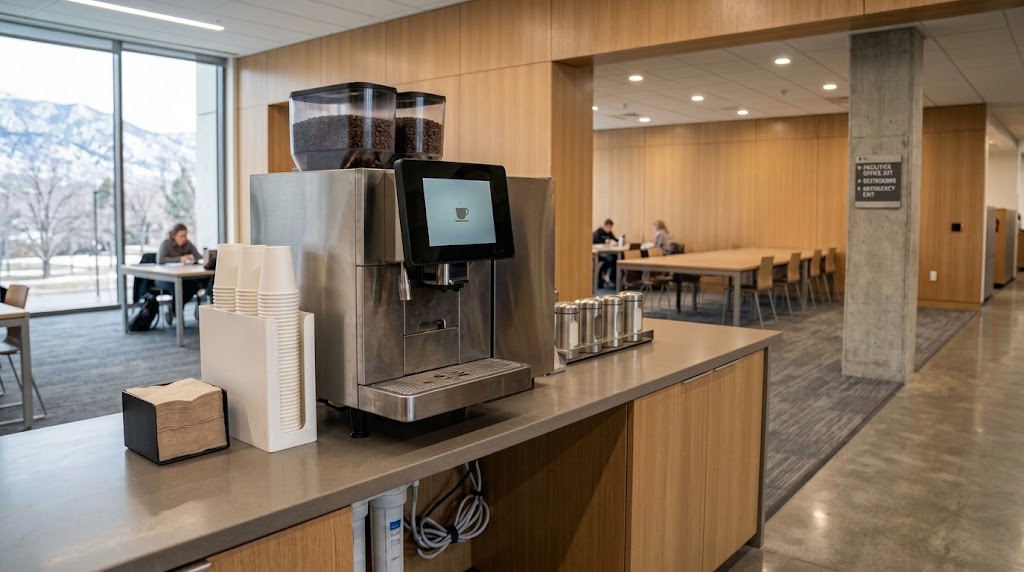
- Bean-to-cup espresso and coffee equipment: Machines like the De Jong Duke or Bravilor Bonamat, placed and maintained without upfront capital cost from the employer
- Premium local and national coffee brands: From the local/premium roster, that means Ozo Organic Coffee, Queen City Collective, Boyer’s, and Boulder Organic. National options include Lavazza, Peet’s, and Starbucks
- Curated snacks and pantry staples: snacks and pantry supplies managed on a replenishment schedule, not a one-time stock-up
- Filtered water: Countertop or plumbed, depending on office configuration
- Managed micro market: For larger offices, a fully stocked, self-checkout micro market with 24/7 access via GrabScanGo, Denver Beverage’s micro market platform
The frame that matters for HR isn’t the product list; it’s the breadth of what employees can access without leaving the building, on demand, at a quality level that competes with what they’d make at home or buy at a coffee shop.
That’s what makes the program feel like an investment in people rather than a facilities line item. Denver Beverage’s full coffee programs page has more detail on the specific brand and equipment options available for Colorado offices.
The Internal Business Case: How to Justify the Investment
There isn’t a single definitive study linking refreshment programs to retention rates directly. The case here is built from adjacent research on workplace satisfaction, amenity-driven attendance, and employer review data, which is honest framing, not a weaker one.
This is the section worth sharing with your CFO or VP of Finance. Not because coffee is a persuasive argument on its own. Here’s the comparison that actually matters: what the program costs against what turnover costs.
The turnover cost baseline
- Cost range: replacing an employee costs roughly 50% to 200% of their annual salary, per research compiled by figures.hr on employee turnover costs
- Example: a mid-level office role paying $65,000 per year carries an estimated replacement cost of $32,500 to $130,000
- What’s included: recruiting, onboarding, lost productivity, and institutional knowledge loss
The program cost comparison
- Typical range: $15,000 to $25,000 annually for an office of 100 to 200 employees
- What drives the number: headcount, usage, and program scope
- The caveat: this is a directional framework, not a fixed quote; the specific cost for your office depends on a conversation with a provider
- The comparison that matters: since breakroom quality is already tied to the culture signals that influence retention, if a well-designed program is a meaningful factor in retaining even one mid-level employee per year, the ROI (Return of Investment) math is straightforward
The qualitative signal
Employer review data on platforms like Glassdoor consistently links breakroom quality and office perks to broader sentiment scores around workplace culture. This isn’t because free coffee is inherently motivating.
- Neglect signal: a broken, under-stocked, or visibly neglected breakroom tells employees that leadership isn’t paying attention to daily quality of life, and employees notice
- Investment signal: the inverse holds too, a well-run, stocked breakroom is a small but consistent signal that the company invests in the environment where people spend most of their waking hours
- What it can’t do: a refreshment program is a supporting factor in retention, not a primary driver; compensation, growth opportunity, and management quality will always outrank it
- What it does do: it’s a low-cost, high-frequency touchpoint that shows up in satisfaction data precisely because it’s experienced every day, not just at review time
Return-to-Office Attendance as a Measurable Outcome
Retention is a long-cycle metric, but attendance is immediate and trackable, which makes a premium breakroom environment one of the few interventions that deliver daily, repeated value rather than a one-time novelty.
What drives voluntary attendance
CBRE’s Americas Office Occupier Sentiment Survey found that employers are closing the gap between desired and actual office attendance by investing in experience-driven amenities, not just enforcement. There’s no single published study directly linking badge-in data to amenity quality day by day, but the broader pattern, employers leaning on experience rather than policy alone, is well documented. Office experience surveys more broadly name several factors together, not any one in isolation:
- Food and coffee quality
- Breakroom quality
- Meeting spaces
- Social connection
Why reliability matters more than competitors admit
If the coffee machine is broken on a Tuesday and still broken on Thursday, it doesn’t just fail to attract employees; it actively becomes a source of frustration and a signal that the company’s investment in the office isn’t being maintained. Denver Beverage runs 7-day equipment service coverage. That’s not a marketing claim; it’s a structural detail that determines whether a breakroom program actually functions on the days your employees are in the building.
Extending access with a micro market
For offices large enough to warrant it, a micro market with 24/7 access via GrabScanGo extends this value to employees who arrive early, stay late, or come in on off-cycle days. There’s no cafeteria schedule to work around and no staffing requirement; it functions whether HR planned for it or not.
What Colorado Companies Are Actually Choosing
Denver Beverage’s DRS (Denver Refreshment Services) team works with Colorado offices that are using their office coffee service program as a deliberate return-to-office strategy, not just a procurement convenience.
What a typical program looks like in practice
- Equipment: a De Jong Duke bean-to-cup machine placed at no upfront equipment cost
- Coffee lineup: stocked with Boyer’s beans (Denver Beverage is the exclusive foodservice distributor for Boyer’s Coffee), alongside Ozo Organic Coffee, Queen City Collective, and Boulder Organic for offices that want local variety, plus Lavazza, Peet’s, and Starbucks for offices with national brand preferences
- Service: serviced on a 7-day coverage schedule, restocked on a set cadence, with Denver Beverage’s coffee brewing equipment team available if anything needs attention between visits
- Scale-up path: offices that outgrow a single-machine setup move into a full managed micro market with the GrabScanGo platform handling self-checkout, inventory tracking, and replenishment, no staff required from the employer’s side
Geographic coverage for this program runs from Cheyenne, Wyoming, to Pueblo, Colorado, with primary concentration in the Denver Metro and Colorado Springs areas. If your office is in the Front Range corridor, this is a program that’s available for your team right now.
If the business case in this piece resonates, a conversation with Denver Beverage’s DRS team about what a program would look like for your office is the natural next step, not a commitment.
Ready to See What This Looks Like for Your Office?
The numbers above are a starting point, not a quote. What actually matters is what a program built around your headcount and your office layout would look like.
Talk to Denver Beverage’s DRS team about building a program around your office.
FAQ
How much does an office coffee and refreshment program typically cost per employee?
Most mid-size offices pay $75 to $150 per employee annually, since a full program for 100 to 200 employees runs $15,000 to $25,000 total per year. Cost rises with a wider product mix or a micro market component, and falls with a simpler, usage-based program.
Does a refreshment program actually affect employee retention, or is this a soft benefit?
It’s a supporting factor in retention, not a primary driver; compensation, career growth, and management quality carry more weight. But it shows up consistently in satisfaction and exit-interview data because it’s a daily experience: a neglected breakroom generates negative sentiment, while a well-run one builds quiet, recurring goodwill.
What’s the difference between a managed refreshment program and just buying a coffee machine?
Buying a machine means you own the equipment, maintenance, supplies, and restocking yourself. A managed program places the equipment at no upfront cost, services and stocks it on a schedule, and replenishes based on usage, keeping your team’s operational burden close to zero.
How does this work for hybrid teams where headcount varies day to day?
Usage-based replenishment and smart stocking absorb variable headcount without waste. A micro market tracks inventory at the unit level and restocks based on actual consumption, so employees who come in on off-cycle days still find it fully stocked.
Is this available for offices outside of Denver proper?
Yes. Denver Beverage’s DRS program covers the Front Range from Cheyenne, Wyoming to Pueblo, Colorado, with primary concentration in Denver Metro and Colorado Springs. If your office is located in Boulder County, Fort Collins, or anywhere along the I-25 corridor in that range, you’re within the service area. Mountain locations are not currently part of the micro market program, and distribution or service availability for locations outside the Front Range should be confirmed directly with the DRS team.