In the bottleless vs bottled water cooler decision, both systems deliver clean drinking water, but they have very different cost profiles, storage demands, and maintenance requirements. The right choice depends on your office’s size, layout, and how much operational friction you’re willing to manage long-term. This guide isn’t a pitch. It’s a framework to help you decide, and our filtered water and ice programs are there when you’re ready to talk options.
How Each System Works
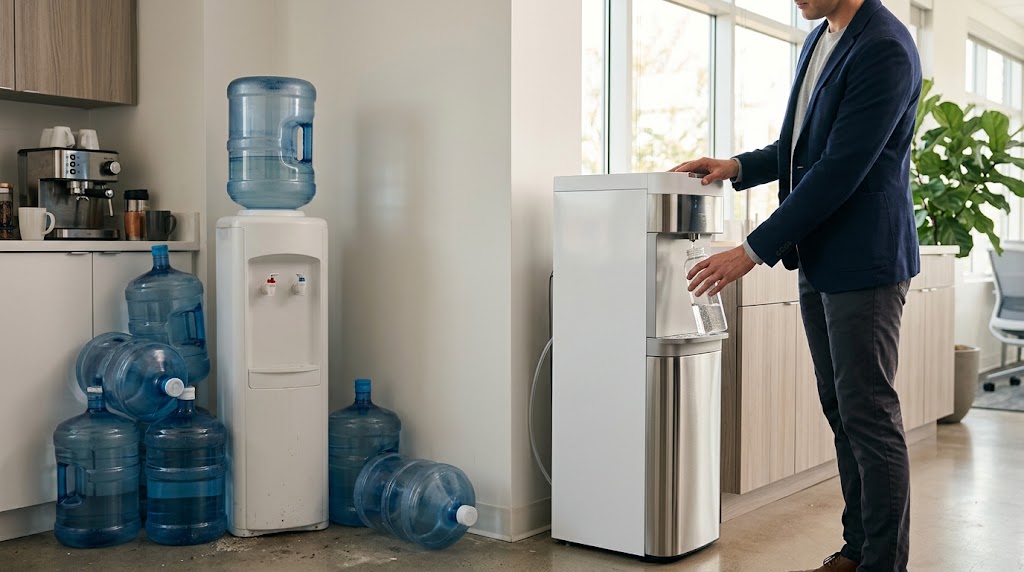
Bottled water cooler: A supplier delivers pre-filled 5-gallon water jugs on a recurring schedule. A staff member loads each jug onto the dispenser. No plumbing connection is required, so the cooler can go anywhere with an outlet.
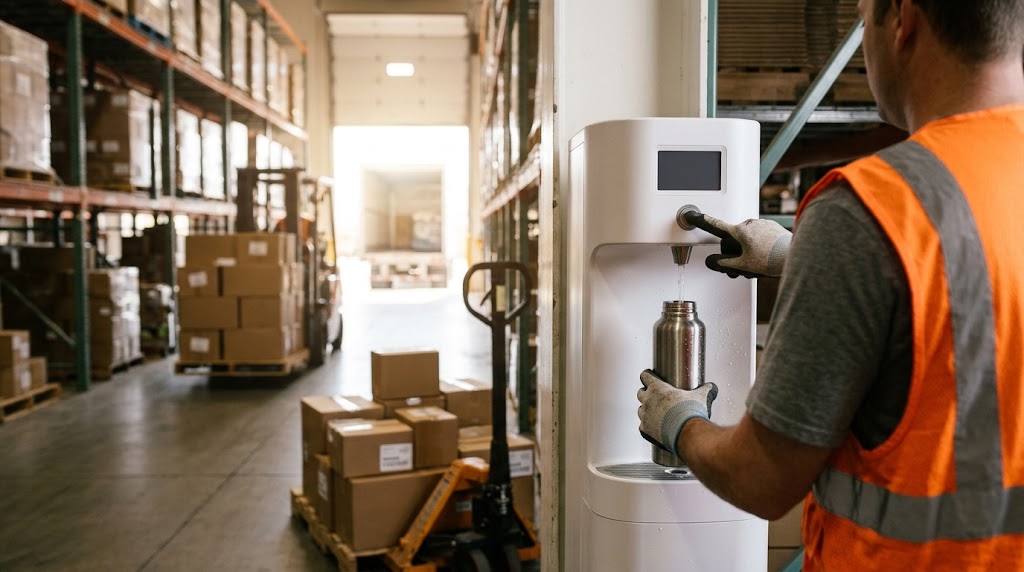
Bottleless water cooler: A point-of-use water cooler connects directly to the building’s water supply and filters tap water on-site. There are no deliveries and no jugs to store, but the unit does need a water line within reach. Most bottleless units dispense hot and cold water from the same machine. Some also offer a sparkling water option, which a bottled water cooler can’t match without a separate system.
Cost Over Time: Where the Real Difference Shows Up
Upfront, a bottled water cooler looks cheaper. You’re renting or purchasing a simple dispenser. But recurring costs compound fast.
Year 1 comparison:
- Bottled water: You pay for every jug that gets delivered, so the more your team drinks, the more you spend. The dispenser rental or purchase cost comes on top of that.
- Bottleless: You pay once to connect the unit to a water line, then cover filter replacement as you go. The water itself is municipal tap water, which costs very little per gallon.
Year 3 and beyond:
A bottled water cooler’s cost scales directly with how much water your team drinks. A bottleless water cooler’s cost is relatively flat after installation. Most offices find that a bottleless system pays for itself within the first year or two at typical office consumption volumes, particularly in teams of 30 or more.
Storage and Delivery Logistics
Price is only part of the picture. The day-to-day work of keeping an office stocked with water is often what settles the decision.
- Bottled, delivery: Someone has to be there to accept each delivery. If no one is, you’re short on water until the next window.
- Bottled, storage: A full 5-gallon water jug is heavy, and a mid-size office can easily need a dedicated storage area for water inventory. That’s floor space in a shared office, and it’s often more valuable than it looks on paper.
- Bottled, lifting: Someone on your team moves the jugs to storage and lifts each one onto the dispenser.
- Bottleless, logistics: No deliveries to schedule, no heavy lifting, and no storage footprint.
- Bottleless, placement: You need a water line nearby, so placement is constrained by plumbing access, not by where the storage shelf is free.
Installation of a bottleless unit isn’t immediate. It takes planning and coordination, particularly if a water line needs to be run to the target location. Factor that into your timeline if you’re furnishing a new space.
Water Quality and Sanitation: What the Labels Don’t Tell You
Buyers often assume one system is obviously better on water quality, but neither wins by default. What matters is how the water is regulated or filtered, how well the equipment is maintained, and whether the supplier can show it. Here’s what to look at for bottled water and for bottleless filtration, including the certifications worth asking about.
Bottled water regulation: Bottled water is regulated by the FDA under 21 CFR Part 129 and must meet standards equivalent to EPA tap water. It’s independently tested and labeled, but it isn’t inherently purer than tap water.
Bottleless filtration: what the certification tells you: Not all bottleless water filtration systems filter to the same level. NSF/ANSI certification is the standard to look for, but the specific standard matters.
- NSF/ANSI 42: Covers aesthetic reduction, primarily taste, odor, and chlorine. A carbon filter certified to this standard improves the drinking experience but doesn’t address health-effects contaminants.
- NSF/ANSI 53: Covers health-effects contaminants, including lead and cysts
- NSF/ANSI 58: Covers reverse osmosis systems.
When evaluating a bottleless water cooler, ask which NSF/ANSI standard its filter is certified to. You can verify certifications directly through the NSF International certified product listings. “NSF certified” without a standard number tells you very little about what the water filtration system actually removes.
Sanitation in bottleless systems: Internal tubing and reservoirs need regular maintenance. Units that sit unused for extended periods, such as a long office closure or a hybrid schedule with several low-use days, can allow bacterial growth if the system isn’t properly maintained or sanitized.
That isn’t a reason to avoid a bottleless water cooler. It’s a reason to choose a unit and a supplier that includes a real maintenance program. Denver Beverage’s bottleless units are installed and serviced by our own technicians, not third-party contractors, so the same team that set it up handles ongoing care.
Bottleless vs. Bottled: Which System Fits Your Office?
Use this as a quick decision framework. Neither system is universally better, and the right choice usually comes down to a few practical factors: how many people use water daily, whether there’s a water line near where the cooler needs to go, and how quickly you need it running. Match your office to the lists below.
Bottleless is likely the right call if:
- Daily users: 30 or more people use water daily, and the cost savings compound quickly at volume.
- Water line: You have a water line near the target location, or you’re willing to have one run.
- Sustainability: You have a plastic reduction goal, since bottleless eliminates single-use plastic and jug return logistics.
- Hot and cold water: You want hot and cold water from one unit without a separate delivery program.
Bottled is likely the right call if:
- No water line: There’s no water line near where the cooler needs to go, and running one isn’t practical.
- Small team: You have a very small team with low daily consumption, where the volume economics don’t favor bottleless.
- Speed: You need a solution running quickly, with minimal installation coordination.
One question worth asking separately: If your office runs a hybrid schedule with several low-occupancy days per week, ask your supplier how the bottleless unit handles low-use periods. A unit that sits idle between busy days needs a maintenance plan built for it.
If you’re building out the full office refreshment program at the same time, it’s worth evaluating your office coffee service alongside the water decision. Most office managers making this choice are also reassessing coffee, and the two programs are easier to coordinate with one supplier than two.
Bottleless Water Coolers Denver Beverage Supplies
Once you’ve decided bottleless is the right model, Denver Beverage supplies three options for commercial offices on the Front Range and the I-70 corridor.
- Borg & Overstrom: The premium point-of-use water cooler in our lineup, for offices that have chosen the bottleless route.
- Bevi: A bottleless water dispenser that also offers flavored water. It suits offices that want more variety than plain filtered water from one machine.
- LaVit: Another bottleless water machine we supply. Ask us how it compares for your office and space.
Equipment is provided at no charge for qualified accounts, and installation and service are handled by Denver Beverage’s own technicians. You can see how these machines fit into our wider filtered water and ice programs. If you’re also building out a coffee program, our coffee brewing equipment page covers the bean-to-cup and drip options we supply for offices.
Ready to Talk Through Your Water Program?
Give us a call at 303-295-3737 or get in touch to talk through which water program fits your office setup. Installs take coordination and aren’t immediate, so the earlier you reach out, the smoother the process.
Frequently Asked Questions
What is the difference between a bottleless and a bottled water cooler?
A bottled water cooler uses pre-filled 5-gallon water jugs delivered on a schedule, while a bottleless water cooler connects to your building’s water supply and filters tap water on-site through an internal water filtration system. Bottleless units don’t require deliveries or storage, but they do need a direct plumbing connection.
Is a bottleless water cooler worth it for a small office?
For a very small team with low daily use, the delivery model can be cost-competitive, so bottleless isn’t automatically worth it. For offices of 30 or more people, most offices find a bottleless water cooler pays for itself within the first year or two and keeps saving after that. Storage and delivery logistics often matter as much as the numbers.
What does a bottleless water cooler need to be installed?
A bottleless water cooler needs a water line connection near its location. If one doesn’t already run to that spot, it will need to be added. Installation takes planning and coordination and is rarely immediate, and Denver Beverage’s technicians handle it, not outside contractors.
How often does a bottleless water cooler filter need to be replaced?
Filter replacement intervals vary by unit and usage volume. Your supplier should track the schedule and handle filter replacement as part of the service program, so it isn’t left to you to manage.
What NSF/ANSI certification should I look for in a bottleless cooler?
Look for NSF/ANSI 53 if water quality beyond taste and odor is a priority, since it covers health-effects contaminants including lead. NSF/ANSI 58 applies to reverse osmosis systems. You can check a specific unit’s certification through the NSF International certified product listings.