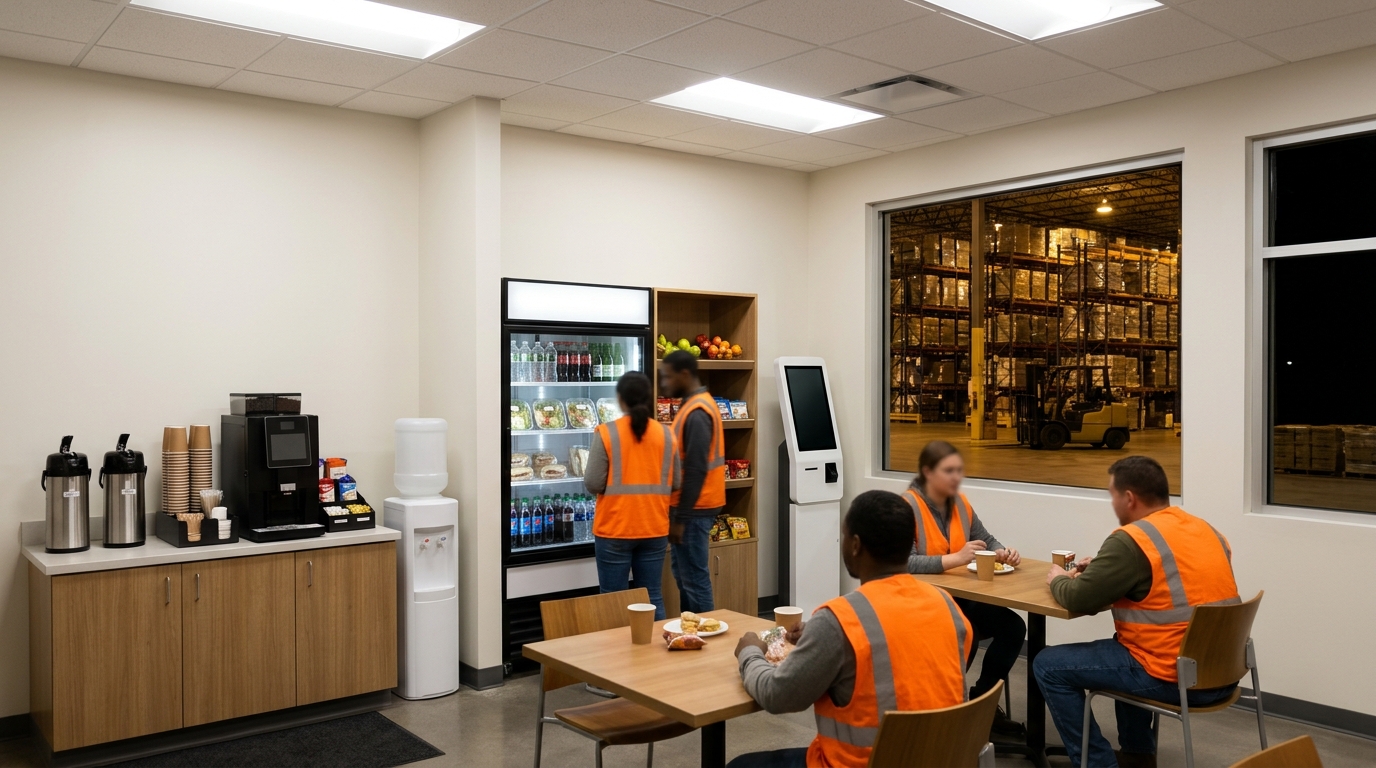
A warehouse break room that works for shift workers needs three things: coffee that’s always ready, water people actually want to drink, and a food option that doesn’t depend on someone on staff to manage it. When one of the three is missing, workers notice right away. Getting these right is an operational decision more than a morale project.
What Makes a Warehouse Break Room Different
A warehouse or industrial site isn’t a bigger office, and the break room has to work under different conditions. Four things set it apart, and each one shapes the decisions that follow.
- Demand arrives in waves: In an office, people drift to the coffee station all day. In a warehouse, a whole shift often breaks at the same time. Equipment has to be chosen for shift changeover, not for average daily traffic, because a single machine that suits a small office becomes a line when a crew arrives together.
- Hydration is a practical need: People doing physical work need easy access to water during and after a shift. Water that’s close, cold and appealing gets used.
- Water access is a workplace basic: OSHA’s sanitation standard for permanent workplaces requires employers to provide potable drinking water. Check your specific obligations with your HR or legal team before you plan the room.
- The room may run without supervision: Night shift workers need the same access as day shift workers. Equipment that needs staff to operate or restock it becomes a problem on a site that runs around the clock, so self-service and reliability matter.
Coffee That Keeps Up With Shift Changeover
Coffee gets its hardest test at changeover, when a whole crew wants a cup at the same time. Here are the equipment options and what goes with them.
- Bean-to-cup machines: A bean-to-cup machine brews each cup fresh from whole beans on demand, so there’s no stale pot and nobody has to remember to start a new batch.
- Batch options: Airpot brewers suit sites that want batch brewing for a crew, and pre-measured packs are another option. Denver Beverage works with both approaches and can help you match equipment to the size and pattern of your shifts.
- Equipment and supply: Dispensing equipment is provided at no charge for qualified accounts, and product is bought through Denver Beverage. The office coffee service program covers the supply that goes with the machine: fractional pre-measured coffee packs, creamers, bulk beans, filters, cups and lids. The coffee brewing equipment page covers the equipment options.
- Coffee roster: Ozo Organic Coffee, Queen City Collective, Boyer’s, Boulder Organic, Lavazza, Peet’s and Starbucks. The company is the exclusive foodservice distributor for Boyer’s.
- Taste test: If your team has opinions about the coffee, a free coffee taste test is available before you commit.
Hydration Stations for Physical Work
Water is the second piece. On a site where nobody is assigned to the break room, a self-service machine does the job.
- Bevi smart water machines: They give a break room still and sparkling water, including flavored options, from one machine that connects to the building’s water supply. There are no bottles to store or empties to clear between shifts.
- Service: Bevi machines are installed and serviced by Denver Beverage’s own technicians.
- Filtration and ice: Water filtration, bottleless coolers and ice machines are also installed and serviced, for sites that need them alongside the water station. See the filtered water and ice page, or read the guide to hydration stations for warehouses and industrial sites for more detail on the options.
Micro Markets: Food Access That Runs Itself
Food is the third piece. On a site with several shifts, a traditional vending machine can be a weak answer. A micro market is an unstaffed, self-checkout food and drink area: employees pick what they want and pay at a kiosk, with no cashier.
- Cost to install: For qualifying locations there’s no upfront cost to install. Where micro market equipment is installed, a service contract is required.
- Restocking: Denver Beverage restocks micro markets 2 to 3 times a week based on sales data.
- Revenue: The host site receives a share of net sales.
Read how managed micro markets work for the full picture, or see the micro markets page.
For sites that prefer a simpler setup, snacks and pantry supply is also available. Pantry items are continuously restocked, billed on a monthly itemized invoice and delivered at no extra charge.
What Facility Managers Ask Before Getting Started
These are the questions facility managers ask when they call. Here are the direct answers.
- Installation cost: Equipment is provided at no charge for qualified accounts, and micro markets have no upfront cost to install for qualifying locations. Installs take planning and are rarely immediate, so contact the team early in a build-out or refresh.
- Service: Denver Beverage’s own technicians handle it, not subcontractors. The team has 13 service technicians, 7-day service coverage and a 24-hour service response. Technicians are CFESA-trained, and repairs carry a 90-day labor warranty.
- Coverage: Installation, repair and service cover the Front Range and the I-70 corridor. Call 303-295-3737 to confirm coverage for your address.
- Switching: The team can walk you through what a change looks like for your setup. Call 303-295-3737 to talk it through.
Get a Quote
If you’re planning a break room refresh for a warehouse or industrial site, a quote is the easiest place to start. Call 303-295-3737 to talk through a coffee program, a Bevi water station or a micro market, or see the office coffee service page. Quote requests get a response within 24 hours, and a free coffee taste test is available if your team wants to compare options. Denver Beverage works with commercial accounts only.
Frequently Asked Questions
What should a warehouse break room include?
A warehouse break room should include reliable coffee, easy access to water and food that’s available on every shift, including nights. In practice that means coffee equipment that keeps up when a crew breaks together, a water station with still and sparkling options, and a self-checkout micro market or stocked pantry that doesn’t need staff to run it.
How do you set up a break room in a warehouse?
Setting up a warehouse break room starts with how many people use it at once and how long their break lasts, because that tells you how much coffee and water capacity you need. Equipment can be provided at no charge for qualified accounts. Installs take planning, so contact a supplier early rather than close to your target date.
What are the OSHA requirements for warehouse break rooms?
OSHA’s sanitation standard requires potable drinking water at permanent workplaces. Beyond that, requirements depend on your site and state, so check with your HR or legal team before you finalize the room.
How can I improve employee morale in a warehouse?
A break room that works on every shift is a practical way to improve morale in a warehouse. Reliable coffee, good water and food access on nights as well as days show people that their shift matters.
What is the difference between a micro market and a vending machine?
A vending machine dispenses packaged items through a mechanical selection slot, while a micro market is an open, unstaffed area where employees pick up items directly and pay at a self-checkout kiosk. For a site that runs several shifts, a micro market works without a cashier, and Denver Beverage restocks it 2 to 3 times a week based on sales data.