Carbonation dead or draft beer stopped pouring mid-service? Whatever’s wrong, it’s almost always one of four things: an empty tank, a bad regulator reading, a leak somewhere in the system, or a pressure problem that’s not obvious from the gauge alone.
Find the section below that matches what you’re seeing, and work through it in order.
Leaking CO2 Gauge
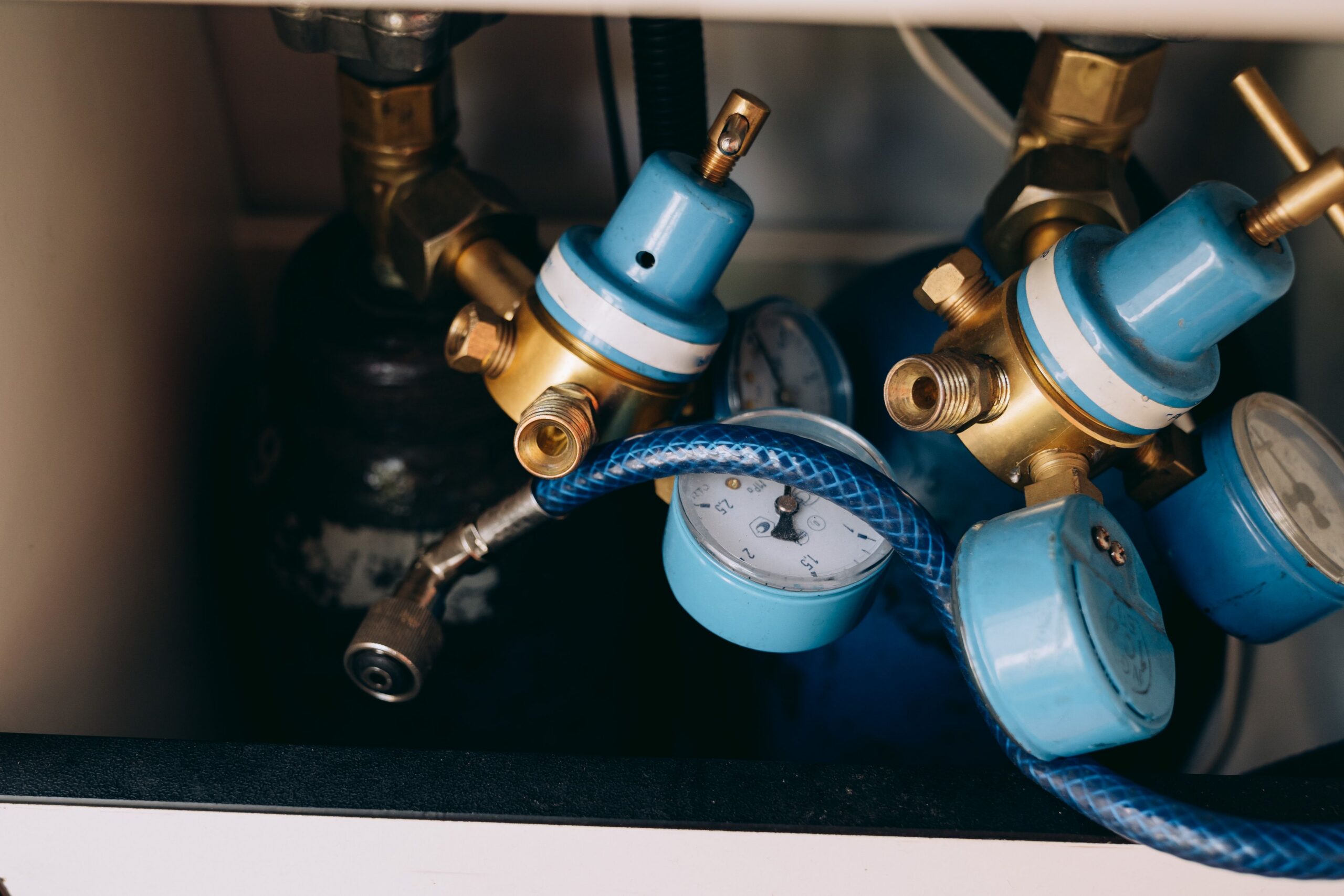
If your CO2 gauge itself is leaking, check the connection first. A missing washer behind the valve connection nut is the most common cause. Hand-tighten the connection nut and recheck. If the leak continues, the cause may be a bad relief valve or a faulty gauge, both of which require a service call.
No Carbonation or Beer Pours Flat
The most common cause is an empty or near-empty CO2 (carbon dioxide) tank. Work through these checks in order before looking anywhere else:
- Check the pressure gauge on the cylinder. If it reads below 200 PSI (pounds per square inch), the tank needs replacing.
- Confirm the tank valve is fully open. A partially closed valve restricts flow even when gas remains.
- Check whether the line from the tank to the regulator is connected securely.
- If the gauge reads above 200 PSI and the valve is open, move to the regulator section below.
Still flat after confirming the tank’s good? You’re probably looking at a regulator or line issue, so scroll down to the next section, or if you’re mid-service and can’t wait, reach out and we’ll get someone out to you.
If soda lines are part of the problem, our fountain and bar gun troubleshooting guide offers a full breakdown of what to check.
Regulator Reading Looks Wrong or Keeps Dropping
Two different problems can look identical on the gauge, but they call for different fixes. Here’s how to tell which one you’re actually dealing with.
Gauge reads empty, but the tank isn’t:
- Under high draw rates, rapid gas expansion cools the regulator body, a process called the Joule-Thomson effect, and the gauge can temporarily read low or empty as a result.
- Reduce your draw rate and let the regulator warm up for a few minutes.
- Re-check the reading before assuming the tank is actually out.
Gauge reading is erratic or won’t hold pressure:
- For soda systems, your primary regulator should read 95 to 105 PSI, and your secondary regulator should read 60 PSI.
- If the readings jump around or won’t stabilize at those values, the regulator is likely failing.
- Don’t adjust an unfamiliar regulator yourself; this is a field repair.
You Can Hear or Smell a Leak
A hiss near a fitting, soapy water that won’t stop bubbling, or a tank emptying faster than it should are all signs of an active leak somewhere in the system. Where exactly it’s leaking is what decides whether you can fix it in a minute or need to call it in.
Fittings and connections:
- Apply soapy water to the fitting at the tank connection, the regulator, and any visible line connection points.
- Active leaks will bubble.
- A leaking fitting at the tank connection can often be fixed by hand-tightening it.
Deeper leaks:
- If the leak is past the tank connection, at the regulator body, distribution manifold, or further into the line, that’s a field repair.
- Don’t attempt to trace or handle internal hoses yourself.
- Unexpectedly rapid tank depletion with no visible source is also a sign of a slow leak somewhere in the system.
Safety note:
- CO2 is odorless and can reach dangerous concentrations in enclosed spaces: bar cellars, under-counter installations, and walk-in coolers are all at risk during a leak.
- If staff report dizziness or headaches near a suspected leak, evacuate immediately per your posted emergency procedures and call Denver Beverage. CO2 accumulation in enclosed spaces is a recognized workplace hazard, not just a system malfunction, treat it accordingly.
- Don’t troubleshoot in an enclosed space with a known or suspected active leak.
Pressure Is Set Correctly, but Pour Quality Is Still Wrong
If your primary regulator is already reading 95 to 105 PSI, that rules out the most common cause. So what else could be throwing off your pour?
- Line temperature: Warm lines cause foaming in draft beer and inconsistent carbonation in soda. Check that your cooler is holding temperature.
- Line length and draft pressure: Draft beer line pressure isn’t a single universal figure; it depends on line length, line diameter, and cooler temperature. A keg swap or new install may need a calibrated pressure adjustment, not just a gauge check.
- Recent equipment or product changes: Switching BIB brands or swapping a keg can affect pour balance. If quality dropped after a change like that, a recalibration visit is the right next step, not a DIY pressure tweak.
Beyond confirming that 95 to 105 PSI primary reading, any further pressure adjustment is a technician’s job, not something to handle yourself. And if it’s specifically your draft beer line length or pressure that’s the culprit, Denver Beverage’s draft beer system installation and service page walks through that setup in more detail.
When to Call Denver Beverage
If you’re dealing with any of the following, it’s time to call in a technician:
- Swapping the tank didn’t restore carbonation or pour pressure
- Regulator readings won’t stabilize at 95 to 105 PSI (primary) or 60 PSI (secondary)
- A leak is past the tank connection fitting
- Pour quality issues persist after confirming pressure settings
- You suspect a CO2 leak in an enclosed space
Denver Beverage field technicians service beverage equipment across the Front Range 7 days a week. If the steps above haven’t fixed it, reach out for commercial kitchen and beverage equipment repair.
If you’re mid-service and things still aren’t running, our team is one call away.
Frequently Asked Questions
Do CO2 regulators go bad?
Yes, regulators do wear out. You’ll usually notice erratic pressure readings, a gauge that won’t hold steady, or visible damage to the body or fittings. If you’re seeing any of that, replacing it is a job for a technician, not something to tackle yourself.
Why does my CO2 gauge read empty when I just changed the tank?
This is usually a regulator freeze-up. Rapid gas expansion during high draw cools the regulator body, causing the gauge to read low or empty even when the cylinder has plenty of gas. Reduce your draw rate, let the regulator warm up, and re-check.
What PSI should a soda CO2 system run at?
Your primary regulator should read 95 to 105 PSI, with the secondary set to 60 PSI.
How do I know if my CO2 system has a leak?
The easiest test is soapy water on fittings and connection points, an active leak will bubble right away. A hiss you can hear, or a tank that’s emptying faster than it should, are also good signs something’s leaking. Once it’s past the tank connection itself, that’s a job for a technician.
When should I replace my CO2 tank?
Replace it when the cylinder pressure gauge reads below 200 PSI.
Why is my draft beer foamy even after replacing the CO2?
Foamy beer after a tank swap usually isn’t about the gas at all; it’s more likely line pressure, line temperature, or line length that needs adjusting. That’s a calibration issue, and Denver Beverage’s draft beer system installation and service page goes into more detail on the draft-specific side of it.