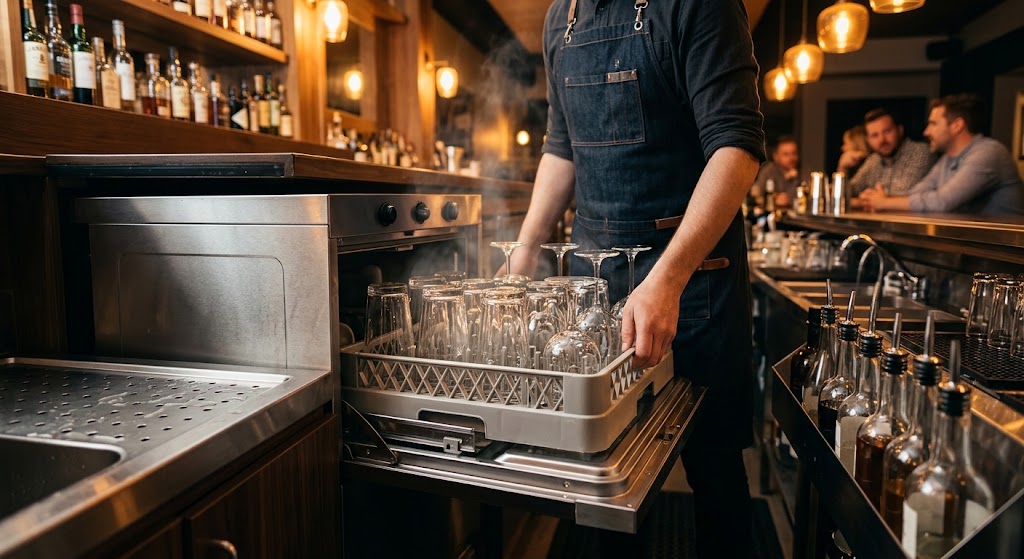
If you’re opening a bar or cafe and wondering how to get an undercounter dishwasher installed, you’re asking the right question. A commercial undercounter dishwasher suits the footprint of a bar, cafe, or small kitchen, but the right machine depends on a few decisions worth making before you commit.
This guide walks through who these machines suit, how high-temp and low-temp models differ, what installation involves, and what a machine costs to run. It also covers how a leased program can keep the capital outlay off your opening budget.
Is a Commercial Undercounter Dishwasher Right for Your Setup?
Undercounter machines suit some operations better than others, and the difference usually comes down to what you wash and how much of it you wash at once. For a bar or cafe where glasswashing is the main job, they’re often a natural fit. For a full-service kitchen with heavy volume, they can run out of room. Here’s how to tell which side of that line your operation falls on.
- Where it fits: Bars, cafes, small kitchens, and any operation where glasswashing is a primary need. These machines slot under a counter and handle the throughput most smaller operations actually produce.
- Capacity: Undercounter units use the industry-standard 20×20 rack format. Check the rated racks per hour and wash cycle time on the spec sheet, then match them to your busiest service.
- Where it stops scaling: A full-service restaurant doing 200-plus covers a night with a complete menu is better served by a door-type or conveyor dishwasher, which is built for throughput that undercounter units weren’t designed to sustain.
- Terminology: A commercial countertop dishwasher sits on top of a counter rather than under one. It’s a different form factor, so keep that in mind if you see the term in your research.
This guide is for bars and small kitchens, not production-level restaurant kitchens. Denver Beverage works with restaurants and bars across the Front Range and the I-70 corridor.
High-Temperature vs. Low-Temperature: Which One Fits Your Bar or Cafe?
This is the most important decision most buyers haven’t made yet. High-temp and low-temp machines sanitize differently, cost different amounts to run, and need different setups. Here’s how to think it through.
- How they sanitize: A high-temperature dishwasher heat sanitizes, bringing the final rinse to a temperature that meets NSF/ANSI 3 requirements without chemical sanitizer. A low-temperature dishwasher sanitizes chemically, typically with chlorine or iodine-based solutions, at lower rinse temperatures.
- Energy and chemical costs: High-temp machines use more electricity and hot water per wash cycle, which matters on a demand-metered commercial rate. Low-temp machines use less energy but need a steady supply of detergent, rinse aid, and chemical sanitizer, and that supply has to be managed accurately to stay health-code compliant.
- Glassware results: High-temp machines dry faster and leave no chemical residue on glassware, which matters for pint glasses and stemware, so they’re a natural choice when a bar needs a commercial glassware dishwasher.
- Booster heater: A high-temp machine needs incoming hot water at approximately 140°F. If yours is below that, a booster heater brings the final rinse up to temperature. A free dish machine assessment confirms whether you need one before anything is ordered.
- Which to choose: Low-temp typically costs less to purchase or lease, while high-temp costs more in energy and less in chemicals. Neither is universally better, and the right answer depends on your water temperature, your energy rate, and what you’re washing.
Denver Beverage’s free dish machine assessment covers the high-temp vs. low-temp decision for your specific setup.
What Installation Actually Involves
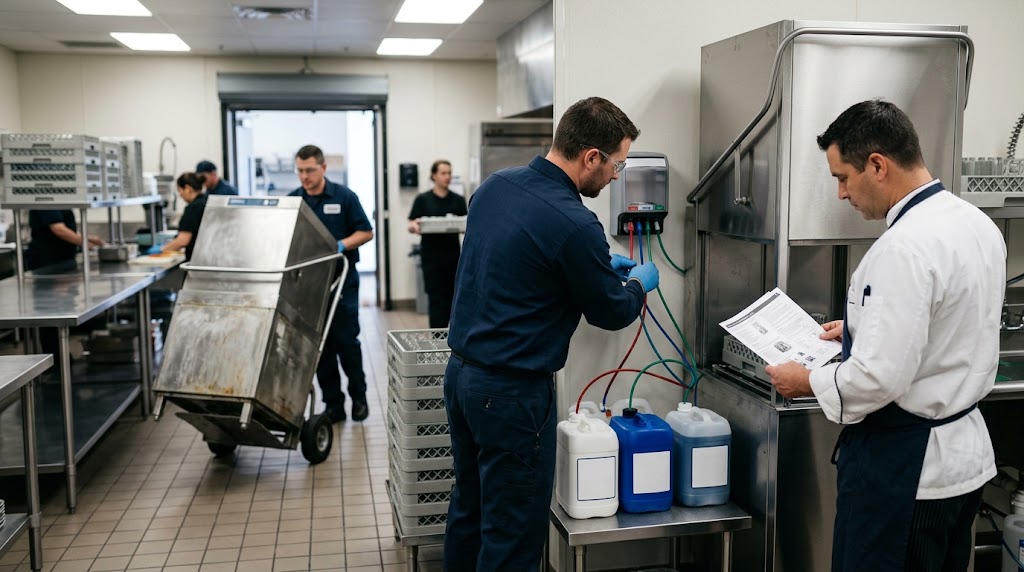
Installation is the part most buyers know least about, and it’s the question that brings many bar and cafe owners to us. Here’s what it involves in plain terms. A technician confirms each requirement at the assessment, not on delivery day.
- Drain connection: The machine needs a floor drain or a drain connection nearby. If there’s no drain access, a plumbing step comes first.
- Water supply: A water supply line connects to the machine.
- Electrical circuit: Undercounter dishwashers need a dedicated circuit, and the amperage varies by model. Don’t assume your existing panel has a free circuit ready to go.
- Booster heater: Whether you need one depends on the machine type and your incoming hot water temperature. It’s confirmed during the assessment, not assumed.
- The process: Installations take planning and are rarely immediate. Denver Beverage’s own CFESA-trained technicians handle installation, not subcontractors. The steps run in order: assessment, account setup, installation scheduling, and a technician visit.
If you’re opening a new location, start the conversation early so the install doesn’t hold up your opening.
What It Costs to Run
Most buyers ask about the upfront price first. The more useful question is what the machine costs to run over time, because that’s the number you’ll feel every month. Here’s what goes into that number.
- Lease vs. purchase: Denver Beverage’s ADS (American Dish Service) leased line starts at $129 per month with free repairs included. That means no large upfront equipment cost, with repairs covered by our own technicians. If you’re pricing a straight purchase elsewhere, factor in service contracts separately.
- Energy: High-temp machines use more electricity per cycle than low-temp units. For a bar or small kitchen running consistent volume, that difference shows up on a commercial energy bill. Low-temp machines offset lower energy use with ongoing chemical costs.
- Chemical supply: Low-temp machines need detergent, rinse aid, and sanitizer on an ongoing basis. Denver Beverage supplies Purworks professional cleaning chemicals, made in Denver and sold in concentrated 1.5-gallon containers. You can run them through the same account as your machine through our dish and laundry chemical programs.
- Water consumption: ENERGY STAR certified commercial dishwashers have a published maximum water consumption per rack. The database is public and worth checking for any model you’re evaluating, because water use per cycle adds up across a full service.
- Service coverage: Repairs on ADS machines carry a 90-day labor warranty. Denver Beverage’s 13 CFESA-trained technicians cover the Front Range and the I-70 corridor with 7-day service coverage and a 24-hour service response. A machine that’s down on a Saturday night is a real problem, which is why weekend coverage matters. See our commercial dishwasher repair service page for how repairs are handled.
Health Code Compliance and NSF Certification
NSF certification is a spec sheet check, not a reason to worry. Here’s what it means and what to look for.
- NSF/ANSI 3: The commercial warewashing equipment standard. It sets the minimum performance requirements a machine must meet to be approved for a licensed foodservice establishment: final rinse temperature for high-temp units and sanitizer concentration for low-temp units.
- Why it matters: Health departments inspect for this, and a machine that isn’t NSF certified can fail a health inspection.
- What to check: Verify NSF certification on the spec sheet before you commit to a lease or purchase. If you’re unsure, the dish machine assessment will confirm.
Let’s Look at Your Dish Station Before You Buy
Not sure whether high-temp or low-temp fits your setup, what your plumbing needs, or what the monthly cost looks like for your volume? A free dish machine assessment is the right first step.
Call 303-295-3737 to book yours, or reach out online. Quote requests get a response within 24 hours. Denver Beverage serves more than 2,400 customers on the Front Range and the I-70 corridor.
Frequently Asked Questions
What is the best undercounter commercial dishwasher for a small restaurant or bar?
The best unit is the one that matches your setup, and that comes down to three things: your water temperature, your energy rate, and what you’re washing. A free dish machine assessment can confirm which unit fits before you commit. If you’d rather lease than buy, Denver Beverage’s ADS line starts at $129 per month.
How many racks per hour can a commercial undercounter dishwasher handle?
It varies by model, so check the rated racks per hour and wash cycle time on the spec sheet for each unit you’re evaluating. Undercounter units suit bars and small kitchens. For higher-volume operations, a door-type dishwasher handles more throughput per hour.
What is the difference between a high-temperature and low-temperature commercial dishwasher?
A high-temperature dishwasher sanitizes with heat, bringing the final rinse to a temperature that meets NSF/ANSI 3 requirements without chemical sanitizer. A low-temperature dishwasher sanitizes with chemicals. High-temp costs more in energy, less in chemicals, and produces drier glassware. Low-temp costs less in energy but needs a consistent chemical supply to stay health-code compliant.
Do undercounter commercial dishwashers need a booster heater?
High-temp machines need one only when incoming hot water is below approximately 140°F, and low-temp machines don’t need one. A dish machine assessment confirms whether your setup needs a booster heater, so it isn’t assumed.
How much does a commercial undercounter dishwasher cost per month?
Denver Beverage’s ADS leased line starts at $129 per month with free repairs included. Chemical supply costs are separate and depend on machine type, and high-temp machines have higher energy costs per cycle. The free dish machine assessment helps you work out the monthly cost for your actual setup and volume.
What does installation involve? Do I need a plumber?
You need a plumber only if your drain and water access aren’t already in place. A commercial undercounter dishwasher needs a drain connection, a water supply line, and a dedicated electrical circuit, and any missing prep happens first. Denver Beverage’s own installation technicians, who also handle commercial kitchen equipment repair, install the machine itself. A site assessment confirms what prep is needed before a date is scheduled.