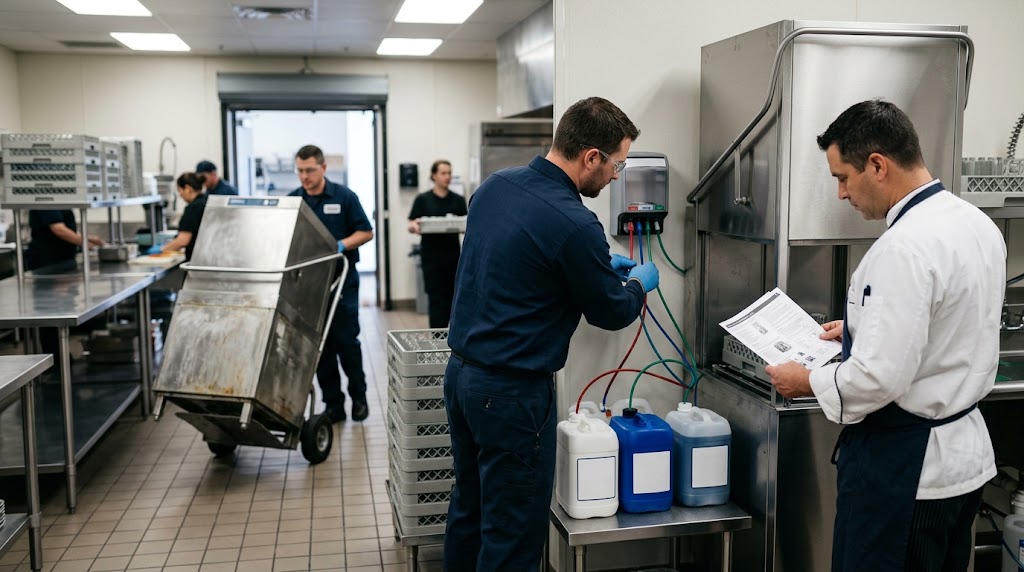
If your dish machine supplier isn’t returning calls, you can switch, and you don’t have to lose service for a day to do it. The process comes down to four steps: read your contract, time your exit notice, coordinate the equipment swap-out, and change your chemical program at the same time. Get them in the right order and the transition stays manageable. Miss one and you risk a gap in service.
This guide walks through how to switch dish machine providers in plain terms. It’s written for restaurant owners, hotel F&B directors, and healthcare operators who are leaving Ecolab, AutoChlor, ProClean, or a similar national provider and want to know exactly what happens between “I’m done with my current supplier” and “the new machine is running.”
Read Your Contract Before You Do Anything Else
Pull your current agreement before you make any calls. These are the four things to check, because they decide both your timing and your cost.
- Auto-renewal and notice window: Check whether your agreement renews automatically. If you don’t cancel within the set window before the renewal date, it can roll over, and that’s the window your current provider is counting on you to miss. Find the exact deadline and mark it on your calendar.
- Early termination fees: Check whether a fee applies and whether it’s tied to equipment removal or chemical volume. Knowing the real cost of leaving lets you weigh it honestly against ongoing service problems.
- Equipment ownership: Dish machine rental contracts typically mean the provider owns the machine and removes it when you leave. That shapes swap-out day logistics, so know whether you own or rent before you start coordinating dates.
- Chemical supply structure: Some contracts bundle machine rental and chemical supply, and others separate them. If yours is bundled, the equipment and chemicals change together. If they’re separate, you may have more flexibility on timing, but the chemical dispensing system still has to be swapped when you switch. More on that in the chemical changeover section below.
Time the Exit Correctly
Once you know your notice window, the next step is sending notice correctly and lining up the new provider. The goal is to avoid a gap between the old machine leaving and the new one running.
- Send notice the way the contract specifies: This is usually certified mail or email to a specific address. Verbal notice is not notice, and a conversation with a local rep won’t start your exit clock.
- Get written confirmation and a removal date: After you send notice, confirm receipt in writing and get an equipment pickup date from the outgoing provider. You need that date before you can schedule installation.
- Contact the new provider before you give formal notice: Installs take planning and are rarely immediate, so learn the install timeline before you commit to an exit date. If the install runs longer than expected after you’ve given notice, you’ll have a gap, and that’s the disruption operators fear.
- Coordinate removal and installation: Ideally, the old equipment comes out and the new equipment goes in on the same day or back-to-back. A good local provider works backward from the confirmed removal date to schedule installation, so ask whether they do this before you sign.
Swap-Out Day: What Actually Happens
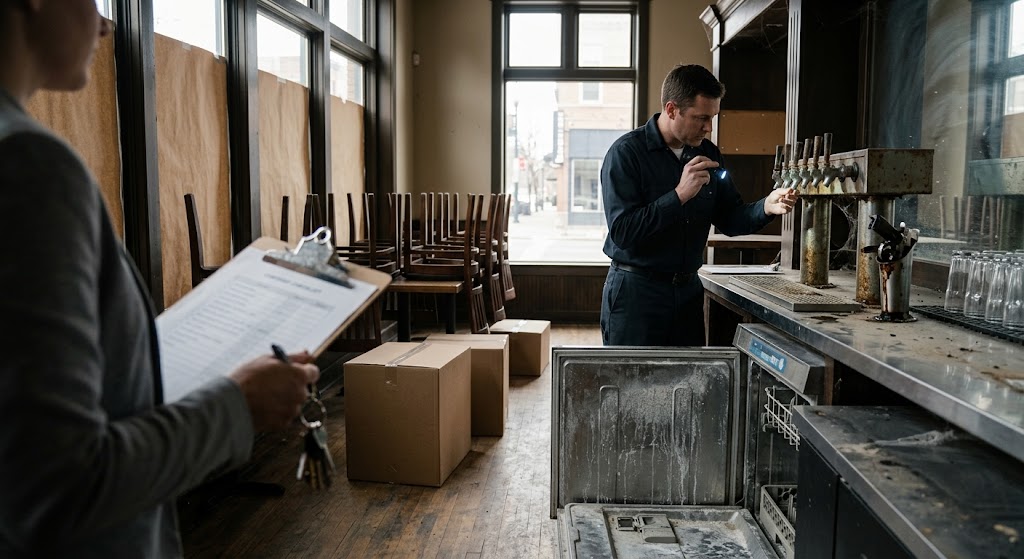
This is the part most operators haven’t seen before, and it’s where a coordinated switch either runs smoothly or turns into a gap in service. The outgoing provider’s equipment comes out, your new machine and dispensing system go in, and your team gets a quick orientation. Here’s what to expect, step by step.
- Removal: The outgoing provider removes their dish machine, their chemical dispensing system, and any wall-mounted dispenser hardware they installed.
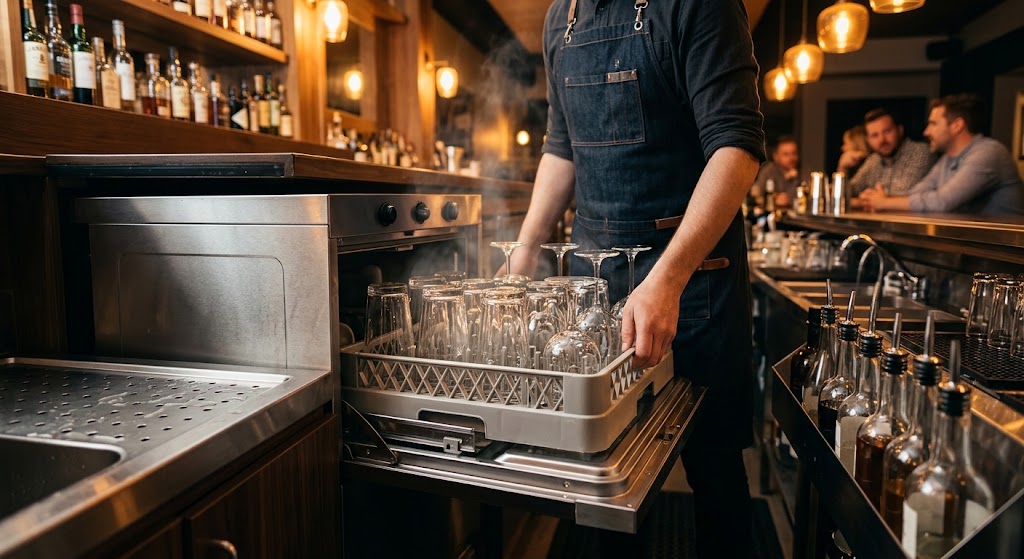
- Replacement equipment: If you switch to Denver Beverage, your new machine is an ADS (American Dish Service) unit from our own leased line. Pricing starts from $129 a month, and repairs are free. Our own technicians install it, not subcontractors. You can see how it fits with our dish and laundry chemical programs.
- Dispensing systems: Chemical dispensing systems aren’t interchangeable. Each is calibrated for its own chemical program, so the old unit comes out before the new one goes in. Running a different chemical through an existing system causes incorrect concentrations and potential compliance issues.
- Staff orientation: Your team needs a brief walkthrough on the new machine’s controls and the new dispensing system. It takes 15 to 30 minutes and should be scheduled with the installation technician on the same day.
- Health department compliance: Before service resumes, the machine has to be running within the required parameters. How that’s measured depends on the machine type. High-temp machines are judged on final rinse temperature, while low-temp (chemical-sanitizing) machines are judged on sanitizer concentration. Certification should be your new provider’s job, not yours.
Chemical Changeover: Don’t Mix Programs
The chemical side of a switch is easy to get wrong, because the chemicals and the dispensing equipment work as a matched set. Change one without the other and you end up with incorrect concentrations. Here’s how to keep the two in step.
- Never mix programs: The outgoing provider’s chemicals must be fully flushed from the system before the new chemicals go in. The new provider’s technician handles this as part of installation
- Purworks: Purworks is Denver Beverage’s own line of professional cleaning chemicals, made in Denver and sold in concentrated 1.5-gallon containers. It’s what goes in when you switch your dish program to Denver Beverage
- Program-specific dispensing: The wall-mounted units that inject detergent and rinse aid are calibrated for a specific program. Swapping chemicals without swapping the dispenser causes incorrect concentrations and potential compliance issues
- First rack: The new chemical program should be dialed in and verified before your first full rack, so hold off on service until that’s done
What to Ask a New Provider Before You Sign
These questions separate providers who will perform from those who only sound similar on paper. Here’s how Denver Beverage answers each one.
- Servicing: Who does the repairs, their own technicians or a subcontractor? Denver Beverage’s 13 service technicians are employees, not contractors, and they’re CFESA-trained.
- Response time: How fast will someone show up, and is that in writing? Denver Beverage offers a 24-hour service response with 7-day service coverage. If a provider can’t give you a number, that tells you something.
- Labor warranty: What does the warranty on labor cover? Denver Beverage covers repairs with a 90-day labor warranty.
- Free assessment: Will they look at your setup before you commit? Denver Beverage offers a free dish machine assessment before you sign anything, including a high vs. low-temp recommendation.
- Equipment: Is the machine part of the program, or do you buy it separately? ADS machines through Denver Beverage start from $129 a month with repairs included.
For operators on the Front Range and the I-70 corridor weighing a switch, our commercial dishwasher repair service page covers what service looks like after install. If you run restaurants and bars or a similar high-volume food service operation, the dish machine program can sit alongside your fountain, bar gun, and chemical programs on one account.
Ready for a Free Dish Machine Assessment?
If you’re ready to leave your current provider, call 303-295-3737 or get in touch for a free dish machine assessment, including a high vs. low-temp evaluation, before you commit to anything. We serve operators on the Front Range and the I-70 corridor and respond within 24 hours.
Frequently Asked Questions
Can I switch dish machine providers mid-contract?
Yes, you can switch mid-contract. Check your agreement for early termination terms and the required notice window. The cost may still be worth it when you weigh it against ongoing service problems.
Will I have to go without a dish machine during the switch?
Only if the timing isn’t coordinated. A competent new provider schedules installation around the confirmed removal date, ideally the same day or back-to-back. Contact the new provider before you give formal notice so you know their install timeline before you’re committed.
Do I have to replace my chemicals when I switch providers?
Yes, chemical programs are tied to the dispensing system, and the two must change together. The outgoing provider’s dispenser comes out with their machine, and the new provider installs their own, calibrated for their program. Running one provider’s chemicals through another’s hardware causes concentration errors and compliance problems.
What’s the difference between high-temp and low-temp dish machines, and does it matter when switching?
Yes, it matters. High-temp machines sanitize using final rinse water temperature, while low-temp (chemical-sanitizing) machines use sanitizer concentration. The type affects which standard applies and what your staff needs to monitor. Denver Beverage’s free dish machine assessment covers this, including a high vs. low-temp recommendation.
How is Denver Beverage different from Ecolab, AutoChlor, or ProClean?
Denver Beverage is built around local service and one account. Our own technicians, not subcontractors, handle installation and repairs, with a 24-hour service response and 7-day service coverage. Repairs carry a 90-day labor warranty, and Purworks chemicals, made in Denver, are part of the same program as the equipment and service.