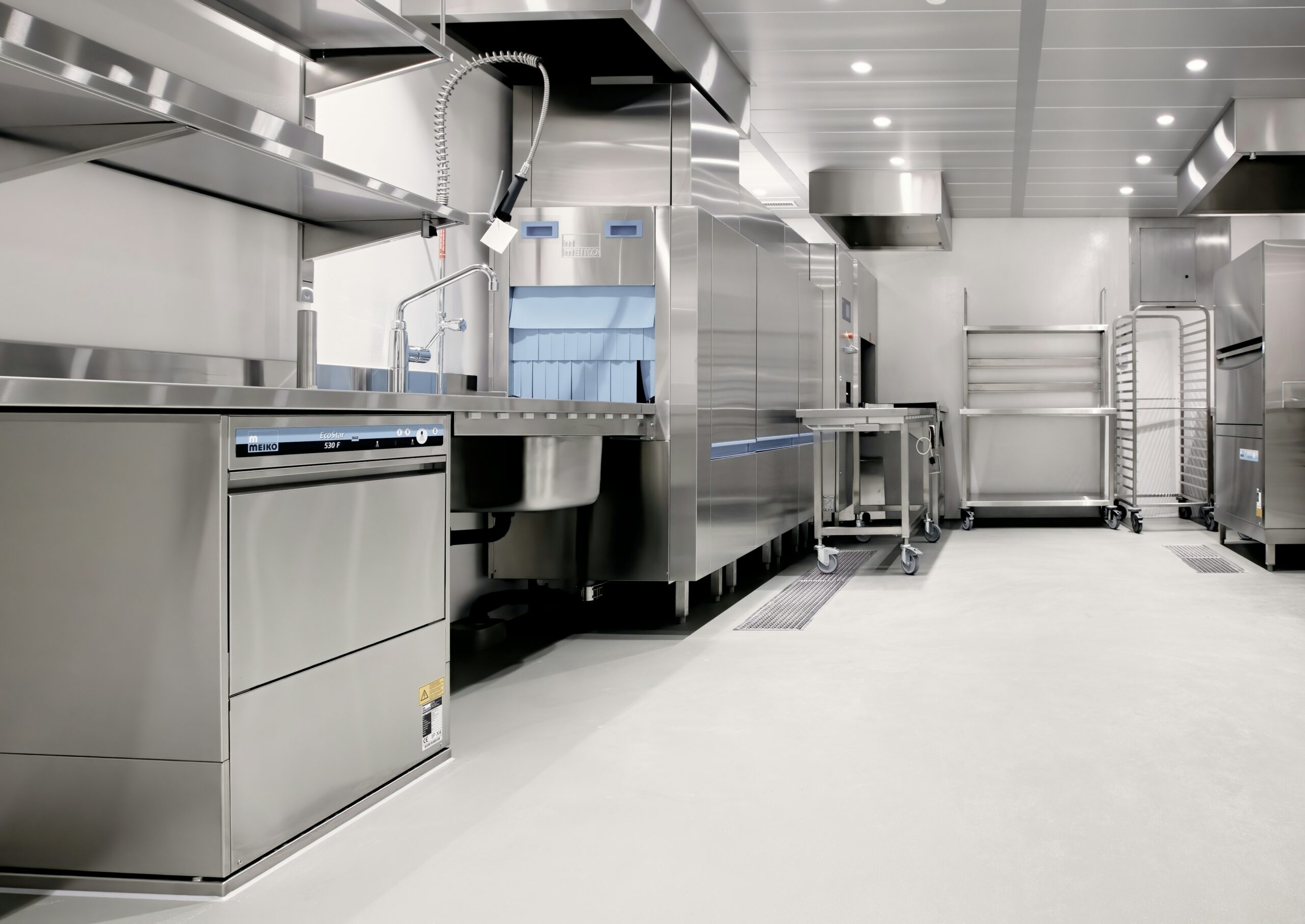
Dish and laundry operations in a healthcare facility carry regulatory obligations that commercial foodservice does not. A restaurant selects an NSF-registered sanitizer and meets its obligation. A healthcare facility serving patients must also satisfy infection control requirements, Joint Commission standards, and handling rules for contaminated linen. The vendor and program you choose determine whether your documentation holds up during a survey, not just whether your dishes come out clean.
If you’re already working with healthcare beverage programs through Denver Beverage, a chemical program fits within the same vendor relationship, with no separate onboarding required.
What Healthcare Dish Programs Require That Commercial Programs Don’t
Healthcare foodservice operates at a different regulatory ceiling than a commercial restaurant kitchen. Understanding where the requirements diverge is the first step in evaluating whether your current program actually meets them.
Chemical Selection Under NSF and FDA Requirements
Dish detergents, sanitizers, and degreasers used in healthcare foodservice must carry NSF registration for food-contact surface use. For sanitizing solutions applied in patient-facing food environments, FDA 21 CFR Part 178.1010 approved sanitizing solutions for food-contact surfaces governs which chemical classes are approved and under what conditions. The three primary classes used in warewashing chemicals programs are:
- Quaternary ammonium compounds (quats): Effective on commercial dish machines, but concentration-sensitive. Validated use ranges typically fall between 200 and 400 ppm. Not all quat formulations are appropriate for high-soil healthcare environments.
- Chlorine-based (hypochlorite) sanitizers: Widely used in high-temperature dishwasher applications. Rapid kill rate, but corrosive to stainless steel at incorrect concentrations. Validated at 50 to 100 ppm in the sanitizing rinse.
- Iodophors: Less common in dish programs. Used at 12.5 to 25 ppm and may leave residue on certain surface types.
High-temperature vs. Chemical-sanitizing Dish Machines
Healthcare facilities use one of two sanitizing methods, and each comes with its own equipment and documentation demands:
- High-temperature dishwashers. Final rinse of at least 180°F at the dish surface, per NSF/ANSI 3 (Commercial Warewashing Equipment). This reduces reliance on chemical sanitizers in the final rinse cycle, but demands consistent water temperature and a functioning booster heater.
- Chemical-sanitizing machines. Operate at lower temperatures but require precise automated chemical dispensing and verified concentration at the point of use.
Healthcare facilities offering beverage services must document which method they’re operating under and demonstrate that the chosen method meets sanitization efficacy standards. A detergent dispensing system and monitoring protocol must match the machine type, since this isn’t one-size-fits-all chemistry.
HACCP Compliance in Healthcare Foodservice
Healthcare kitchens serving patients operate under HACCP-aligned food safety plans. Warewashing is a critical control point. Chemical concentration monitoring logs are not optional documentation. They are evidence that the critical control point is being managed. A chemical program that does not include documentation support is not a complete program for a healthcare customer.
Healthcare Laundry Chemical Programs: CDC and OSHA Requirements
Linen and textile processing in healthcare settings carries its own regulatory framework, and this is the area most suppliers leave entirely unaddressed. Understanding the requirements is the baseline for evaluating any laundry chemical program.
CDC Guidance on Laundry Temperatures
The CDC Guidelines for Environmental Infection Control in Health-Care Facilities specify that soiled healthcare linen should be laundered using detergent in water at the warmest temperature appropriate for the fabric type, and at least 160°F for heavily contaminated items.
When a facility uses a low-temperature system instead, it must substitute a chemical system validated to achieve equivalent pathogen reduction. That is a program-design constraint, not a purchasing preference, and it shapes which products a supplier can legitimately offer you.
Low-temperature Laundry Chemistry Trade-offs
Many facilities are moving to low-temperature laundry systems (below 140°F) to save on energy costs. But washing at a lower temperature means the chemicals have to do more of the work that heat used to do.
The typical solution is peracetic acid-based or activated oxygen chemistry. These products need EPA registration under FIFRA, meaning the EPA has confirmed they actually kill the pathogens they claim to, including C. diff spores, which matters for any facility handling contaminated linen.
Your chemical supplier should be able to hand you that registration documentation on request, and help you present it if a surveyor asks. Denver Beverage’s laundry chemical program covers product selection for both high-temperature and low-temperature systems.
OSHA Bloodborne Pathogen Standard (29 CFR 1910.1030)
According to 29 CFR 1910.1030, contaminated linen must be handled with specific protective measures and placed in clearly labeled or color-coded bags. Chemical program suppliers serving healthcare laundry operations need to understand these handling requirements. This matters particularly when on-premise laundry staff are using dispensing systems that require any degree of manual intervention.
On-premise Laundry and Documentation Ownership
Joint Commission EC.02.06.01 requires facilities to maintain a clean and sanitary environment. For on-premise laundry, that means the facility owns the documentation: temperature logs, chemical concentration records, and equipment PM records.
A laundry chemical program that does not generate and organize this documentation is leaving a survey liability open. Denver Beverage’s infection control-aligned program covers chemical supply, automated dispensing, and maintenance, keeping all records under one accountable vendor relationship.
What a Complete Program Includes and How to Evaluate Suppliers
The SERP for this topic is dominated by market research reports and public health reviews. None of them answer the operational question a Dietary Director or Facilities Director actually needs answered: what should a complete chemical service program include, and how do you evaluate a supplier against that standard?
Use this framework when assessing any vendor. Ask for documentation on each point, not just a verbal commitment.
- NSF-registered and EPA-registered products for every application. This covers warewashing chemicals, laundry sanitization, and surface disinfection. Ask for the registration numbers, not just the product names.
- Automated chemical dispensing systems installed and calibrated to your specific machine and water conditions. Manual dispensing creates concentration variance that chemical-sanitizing programs cannot tolerate. A supplier who leaves dispensing to staff discretion is creating a compliance gap.
- Chemical concentration monitoring at regular intervals, with logs available for survey review. A documented monitoring protocol matters more than a quarterly check-in call.
- Water hardness assessment and scale deposit management. Colorado’s water hardness varies by municipality and source. Hard water interferes with sanitizer efficacy at the dish surface and affects rinse aid performance. A supplier who has not assessed your water supply is guessing at your chemistry.
- Preventive maintenance and equipment service. Chemical programs and the equipment they run through are not separable. A high-temperature dishwasher with a failing booster heater is a compliance liability regardless of the warewashing chemicals in use. A supplier who manages both chemicals and commercial dishwasher repair eliminates the accountability gap that occurs when your chemical rep and your equipment technician work for different companies. Commercial kitchen and beverage equipment repair extends the same single-vendor coverage beyond warewashing to your broader kitchen equipment.
- Training support for dietary and laundry staff. Staff turnover in healthcare foodservice is high. A program that includes initial and ongoing training on chemical handling, concentration verification, and OSHA-required PPE is part of what a program is, not an upsell.
- Cleaning products coverage for adjacent applications. Facilities managers evaluating full-scope chemical supply should also confirm that their supplier covers cleaning products for non-food-contact surfaces, housekeeping, and facility maintenance needs.
If a supplier cannot document any one of these elements, the program has a gap. In a healthcare environment under Joint Commission scrutiny, a gap in one area can expose the entire program during a survey.
How Denver Beverage Structures This for Colorado Healthcare Facilities
Denver Beverage supplies dish and laundry chemical programs as part of a bundled foodservice supply relationship. The same account that handles your beverage supply, coffee program, and disposables can also manage your warewashing and laundry chemistry. There is no new vendor onboarding, no second contract process, and no additional accounts payable relationship to manage.
Program structure for healthcare facilities includes:
- Chemical supply: Product selection for dish detergents, sanitizers, laundry chemistry, and rinse aid calibrated to your machine type, water conditions, and patient-care environment
- Dispensing equipment: Installation and calibration of automated chemical dispensing systems matched to your specific commercial dish machine and laundry equipment
- Preventive maintenance and repair: 13 field technicians with 7-day service coverage on the Front Range, because a dish room equipment failure in a healthcare facility cannot wait until Monday
- Documentation support: Chemical concentration monitoring records and PM logs maintained to support survey readiness under Joint Commission and State Health Department review
- State of Colorado preferred vendor status: Relevant to procurement officers evaluating approved supplier lists and facilities operating under state contract requirements
Denver Beverage has operated in Colorado since 1986, with statewide distribution and Front Range equipment service coverage across Denver Metro, Boulder County, Fort Collins, Colorado Springs, and Pueblo, including the I-70 corridor.
If your current program can’t produce concentration logs, PM records, or registration documentation on request, that’s a gap worth closing before a surveyor finds it first. Talk to Denver Beverage about what a single-vendor chemical program would look like for your facility.
Frequently Asked Questions
What chemicals are used in healthcare dish machines?
Healthcare dish machines use one of three NSF-registered and FDA-approved chemical classes under 21 CFR Part 178.1010. Quaternary ammonium compounds (quats) are used at 200 to 400 ppm. Chlorine-based hypochlorite sanitizers are used at 50 to 100 ppm in the sanitizing rinse. Iodophors are used at 12.5 to 25 ppm and are less common in high-volume dish programs. All three require documented concentration monitoring in a healthcare setting.
What are the sanitizing requirements for dishwashers in healthcare facilities?
A high-temperature dishwasher must deliver a final rinse of at least 180°F at the dish surface, per NSF/ANSI 3. A chemical-sanitizing machine must apply an approved chemical class at a validated concentration per FDA 21 CFR Part 178.1010. Both methods require documented chemical concentration monitoring. The facility must record which method is in use and demonstrate consistent compliance during inspections.
What is the difference between high-temperature and chemical-sanitizing dish machines?
A high-temperature dishwasher relies on thermal kill at the dish surface and reduces chemical demand in the final rinse. It requires a functioning booster heater and consistent water temperature. A chemical-sanitizing machine operates at lower temperatures and relies on a precisely dispensed chemical sanitizer. Each method has different maintenance requirements and generates different documentation. Healthcare facilities must know which method they are running and ensure their chemical program is designed for it.
How often should dish machines in healthcare settings be serviced?
Preventive maintenance frequency should follow the manufacturer’s recommended schedule and the facility’s daily volume. In a healthcare setting, PM records serve a dual purpose: they keep equipment performing to specification and they document infection control compliance for surveyor review. A failed booster heater or a malfunctioning detergent dispensing system is both an operational problem and a documentation gap.
How do commercial dish machine service programs work in hospitals?
A qualified program covers chemical supply, dispensing system installation and calibration, preventive maintenance, and equipment repair under one vendor relationship. When chemical supply and equipment service are managed by separate companies, documentation gaps emerge and accountability becomes unclear during a survey. A single-vendor model keeps concentration records, PM logs, and repair history in one place, which is what a Joint Commission surveyor expects to see.