A healthcare facility runs around the clock. Its cafeteria does not. Night-shift nurses, families in a surgical waiting room, and ambulatory residents all need food access when no dietary staff are present. Vending machines fill that gap with chips and candy bars. A micro market fills it with Greek yogurt, protein shakes, fresh grab-and-go meals, and bottled water, with zero dietary staff time required to run it.
This guide covers how micro markets work, who benefits, and what to check before you commit. For the full picture of Denver Beverage’s healthcare beverage programs, including coffee, beverages, and chemical programs, start there.
Who Inside a Healthcare Facility Actually Uses a Micro Market?
Most vendor materials wave at “staff and visitors” as a single audience. In a healthcare setting, those are three distinct groups with different needs, different schedules, and different relationships to your facility.
- Night-shift clinical staff work 12-hour rotations with a 30-minute break window. When the cafeteria closes at 7 PM, a vending machine is the only option on most floors. A micro market stocked with protein-forward items, think Fairlife protein shakes, hardboiled eggs, string cheese, RX bars, and Greek yogurt, directly supports healthcare workplace wellness for the people keeping your facility running overnight. This is a hospital staff amenity that registers in employee satisfaction surveys, not just a convenience add-on.
- Visitors in waiting areas are often spending four to eight hours in surgical waiting rooms or ICU family lounges with no food access that doesn’t require leaving the building. A micro market in a ground-floor common area gives families access to fresh food options without leaving the premises. There is no labor cost to the facility. Visitors buy directly at the self-checkout kiosk and move on.
- Ambulatory residents and patients in skilled nursing, assisted living, and rehabilitation settings represent a third use case that most micro market vendors ignore entirely. A resident with enough mobility to walk to a common-area market is making an independent purchase on their own terms. That matters for quality-of-life metrics and dignity of care in a way a dietary cart cannot replicate.
Product mix across all three audiences should include fresh grab-and-go meals, healthy snacks, bottled water, juice, coffee, and basic personal care items. Denver Beverage manages the planogram through the GrabScanGo platform. Your dietary staff do not decide what goes on the shelves or manage reorders. Pairing a micro market with stocked breakroom supplies in your staff lounge covers the broader break room solution your clinical team actually needs.
How a Healthcare Micro Market Works Operationally
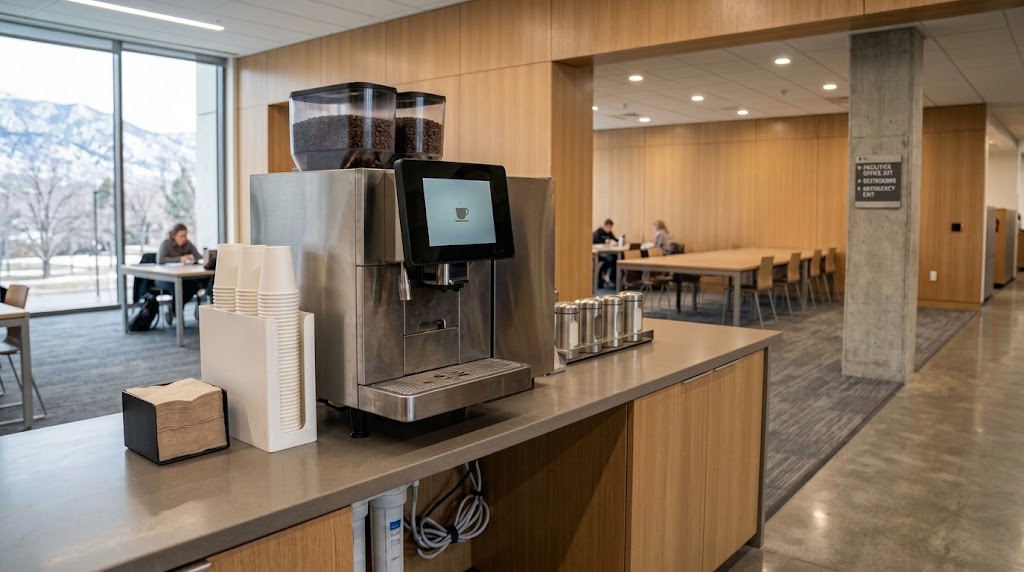
A micro market is an open-concept refreshment station: cooler units, dry goods shelving, and a self-checkout kiosk arranged in a dedicated space, with no cashier, no coin mechanism, and no locked cabinet. Shoppers select items and pay at the kiosk directly.
- Payment: Denver Beverage’s micro market installation platform accepts credit and debit cards, contactless payment via Apple Pay and Google Pay, and account-based payment through GrabScanGo. No cash handling for the facility, no change-making at the kiosk.
- Restocking and inventory: GrabScanGo handles remote monitoring of inventory levels using inventory management software that tracks sales in real time. Restocking frequency is determined by actual usage volume, not a fixed calendar schedule. Denver Beverage’s field technicians handle restocking and equipment maintenance, dietary staff are not operationally involved.
- Hours: The market operates with 24/7 access. In a healthcare facility, that means it’s available at midnight when the cafeteria has been closed for five hours.
- Loss prevention: Cameras are standard on every installation. Product is open-access, not locked, and shrinkage control is built into the program model rather than passed back to the facility as a liability.
- Product mix: Planogram optimization through GrabScanGo adjusts product mix based on what actually sells at your location.
To see how Denver Beverage’s micro market program works in practice, the hotel lobby micro market case study shows the same operational model in a 24/7 environment, including restocking cadence, product mix, and monthly revenue outcomes.
Healthcare-Specific Considerations Before Installation
This is where due diligence matters. The four areas below are what a healthcare administrator should review before signing a micro market agreement.
1. Space and environment
- Roughly 200 to 400 square feet, enough for a cooler, dry goods shelving, and a self-checkout kiosk
- Works in staff break rooms, visitor waiting areas, and ground-floor common areas
- Not appropriate for secured clinical areas, psychiatric wards, or ICUs with restricted access in a standard open-concept format
- A modified, locked-access configuration exists for restricted environments, but confirm this with your vendor before assuming it applies
2. Regulatory context
A micro market operating inside a licensed healthcare facility is classified as unattended retail under applicable food safety frameworks. In Colorado, retail food establishments require licensing through the Colorado Department of Public Health and Environment’s retail food establishment licensing program.
The micro market operator, not the hospital, typically holds the food facility license for the market itself. Confirm this allocation in writing before installation, and verify it doesn’t create a documentation gap in your own food safety records. Most deployments clear this without difficulty, but ignoring it is the wrong posture for a healthcare audience.
3. Infection control
- Site the market away from patient care areas
- High-touch surfaces (kiosk touchscreen, cooler handles) require regular cleaning and sanitation
- Confirm surface sanitation is part of your operator’s service protocol before contracting; Denver Beverage includes this in its service scope
4. Revenue and contracting model
A standard micro market agreement is a zero-capital model for the facility. Denver Beverage provides and owns the equipment, stocks and manages the market, and takes revenue from sales. The facility gets the service benefit with no capital outlay and no labor cost, a structure that differs materially from a vending contract or a cafeteria management agreement.
Revenue-share terms vary by operator, and the National Automatic Merchandising Association publishes benchmarks for unattended retail program structures that can serve as a reference point when evaluating contract terms. Confirm all financial terms in writing.
One thing worth noting directly: micro market payment systems don’t handle protected health information and aren’t subject to HIPAA, but administrators sometimes ask.
How a Micro Market Compares to Other Refreshment Options in Healthcare Settings
The micro market is not the right answer for every refreshment need in a healthcare facility. Understanding where it wins and where it does not is more useful than a one-sided pitch.
One bridge sentence before the comparison: the table below compares a micro market against a traditional vending machine and a staffed cafeteria across the five dimensions that matter most to healthcare administrators.
| Dimension | Micro Market | Vending Machine | Staffed Cafeteria |
| Hours of operation | 24/7 access | 24/7 | Limited (typically 6 AM to 7 PM) |
| Product quality and variety | Fresh food options, protein items, beverages, personal care | Packaged snacks and drinks only | Full meal service, widest variety |
| Labor requirement for facility | None | None | Significant (dietary staff, scheduling) |
| Cost to implement | Zero capital outlay; operator owns equipment | Equipment lease or purchase | High (build-out, staffing, inventory) |
| Staff and visitor experience | Self-checkout kiosk, cashless payment, open browsing | Limited selection, coin or card only | Best for full meals; closed off-hours |
The cafeteria is still the right answer for full meal service. The micro market wins on off-hours coverage, unattended retail flexibility, and zero labor burden. As a vending machine alternative, it offers fresh food options and a better experience for night-shift clinical staff and overnight visitors. Employee satisfaction data consistently reflects the gap between what a vending machine offers and what a stocked micro market provides.
Is a Micro Market the Right Fit for Your Facility?
Use this checklist to evaluate fit before engaging a vendor.
- 24/7 operations with off-hours staff. If nurses, CNAs, and support staff are present when the cafeteria is closed, the core use case exists.
- Available common-area space. A footprint of 200 to 400 square feet near staff or visitor traffic is the minimum viable installation area.
- Unmet off-hours need. If your current dining program leaves a gap between 7 PM and 6 AM, a micro market addresses it directly without adding dietary overhead.
- Multiple internal audiences. Facilities with night-shift clinical staff, waiting-area visitors, and ambulatory residents get the most value from a single installation because the market serves all three groups simultaneously.
- Location within Denver Beverage’s service area. Micro market service is concentrated in the Denver metro and Colorado Springs metro, extending to the Front Range corridor from Fort Collins to Pueblo. If your facility is in this geography, Denver Beverage can support ongoing restocking and equipment service. Mountain locations are not currently served.
- Interest in a zero-capital model. If your facility cannot absorb equipment capital or additional labor headcount, the standard micro market agreement structure addresses both constraints.
If most of these apply to your facility, a micro market is worth a detailed conversation. Denver Beverage’s healthcare beverage programs page covers the full scope of services available to healthcare facilities in Colorado, including beverages, coffee programs, and chemical programs, alongside the micro market offering.
Not sure if your facility qualifies? Talk to Denver Beverage and walk through your space, shift patterns, and service area together.
Frequently Asked Questions
What is the minimum space required for a healthcare micro market?
A functional micro market requires approximately 200 to 400 square feet. This accommodates a cooler unit, dry goods shelving, and a self-checkout kiosk with enough clearance for foot traffic.
Does a micro market require any staff time from the facility?
No. Denver Beverage handles restocking, remote monitoring, planogram optimization, and equipment maintenance through the GrabScanGo platform. Dietary staff are not involved in operations.
Is a micro market subject to HIPAA?
No. Micro market payment systems process standard financial transactions and do not handle protected health information. HIPAA compliance requirements do not apply to the market or its payment platform.
What payment methods does a healthcare micro market accept?
Denver Beverage’s GrabScanGo platform supports credit and debit cards, contactless payment including Apple Pay and Google Pay, and account-based payment. There is no cash handling required.
Can a micro market be placed in a secured clinical area?
A standard open-concept micro market is not appropriate for psychiatric wards or ICUs with restricted access. A modified locked-access configuration is available for secured environments. Discuss this with your vendor before assuming standard deployment applies.
How does the financial model work?
Under a standard agreement, Denver Beverage provides and owns all equipment, stocks and manages the market, and takes revenue from sales. The facility pays no capital cost and carries no labor burden. Revenue-share terms vary and should be confirmed in writing.