The short answer: an office snack delivery service drops a box at your door, and your team handles everything from there. A managed pantry service means a vendor shows up, stocks the shelves, rotates product, and takes the whole task off your plate.
Which one your office needs comes down to three questions. How much admin time is snack logistics costing you? What do you spend each month? And do you have somewhere to store a bulk delivery?
What “Office Snack Delivery” Actually Means
With a delivery model, the vendor’s job ends at your door. A box or recurring shipment arrives on a schedule, and everything after that falls to your team. For very small teams, this works fine. As headcount grows, the friction compounds.
Here’s what the work looks like once the box lands:
- Handling it: Someone on your team unpacks the delivery, sorts it, and finds somewhere to store it.
- Dealing with leftovers: Someone figures out what to do with the items nobody touched last month.
- Over-ordering: You guess at consumption and end up with a shelf of expired protein bars.
- Under-ordering: You forget to resubmit the form and find an empty cabinet on a Tuesday afternoon.
Over-ordering and under-ordering are the two most common failure points in office snack subscriptions. Neither one is obvious until it’s already happening.
The other hidden cost is dietary fit. A snack subscription box ships what it ships. If your team has members who avoid gluten, nuts, or dairy, you’re filtering through every delivery manually and finding workarounds. That task falls to whoever placed the order.
What a Managed Pantry Service Actually Means
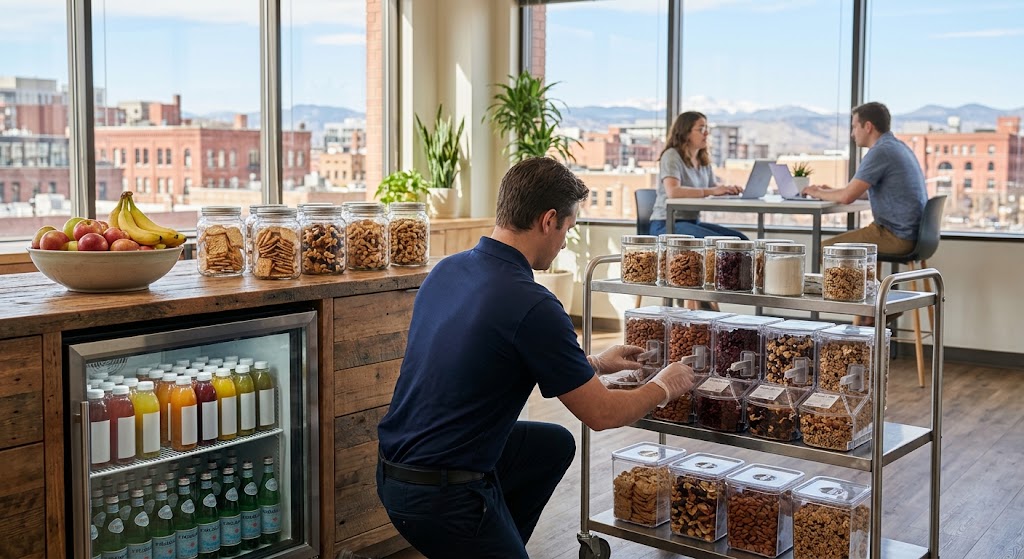
A managed pantry service is a different model entirely. The vendor shows up on a schedule, assesses what’s running low, stocks the shelves and coolers, rotates product out before it expires, and leaves. Nobody on your staff owns the task. The pantry is stocked; the work is done.
Denver Beverage’s snacks and pantry supply program works this way. The office sets preferences and a budget. Denver Beverage manages product selection, restocking, and rotation from there. The same local team that handles your coffee and refreshments handles the pantry, so it’s one account, one point of contact, and no coordination overhead on your end.
Office pantry stocking also makes dietary needs easier to handle. A managed vendor can build those preferences into the program. A box that ships the same curated selection to every subscriber can’t do that.
The Decision Framework: Three Questions to Ask
1. How much admin time is snack management actually costing you?
The time adds up faster than it looks. Someone places the order, receives the delivery, unpacks it, sorts it, and rotates product. Then come the inevitable “can we swap these out?” requests. For a 40-person office, that can easily add up to an hour or more per week.
That’s time an office manager or HR coordinator is spending on a task that genuinely isn’t their job. The managed model exists to eliminate that task entirely, not just make it slightly less annoying.
2. What’s your monthly spend range?
Delivery subscriptions tend to cost less per month but need more staff time. Managed programs can cost more but run themselves. For context, a small Front Range office of 15 to 20 people on a combined coffee and snacks program is realistically in the $1,600 a month range.
3. Do you have somewhere to put a bulk delivery?
A delivery model needs three things from your office:
- Receiving space: Somewhere to put a bulk delivery when it arrives.
- Refrigeration: Cold storage if you’re ordering perishables.
- Inventory rotation: Someone reliable enough to manage it on their own schedule.
A managed program needs none of that, because the vendor handles it. For offices without a storage area or a staff member who can own rotation consistently, that removes a genuine logistical problem, not just a convenience gap.
What a Managed Pantry Program Looks Like in Practice
Denver Beverage serves commercial accounts across the Front Range, including offices in Denver, Boulder, Greenwood Village, and the Denver Tech Center. The pantry program is built around what your team actually wants, not a generic catalog. Office managers set preferences. Denver Beverage handles the sourcing, scheduling, and restocking.
Many accounts combine workplace snacks and coffee into a single program. That means one vendor, one account, and one call when something needs attention. Denver Beverage’s office coffee service covers bean-to-cup equipment and drip, along with local and national brands like Ozo Organic Coffee, Queen City Collective, Boyer’s, Boulder Organic, Lavazza, Peet’s, and Starbucks. Pair that with a managed pantry and your snacks and coffee run on one program. Our office coffee services overview shows the full range.
Larger offices that want a self-service option instead of a stocked pantry have another route. Denver Beverage also installs micro markets with no upfront cost for qualifying locations.
When Delivery Is Still the Right Call
A managed pantry isn’t the right fit for every office, and it’s worth saying that plainly.
Delivery subscriptions and bulk orders make more sense when:
- Team size is under 15: Volume at that scale often doesn’t justify a managed service. A small order every few weeks is genuinely manageable.
- Admin capacity is flexible: If someone on staff genuinely doesn’t mind handling snack logistics and has time for it, the delivery model works.
- Your team is mostly remote or hybrid: Low and unpredictable in-office headcount makes it hard to run a consistent managed program. A delivery model lets you scale the order up or down more easily.
If your office fits one of those descriptions, a delivery subscription or bulk ordering from a retailer is a reasonable choice. The managed model makes sense when the admin time cost is real, the team is consistently in the office, and you want the task off your plate entirely.
Ready to Take Snack Logistics Off Your Plate?
If you manage a Front Range office, the Denver Beverage team can show you what a managed pantry would look like for your headcount. They’ll tell you what’s currently on the program and what it takes to get started. Call 303-295-3737 or request a consultation. Quote requests get a response within 24 hours.
Frequently Asked Questions
How much does a managed office pantry service typically cost?
A managed pantry usually costs more per month than a delivery subscription, but it includes the labor your team would otherwise absorb. For context, a small Front Range office of 15 to 20 people on a combined coffee and snacks program is realistically in the $1,600 a month range. Call Denver Beverage at 303-295-3737 for current program details and a quote for your office.
How is a managed pantry service different from a snack subscription box?
The difference is who owns the ongoing logistics. With a snack subscription box, the product arrives and your team unpacks it, stores it, and manages rotation. With a managed pantry service, the vendor does all of that. They show up, check what’s low, stock the shelves, and rotate product out.
Does Denver Beverage supply both snacks and coffee in one program?
Yes. Many accounts run a combined snacks and coffee program through Denver Beverage, which means one account and one contact for both. The coffee program includes bean-to-cup equipment, drip machines, and brands including Ozo Organic Coffee, Queen City Collective, Boyer’s, Boulder Organic, Lavazza, Peet’s, and Starbucks.
How quickly can a managed pantry program be set up?
Setup takes planning and isn’t immediate, so it helps to start early. The Denver Beverage team will walk you through what’s involved for your location and give you a realistic timeline. Call 303-295-3737 to start that conversation.
What if our office has employees with dietary restrictions and preferences?
A managed vendor can build dietary preferences directly into the program. That’s one of the practical advantages over a delivery subscription, which ships a fixed curated snack selection regardless of your team’s needs. Tell the Denver Beverage team what dietary restrictions and preferences matter for your office and the program is built around those from the start.