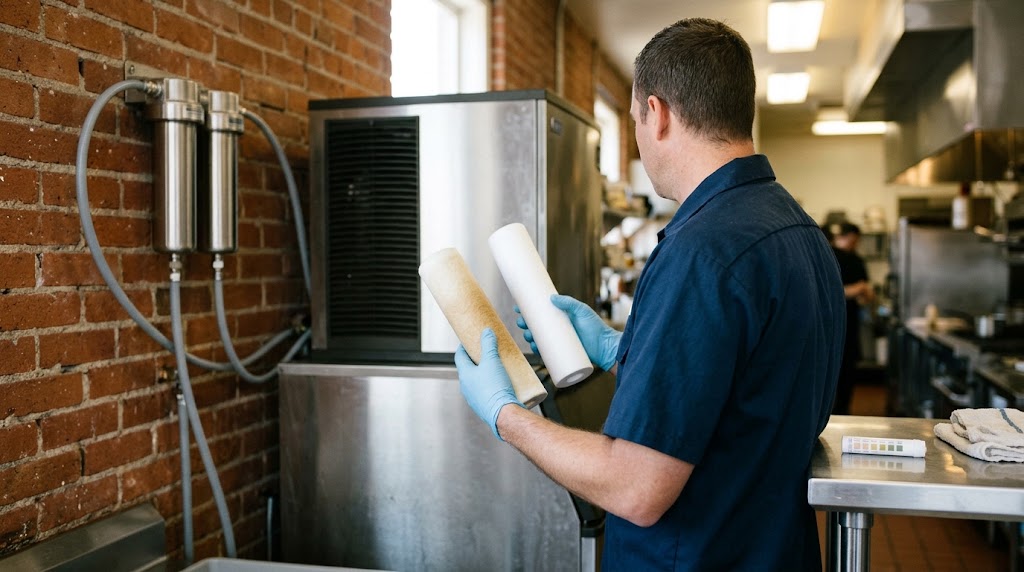
A commercial ice machine water filter does two jobs. It removes the sediment, chlorine, and chloramines that affect how your ice tastes, and it inhibits the scale and mineral buildup that shortens your equipment’s service life. Skip the filter or let it run past its service interval, and both problems compound quickly.
This guide covers what a commercial ice machine water filter actually does, why filter replacement intervals aren’t one-size-fits-all, and what happens when maintenance slips. It also explains what the NSF certification labels on filter packaging actually mean for a food service operation.
What a Commercial Ice Machine Water Filter Actually Does
Most operators assume a single inline filter handles everything. It doesn’t, and the distinction matters. A commercial ice machine water filter typically performs two mechanically separate jobs, and knowing the difference helps you pick the right filter and know when it’s spent.
- Sediment filtration and taste protection: Filters with an activated carbon block reduce chlorine and chloramines, particulate matter, and the off-tastes that come with them. The carbon adsorbs chlorine compounds as water passes through, and a micron rating tells you how small a particle the filter will catch. This is what keeps your ice tasting clean and prevents chloramine from corroding internal copper and stainless components.
- Scale inhibition: This is a separate mechanism entirely. A scale-inhibiting filter adds a food-safe polyphosphate or similar compound that binds to calcium and magnesium ions before they can deposit as limescale on your evaporator plates. When limescale builds up there, the machine has to work harder to freeze water. You get slower production, smaller or misshapen cubes, and eventually a component failure.
A standard carbon inline filter addresses taste and odor. It doesn’t inhibit scale. If your water supply is hard and you’re running only a carbon filter, the evaporator is collecting scale no matter how clean your ice tastes.
How Water Hardness Determines Your Filter Change Schedule
There’s no single correct answer for how often to change the filter cartridge on a commercial ice machine. The answer depends mainly on your incoming water hardness and your machine’s daily output. Three things drive the real replacement interval:
- The gallon rating isn’t the whole answer: Filter cartridges are rated by capacity in gallons, and a big number sounds like it should last a year. But a busy commercial ice machine uses far more water than a residential unit, so it can exhaust a cartridge much faster than the rating suggests.
- Water hardness sets the pace: Hardness is measured in grains per gallon, and on the Front Range and the I-70 corridor it varies considerably by municipality. An operator on harder water will use up a scale-inhibiting filter’s polyphosphate capacity well before the gallon rating runs out. In that case, following the interval on the box leads to under-maintenance.
- Time matters as much as volume: Most commercial filtration manufacturers recommend changing filters every six months regardless of gallon rating. A cartridge sitting in a housing with slow or intermittent water flow can develop biofilm in the filter media even before its capacity is used up.
If you don’t know your local water hardness, your municipality publishes an annual water quality report. A water assessment during an ice machine service call can also tell you what you’re working with before you set a filter cartridge replacement schedule.
What Happens When the Filter Isn’t Changed on Time
The failure chain from a neglected filter is predictable, and each stage makes the next one more expensive to fix:
- Scale builds up on the evaporator: Once scale and mineral buildup starts coating the evaporator plates, the machine works harder to reach freezing temperatures. Production slows, cubes shrink, and freeze-over faults begin. Left long enough, the evaporator itself fails, and that’s a major repair, not a filter swap.
- Chlorine and sediment break through: Once the activated carbon block is saturated, it stops adsorbing chlorine and chloramines, and the ice starts to taste off. In bar environments, that off taste often gets blamed on CO2 or syrup. If your cocktails or fountain drinks taste wrong, check the ice first. Our fountain and bar gun troubleshooting guide shows you how to tell the difference.
- Inlet screens clog: Sediment that gets past a spent filter collects on the water inlet screen inside the machine. A clogged screen leads to a service call that a timely filter replacement would have prevented.
- Biofilm develops in idle equipment: This one is a food safety concern, not just a mechanical problem. When a machine sits idle for a long stretch, water stagnates in the filter housing and internal lines, and biofilm can start to grow. The FDA Food Code treats ice served to people as food, so any contamination risk in the ice-making system is a food safety issue. Seasonal venues, conference room machines, and any unit that goes weeks between uses are the highest-risk cases. When you bring an idle machine back into service, replace the filter cartridge and flush the system. That’s standard ice machine maintenance practice.
Most operators can replace the filter cartridge themselves with the correct cartridge and a proper shutoff procedure. Anything involving internal water line connections, or the filter head and housing beyond a cartridge swap, is a technician task.
NSF Certification: What the Labels Actually Mean for Commercial Food Service
“NSF certified filter” on a box sounds definitive. It isn’t, because the certification covers specific performance claims, not all of them. The standard number on the label tells you what was actually tested.
The NSF/ANSI standards for filtration systems define distinct certification categories, and the differences matter for a food service operation:
- NSF/ANSI 42: Covers aesthetic effects such as chlorine taste, odor, and particulates. A filter certified only to this standard is a taste-and-odor filter.
- NSF/ANSI 53: Covers health-related contaminants, such as lead and cysts.
A standard number alone doesn’t prove a specific claim, because manufacturers choose which contaminants their product is certified to reduce. Check the packaging for both the standard and the specific claim. An operator who picks a filter based only on an “NSF Certified” label may end up with one certified for taste and odor only. For current filter specifications and what’s available through Denver Beverage’s program, call 303-295-3737.
Warranty Implications: A Detail Most Operators Miss
This is where filter selection becomes a financial decision, not just a maintenance one. Three points are worth knowing before you choose a filter:
- Water quality terms: Warranty terms can specify incoming water quality conditions. When hardness exceeds the manufacturer’s threshold, and no approved scale-inhibiting filter is installed, scale damage may fall outside coverage.
- Carbon filters don’t inhibit scale: A standard carbon inline filter takes care of taste and odor, but it does nothing to stop scale. That matters because warranty hardness limits differ by manufacturer and model, so check your own paperwork for the exact number. If your warranty calls for a scale-inhibiting system and you’re running only a carbon filter, a scale-related failure may not be covered.
- The practical step: Review your equipment warranty documentation for its water quality and filtration requirements. If you’re not sure what it says, ask your service provider at the next technician visit. The right filter usually costs far less than an out-of-warranty evaporator replacement.
Denver Beverage’s CFESA-trained technicians handle commercial kitchen and beverage equipment repair on the Front Range and the I-70 corridor, including Hoshizaki, Manitowoc, and Bunn equipment. If a service call reveals a scale-related issue, the technician can assess what filtration the machine needs to prevent a repeat.
Talk to Denver Beverage About Ice Machine Service and Filtration
Denver Beverage has been Colorado-owned since 1986. Our 13 service technicians cover ice machine service across the Front Range and the I-70 corridor, with 7-day service coverage, a 24-hour service response, and a 90-day labor warranty on repairs.
If your ice machine is overdue for a filter change, producing off-tasting ice, or showing signs of scale buildup, our team can assess the equipment and your incoming water supply in the same visit. We also support filtered water and ice programs for commercial accounts. Call 303-295-3737 to request a service call or water assessment.
If you also run commercial warewashing equipment, Denver Beverage’s own ADS (American Dish Service) leased dish machines start at $129 a month, with free repairs included. See our commercial dishwasher repair service page for details or request a consultation.
FAQ
Do commercial ice machines need a water filter?
Yes. A commercial ice machine needs a water filtration system to protect both ice quality and the equipment itself. Chlorine and chloramines in municipal water affect taste, and dissolved calcium and magnesium cause scale and mineral buildup on evaporator plates. A properly specified filter addresses both, and many manufacturer warranties set water quality requirements.
How often should you change the water filter on a commercial ice machine?
Most commercial filtration manufacturers recommend changing the cartridge every six months regardless of gallon rating. Harder water and higher daily output can shorten that interval, so operators on harder municipal supplies often need more frequent changes than the filter’s rated capacity implies.
Can a dirty water filter affect ice machine performance?
Yes, in several ways. A saturated carbon filter lets chlorine and chloramines through, which makes ice taste off. A depleted scale-inhibiting filter lets limescale collect on evaporator plates, which slows production, shrinks cubes, and can cause freeze-over faults. Sediment that bypasses a spent filter also clogs the water inlet screen, which typically needs a service call to clear.
What’s the difference between NSF 42 and NSF 53 for a commercial ice filter?
NSF 42 is the taste-and-odor standard, and NSF 53 is the health-related one. For commercial food service, it matters which standard and which specific claim a filter is certified to before you specify a filtration system.
Does using the wrong water filter void my ice machine warranty?
It can. Warranty terms often set water quality requirements, and scale damage may not be covered without an approved filter. A standard carbon inline filter doesn’t inhibit scale, so check your warranty documentation or ask a technician which filter specification your machine requires.
How do I know if my ice machine needs a filter change?
The clearest signs are off-tasting ice, slower production than normal, smaller or irregular cubes, or a filter past its change interval. If the machine has been idle for an extended period, a filter change and system flush are good practice before it goes back into service. If you’re not sure when the last cartridge was replaced, treat it as overdue and start the schedule from there.