Your soda fountain goes down on a Friday afternoon. Your ice machine quits in the middle of a July lunch rush. Your frozen beverage machine stops cycling during a packed Saturday night shift. None of these failures wait for a convenient service window, and none of them give you much warning.
For a facility manager running multiple locations, one unplanned commercial beverage equipment failure means an emergency ticket and a scramble for parts. The repair bill is typically 1.5 to 2 times what a scheduled preventative maintenance (PM) visit would have cost.
This guide is for the reader who already knows PM matters and wants to know what a legitimate program actually covers: which equipment gets serviced on what schedule, what tasks a professional PM visit includes, and what deferred maintenance costs in real dollars and downtime.
The Real Cost of Reactive-Only Maintenance
Emergency service calls carry a labor premium. Reactive calls typically run 1.5 to 2 times the labor cost of a scheduled PM visit, with the added hit of expedited parts sourcing when a component isn’t on the truck. That multiplier compounds quickly across a portfolio of locations.
- Equipment downtime turns that premium into lost revenue: A high-volume post-mix dispenser generating $300 to $500 per day in beverage sales, sitting idle for a full shift, is a straightforward revenue loss. A frozen beverage machine at a sports bar on a game day carries a similar calculation. Catching a failing seal or a low refrigerant charge during a 10-minute PM inspection costs a fraction of that.
- Skipped maintenance shortens equipment lifespan: Commercial ice machines and carbonation systems that don’t follow a preventative maintenance schedule routinely fail two to three years before their rated service life. A compressor running hot because of a dirty condenser doesn’t announce itself before it fails.
- A failed health inspection carries its own cost: An unclean ice machine or contaminated dispenser lines can mean fines, reinspection fees, and, in the worst cases, forced closure. These aren’t hypothetical consequences. They’re the outcomes of skipping the schedule.
Compliance Requirements That Set the Floor
Beverage equipment cleaning isn’t just best practice. It’s governed by federal standards that set a hard minimum, and two apply directly here:
- NSF/ANSI Standard 12 (Automatic Ice-Making Equipment) requires that ice machines be cleaned and sanitized on a schedule consistent with manufacturer recommendations. In practice, that means a minimum of every six months for most units, and more frequently in high-mineral-content water environments where scale accumulates faster. Remember that NSF certification for an ice machine reflects the unit’s design, not your maintenance record. The maintenance record is your responsibility.
- NSF/ANSI Standard 18 (Manual Food and Beverage Dispensing Equipment) covers cleaning and sanitation requirements for post-mix dispensers, carbonated soda systems, and frozen beverage machines. Nozzles, diffusers, and product lines must be cleaned at intervals that prevent bacterial growth and biofilm formation, a requirement Colorado health departments check directly during inspections, not a suggestion.
These two standards are a compliance minimum, not a maintenance program. Meeting them keeps you out of trouble during an inspection. The schedule in the next section is built to exceed both, because a program designed only to pass inspection isn’t the same as one designed to keep your equipment running.
PM Frequency and Task Breakdown by Commercial Beverage Equipment Type
This is the section most PM guides skip. What follows is a reference schedule you can use as a baseline when evaluating your current program or building one from scratch. Each equipment category carries its own service interval, a specific task list, and the failure mode that skipped routine maintenance tasks will eventually produce.
Ice Machines
Service interval: Every six months minimum. Quarterly in high-use or hard-water environments.
PM tasks:
- Clean and sanitize the evaporator, water distribution system, and all ice-making components
- Replace the water filter (every six months or per manufacturer guidelines)
- Inspect and clean condenser coils
- Check refrigerant levels
- Inspect door gaskets and seals
- Test safety shutoffs
- Descale water lines where mineral buildup is present
Failure mode: Scale and mineral deposits on evaporator plates reduce ice production efficiency and force the compressor to overwork. Biofilm in water lines is a direct health code compliance failure.
A dirty condenser makes the compressor run hotter, cutting its service life by 30 to 50% compared to a properly maintained unit. Ice machine maintenance isn’t optional when your ice machine is also your health inspector’s first stop.
Carbonated Soda Dispensers and Post-Mix Systems
Service interval: Full PM every six months. Nozzle and diffuser cleaning weekly (operator-level task). BIB line and carbonation check quarterly.
PM tasks:
- Clean and sanitize all dispensing nozzles, diffusers, and drip trays
- Inspect and test CO2 (carbon dioxide) pressure and carbonation ratios, with reliable beverage gas supply being a key factor in maintaining consistent carbonation performance
- Check all syrup lines for leaks, kinks, or contamination
- Inspect and replace worn O-rings and gaskets
- Calibrate brix ratios per manufacturer guidelines
- Test backflow prevention
Failure mode: Out-of-spec brix ratios produce off-taste product that goes unnoticed until customers stop ordering. A slow CO2 leak drives up gas costs and eventually yields a flat product.
And a failed backflow preventer isn’t just a maintenance miss. It’s a health code violation that the next inspection will catch. None of this helps if your dispenser is already acting up right now, though; for flat product or no syrup flow today, our fountain and bar gun troubleshooting guide walks through the fix.
Frozen Beverage Machines
Service interval: Full PM every six months. Daily cleaning of dispensing components by the operator. Quarterly inspection of the refrigeration system.
PM tasks:
- Disassemble and sanitize all product-contact components: barrels, spigots, and beater blades
- Inspect and replace worn seals and O-rings
- Check refrigerant charge and compressor operation
- Inspect the drive motor and belt condition
- Calibrate product viscosity and freeze consistency settings
- Check electrical connections
Failure mode: Worn seals allow product contamination and air infiltration that degrade product consistency. A neglected refrigerant charge causes the machine to overchill or underchill, wasting product and stressing the compressor. Equipment downtime on a frozen beverage machine during peak season is a recoverable problem only if parts are available. In summer, they often aren’t.
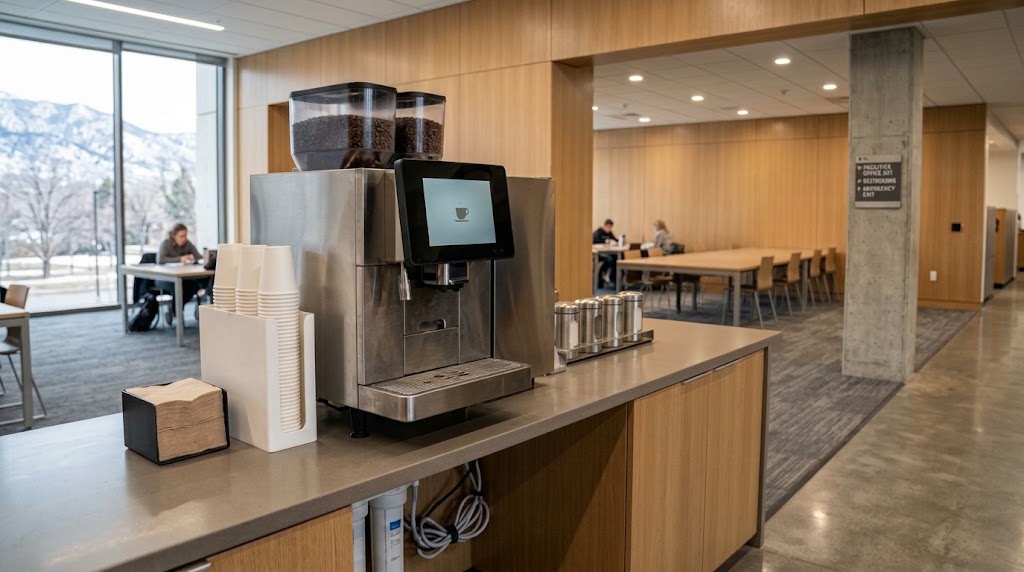
Coffee and Espresso Equipment
Service interval: Descale every one to three months depending on water hardness. Full PM every six months. Group head cleaning daily (operator-level task).
PM tasks:
- Descale boiler and group heads
- Replace water filter cartridge (filter replacement on schedule prevents the scale buildup that descaling has to correct)
- Clean and inspect steam wands
- Calibrate grind settings and shot timing
- Inspect portafilter gaskets
- Check pump pressure
- Run cleaning cycle through all brewing paths
Failure mode: Scale buildup in the boiler is the single most common cause of coffee equipment failure. It restricts water flow, drives up energy consumption, and eventually cracks heating elements. A dirty group head produces off-flavor espresso that a trained customer notices immediately.
How often that scale accumulates depends heavily on the platform you’re running, which is why service intervals aren’t one-size-fits-all across brands; Denver Beverage’s coffee brewing equipment page covers the specific lines we service and supply.
Draft Beer Systems
Service interval: Beer line cleaning every two weeks (Brewers Association standard). Full system PM every six months, including coupler inspection, regulator calibration, and glycol system check where applicable.
PM tasks:
- Clean and sanitize all beer lines, faucets, and couplers
- Inspect and replace worn faucet washers and O-rings
- Calibrate CO2/N2 regulator pressure per gas mix specification
- Inspect the glycol chiller fluid level and temperature where trunk lines are used
- Check tap handles and font seals
Failure mode: Dirty lines produce off-flavor beer and visible cloudiness. A miscalibrated regulator causes over-carbonation (foam waste, customer complaints) or under-carbonation (flat product). A neglected coupler seal contaminates the keg connection. Our draft beer system installation and service team covers both system installation and ongoing PM for draft systems across the Front Range.
What a Professional PM Visit Actually Covers
A professional PM visit is not a visual walk-through with a checklist. Here’s what it should include and what to ask a service provider if you’re not sure your current program delivers this.
- Pre-visit documentation review: A trained service technician reviews the equipment log before touching anything. Past faults, recent repairs, and operator-reported issues shape what gets inspected first. A technician arriving without that context is starting cold.
- Operational baseline before disassembly: Technicians check performance before opening anything up: temperatures, pressures, flow rates, brix ratios. The operational readings tell you what’s actually happening. They also create the baseline that makes the next PM visit more useful.
- Parts were replaced at the visit and were not flagged for follow-up: Worn O-rings, gaskets, and filter cartridges that are within 20% of their service life get replaced during the PM visit. A “checked and noted” inspection that flags components for a future visit is not a PM program. It’s a delay with extra steps.
- Written service documentation: Every PM visit should produce a record listing tasks completed, components replaced, pressure and temperature readings logged, and any deferred work flagged with a recommended timeline. That documentation is your proof of compliance in a health inspection and your evidence trail if equipment fails prematurely under warranty.
A well-structured preventative maintenance schedule doesn’t just prevent breakdowns. It gives you the documentation trail that satisfies health inspectors, extends your equipment to its rated service life, and removes the Friday-afternoon emergency call from the calendar entirely.
Denver Beverage’s commercial kitchen and beverage equipment repair team, the same operation that’s been Colorado’s Coca-Cola distribution partner since 1986, fields 13 technicians across the Front Range, including Denver Metro, Boulder County, Fort Collins, Colorado Springs, Pueblo, and the I-70 corridor, with 7-day service coverage. Scheduled PM visits are confirmed in advance, not routed opportunistically around emergency calls.
If you’d like to talk through what a structured PM program would look like for your locations, reach out to Denver Beverage’s service team directly.
Frequently Asked Questions
How often should commercial beverage equipment be serviced?
Most commercial beverage equipment requires a full PM visit every six months. Ice machines and coffee equipment in hard-water environments may need quarterly attention. Draft beer lines follow the Brewers Association standard of cleaning every two weeks. The right interval depends on equipment type, usage volume, and local water quality.
What does a preventative maintenance visit for beverage equipment actually include?
A professional PM visit covers pre-visit documentation review, an operational baseline check (pressures, temperatures, flow rates), cleaning and sanitizing of product-contact components, inspection and replacement of worn O-rings, gaskets, and filters, and a written service record with readings logged. Parts within 20% of their service life are replaced at the visit, not deferred to a follow-up. Denver Beverage’s field technicians run these as scheduled visits, confirmed in advance rather than squeezed in around emergency calls, across the Front Range.
What happens if I skip preventative maintenance on an ice machine or soda dispenser?
Skipping preventative maintenance shortens equipment life and creates health code exposure, regardless of which equipment is involved. On an ice machine, it means scale buildup on evaporator plates, biofilm in water lines, and compressor overwork that cuts lifespan by 30 to 50%.
On a post-mix dispenser, it means off-taste product, flat carbonation, and eventually a failed backflow preventer, a health code violation on its own. Either scenario ends the same way: a failed inspection, or an emergency repair call carrying a 1.5 to 2 times labor premium.
Does preventative maintenance have to meet any compliance requirements?
Yes, two federal standards set the compliance floor for beverage equipment maintenance. NSF/ANSI Standard 12 governs cleaning and sanitation schedules for ice-making equipment. NSF/ANSI Standard 18 governs post-mix dispensers, carbonated soda systems, and frozen beverage machines. Colorado health departments reference both standards directly during inspections. A proper preventative maintenance schedule is built to exceed them, not just meet them.
How does preventative maintenance compare in cost to emergency repair calls?
Emergency service calls typically carry 1.5 to 2 times the labor cost of a scheduled PM visit, driving up total repair costs before accounting for expedited parts. On top of that, equipment downtime during a failure costs revenue directly. A post-mix dispenser generating $300 to $500 per day in beverage sales, down for a full shift, exceeds the cost of several scheduled PM visits in a single incident.