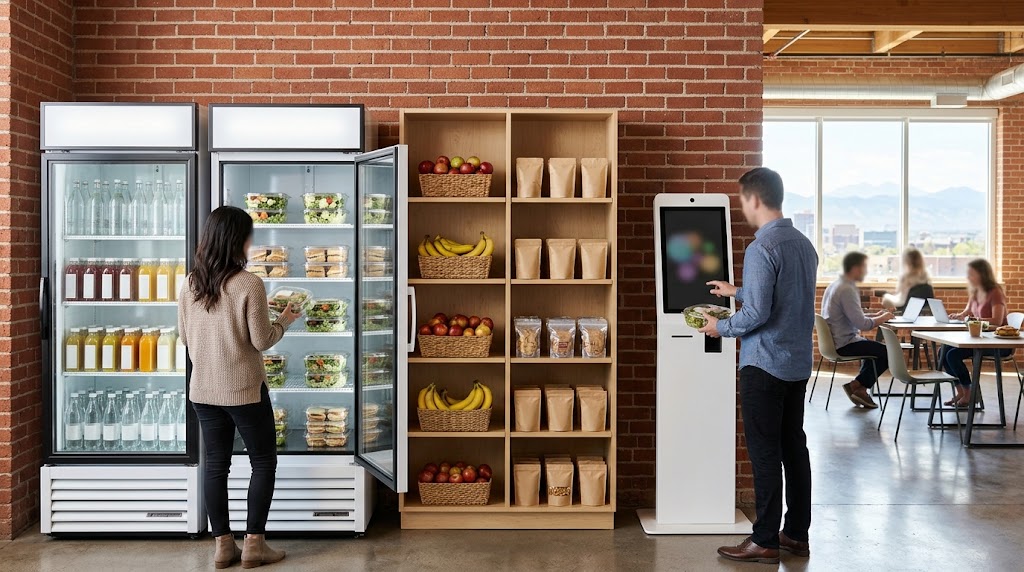
If you’re wondering whether your office qualifies for a micro market, here’s the short answer. Denver Beverage installs micro markets at no upfront cost for qualifying locations, and the quickest way to find out if yours is one of them is a short conversation with the team. There’s no published staff-size or space requirement, because each location is looked at on its own.
This article explains what the no-upfront-cost program covers, so you know what to expect before you call.
What Qualifying Locations Have in Common
Qualifying locations tend to share three things, even without a set cutoff. Here’s what each one means in practice:
- Daily on-site headcount: A micro market’s sales depend on steady daily foot traffic. A workplace where most staff are remote most of the time is unlikely to generate enough volume, while a location with a consistent on-site workforce tends to perform well. The exact threshold varies, and the Denver Beverage team looks at it as part of the conversation.
- A dedicated footprint: A micro market needs physical room for at least one cooler, shelving, and a self-checkout kiosk. A small pantry shelf won’t do, but a breakroom or lobby common area typically can.
- Fit for self-service: The format is unattended by design, so it works best where the space is accessible during normal business hours and self-checkout suits the people using it. That’s rarely a barrier in an office, but it’s what separates a micro market from a staffed café or a managed pantry.
What No Upfront Cost Means
“No upfront cost” means Denver Beverage doesn’t charge to install the micro market at a qualifying location. Its own technicians handle the installation, not subcontractors, and a service contract covers the equipment, so your office isn’t buying or maintaining it.
Denver Beverage also runs the market day to day. It stocks and restocks on a regular schedule, so your team doesn’t place orders or handle restocking. Put simply, your location gets the market, the stocking, and the service, and Denver Beverage earns a share of net sales.
How Revenue Share Works
Revenue share terms for offices are set per account. Your location earns a share of net sales, and the details are agreed when the program is set up. The Denver Beverage team is the right place to ask what the terms would look like for your office.
What to Expect From the Conversation
The qualification conversation is short and practical. The Denver Beverage team looks at who’s in your space each day and how the space is laid out, because a micro market, like any retail space, depends on people using it. If you’re not sure whether your office qualifies, asking is the fastest way to find out.
It also helps to know who you’ll be working with afterward. Micro markets are managed in the Denver and Colorado Springs metro areas, and service comes from Denver Beverage’s own team. That team has 13 service technicians, with a 24-hour service response and 7-day service coverage on the Front Range and the I-70 corridor.
And if you’d like to see what a finished installation looks like, read Denver Beverage’s hotel micro market installation case study.
What Happens Next
Installs take planning and are rarely immediate, so it helps to start the conversation early. The first step is a conversation, not a contract. And if you’re also thinking about office coffee service or snacks and pantry supply alongside a micro market, one conversation can cover all of it.
Find Out If Your Location Qualifies
You don’t need the numbers worked out before you call. Just describe your space and your team, and the Denver Beverage team can tell you whether a micro market fits. Call 303-295-3737 or request a quote, and you’ll hear back within 24 hours.
Frequently Asked Questions
What is a micro market?
A micro market is an open-shelf, self-checkout retail space installed in a workplace. Snacks, beverages, and fresh food are available any time, and people pay at a kiosk with no cashier. It works like a small convenience store inside the building.
How is a micro market different from a vending machine?
A micro market uses open shelving and coolers, so people can see and choose what they want before they check out. A vending machine dispenses one item at a time from a closed cabinet. The open format also makes room for fresh food, and Denver Beverage’s markets use GrabScanGo for self-checkout.
Does the installation really cost nothing?
For qualifying locations, yes. There’s no upfront cost to install, and a service contract covers the equipment. Revenue share terms are set per account, and the Denver Beverage team can explain the details for your office when you call.
How does the revenue share work?
Your location earns a share of net sales from the market. The terms are set per account, and the team can explain what that looks like for your office.
What staff size or space do I need to qualify?
There’s no published figure, so the team looks at each location individually. It depends on how many people are on-site daily and the space available. Call 303-295-3737 or request a quote to find out whether a market fits your office.