Most vendors will show you photos of a finished market and a list of what’s in it. What they won’t show you is who’s running it after day one, and that’s the part that actually determines whether it works.
This article covers exactly that: how Denver Beverage plans, installs, stocks, monitors, and maintains a managed micro market from the first site visit through ongoing daily operation. What does your team have to do once it’s live? Very little.
What “Fully Managed” Actually Means
A micro market that gets dropped into a breakroom and left is a fixture. A managed market is an ongoing operation with a named operator behind it, and that distinction shapes everything else in this article.
Division of responsibility
Your location provides the space and the power. Denver Beverage handles product selection, replenishment scheduling, inventory monitoring, equipment maintenance, and sales reporting. There’s no equipment purchase, no ordering obligation, and no labor cost on the host side.
The platform behind it
GrabScanGo, Denver Beverage’s micro market management system, tracks real-time sales data at the self-checkout kiosk, triggers restocking decisions, and generates the reporting Denver Beverage uses to adjust the product mix over time. It’s what separates a managed market from a self-serve fixture that someone manually checks once a week.
Space Planning and Market Design
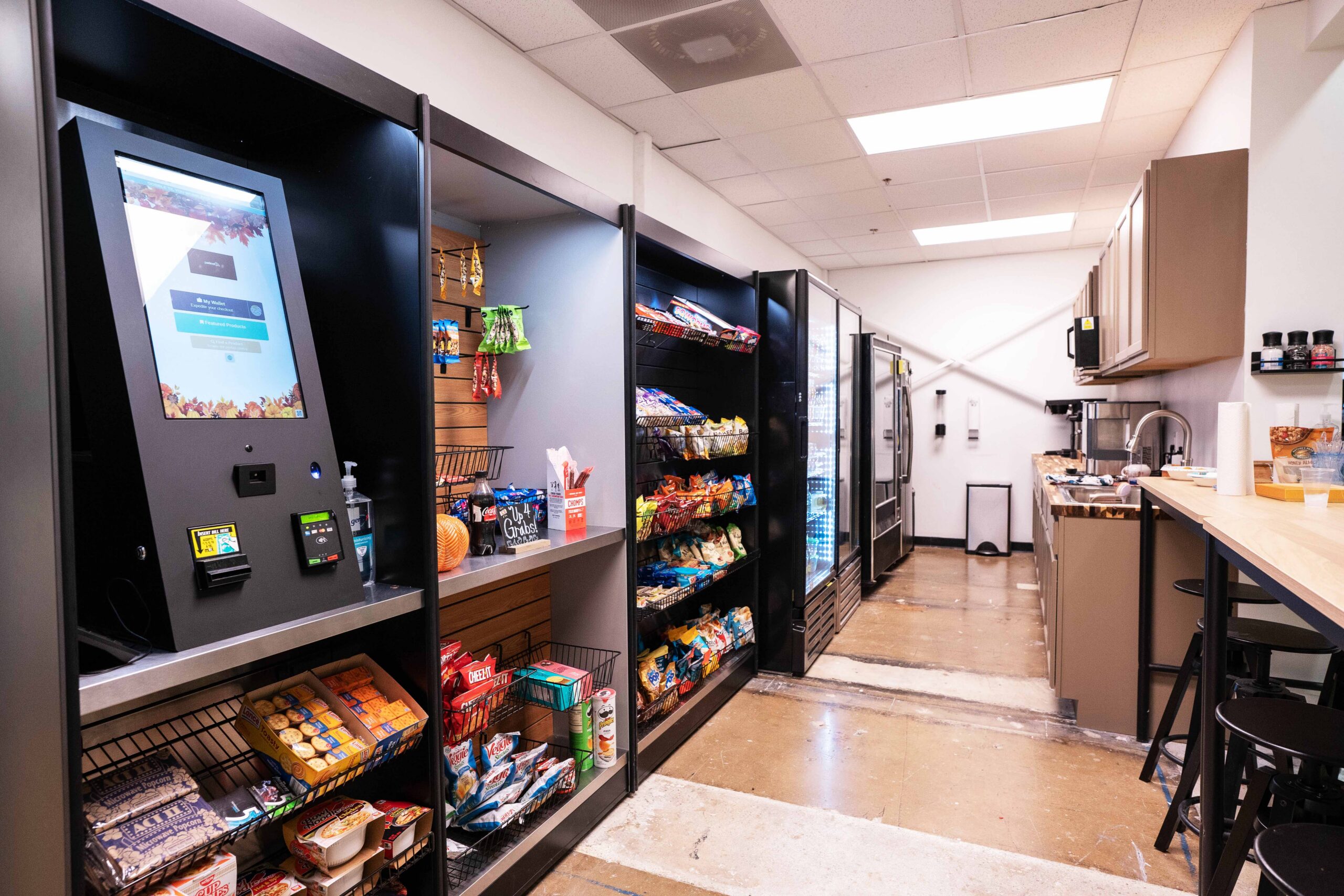
Before anything goes in, Denver Beverage assesses the footprint, traffic flow, and power availability at your location. Fixture placement is planned around the space:
- Open shelving for ambient products
- Coolers for cold beverages and fresh food
- A self-checkout kiosk positioned for easy access
Kiosk placement also follows general accessibility best practices, height, reach range, and clear floor space. The same principles ADA Standards apply to machines like ATMs, even though a specific federal standard for retail self-checkout kiosks hasn’t been finalized yet. Denver Beverage builds these considerations into the installation planning process regardless, since accessible placement is good practice for any facility open to the public, not just a box to check.
A real-world reference point: a Colorado Springs hotel replaced outdated lobby shelves with a fully operational micro market in six weeks. You can read the full details in our hotel micro market installation case study. Six weeks is a reasonable timeline to plan around for a standard installation.
Product Sourcing and Initial Range-Setting
The opening product mix isn’t generic; it’s built from the specific location, not a default catalog. Two things shape that opening range: who the location serves and what already sold well elsewhere.
How the range is set
Denver Beverage builds the initial range based on the specific location: employee headcount, shift patterns, dietary preferences, and any workplace wellness priorities your HR team flags.
Evidence from Colorado Springs
That hotel market launched with a specific product set, Gatorade fruit punch, Clif bars, Boulder Canyon kettle chips, Red Bull, RX bars, and Fairlife protein shakes. That list reflects a merchandising decision made with knowledge of the location’s guests, not a default catalog.
Where categories overlap with other programs
Product categories typically include cold beverages, fresh food, snacks, and personal essentials. The ambient section often overlaps with breakroom supplies for locations that also run a breakroom program. For office locations, micro markets typically sit alongside rather than replace an existing office coffee service, covering grab-and-go needs that the coffee program doesn’t serve.
Ongoing Restocking and Replenishment Cycles
This is where the managed-operator model actually proves itself. Two things drive it: how inventory gets tracked and how often a market gets restocked.
Inventory tracking
Inventory isn’t tracked by someone walking the floor with a clipboard. GrabScanGo monitors real-time sales data at the kiosk, so Denver Beverage knows what’s selling, what’s running low, and what needs to be pulled before it reaches its sell-by date, without anyone at your location doing a count.
Restocking frequency
Set based on location volume. The Colorado Springs hotel runs at two to three visits per week. On each visit, Denver Beverage’s team restocks product, rotates fresh items, and pulls anything approaching its sell-by date. Your team’s involvement is essentially zero.
Reporting, Analytics, and Product Mix Adjustments
Data is what keeps a market’s product mix current instead of static. Here’s how that plays out in practice.
What the data drives
GrabScanGo generates sales data by SKU, time of day, and category. Denver Beverage uses this data to make active merchandising decisions: discontinuing slow-movers, expanding high-velocity items, and rotating seasonal products in and out. The host location gets visibility into this data if they want it, useful for an HR director tracking employee satisfaction or a hotel F&B director monitoring ancillary revenue.
It’s also how the Colorado Springs hotel reaches around $3,000 in profit per month, a result of an actively managed product mix, not a static fixture running the same items it launched with.
Built-in shrink protection
Because GrabScanGo requires cashless payment at the self-checkout kiosk before products leave the market, loss from unpaid items is structurally lower than in an unattended honor-system setup. Every transaction is recorded, a meaningful difference for any location managing shrink across a busy facility.
Equipment Maintenance and Service
Equipment problems don’t become your problem. Two things back that up: who’s responsible and how fast they respond.
Who’s responsible
Cooler temperature monitoring, kiosk software updates, and payment terminal upkeep are all Denver Beverage’s responsibility. If a cooler goes down or the kiosk has a payment issue, your facilities team doesn’t own the repair. Denver Beverage’s 13 field technicians provide 7-day service coverage across the Front Range, and equipment faults are Denver Beverage’s problem to fix.
Why it matters
A facilities manager who already owns every HVAC, elevator, and plumbing fault in their building doesn’t need to add unattended retail equipment to that list. The same technician network that backs Denver Beverage’s commercial kitchen and beverage equipment repair program backs the micro market program.
If you’re weighing whether a managed micro market fits your location, talk to Denver Beverage about what the setup would look like for your specific space.
Frequently Asked Questions
How much space does a micro market need?
Most micro markets work in a dedicated breakroom corner or lobby alcove with standard electrical access. Denver Beverage assesses your footprint during the planning visit and designs the fixture layout around what’s available. The host provides the space and power; Denver Beverage handles everything else.
Does my team need to do anything to manage the market day-to-day?
No. Inventory monitoring, restocking, equipment maintenance, and product selection are all handled by Denver Beverage; your team’s only role is providing the space. That’s the explicit model at the Colorado Springs hotel: no labor, equipment purchasing, or ordering required from hotel staff.
How is a managed micro market different from vending machines?
Open shelving, coolers, and a self-checkout kiosk allow a much wider product range than standard vending machines, including fresh food, full-size cold beverages, and personal essentials. The managed-operator model also means the product mix is actively adjusted from sales data, not left static between occasional refills.
What happens if the kiosk goes down or a cooler stops working?
Denver Beverage’s field technicians cover equipment service 7 days a week across the Front Range. Equipment faults are Denver Beverage’s responsibility to resolve, not your facility’s.